
Flat-backed millipede
Polydesmus inconstans
Description
How to identify
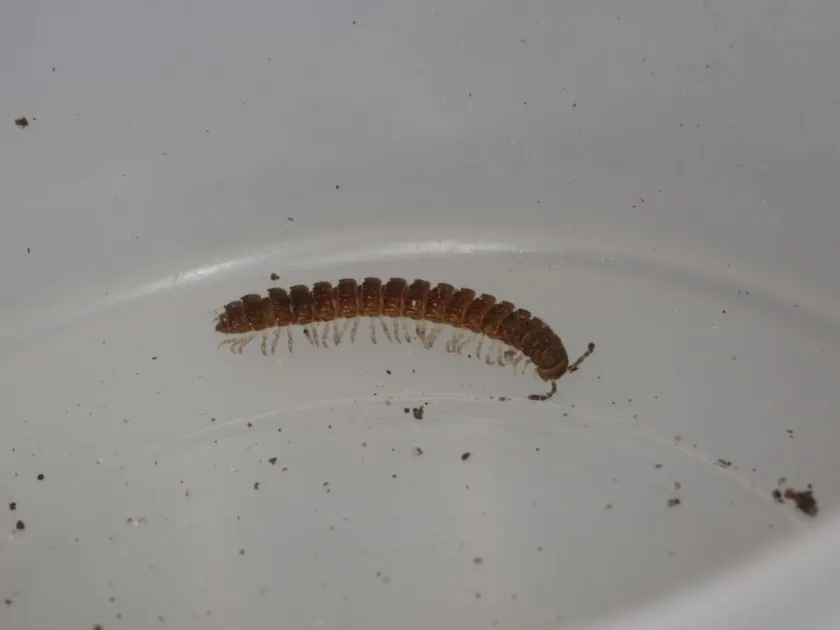
The flat-backed millipede (Polydesmus inconstans) belongs to the order Polydesmida, family Polydesmidae. It is characterized by a flattened body composed of 20 segments, typically displaying a brownish or yellowish-grey coloration.
Adult individuals usually measure between 10 and 15 mm in length. Unlike cylindrical millipedes, this species has distinct lateral projections on each body segment, giving it a unique, flattened appearance that is highly characteristic of the family.
These pests are nocturnal and thrive in moist, shaded environments. They are extremely sensitive to desiccation and spend their daylight hours burrowing deep into the soil or hiding under decaying organic matter.
Reproduction occurs within the soil, where females deposit eggs in small clusters. The larvae undergo several molting stages, gradually increasing their number of body segments as they develop into mature adults.
Identification is aided by their inability to roll into a tight coil when threatened; instead, they usually curve their bodies slightly or attempt to squeeze into nearby crevices to escape predation or disturbance.
What it damages
The species primarily targets underground plant structures, including roots, tubers, and germinating seeds. Vegetable crops grown in greenhouses and nurseries are particularly susceptible due to the consistently high humidity levels.
Crops such as carrots, beets, potatoes, cucumbers, and young seedlings are frequently attacked. The millipedes create irregular shallow pits and galleries in the roots, which often serve as entry points for bacterial and fungal pathogens.
Substantial economic losses occur during early spring, when delicate sprouts and root systems are most vulnerable. Severe infestations can result in total stand failure, forcing growers to reseed or replant entire sections.
Beyond mechanical damage, the feeding activity promotes secondary infections. The damaged tissues are quickly colonized by soil-borne pathogens, leading to rotting and death of the plant parts, which further exacerbates the damage.
Higher pest densities are commonly associated with areas of high soil moisture. In such environments, the feeding pressure can be so intense that the entire root system of a seedling may be consumed within a few days.
When it appears
The activity of Polydesmus inconstans is strictly dependent on soil moisture and ambient temperature. In controlled environments like greenhouses, they can remain active year-round if the soil remains damp.
In open fields, the highest level of damage is typically observed during the spring months. Warm temperatures combined with the high moisture levels found in the soil after winter create optimal conditions for their activity.
During the peak of summer, if the soil surface becomes dry, the millipedes migrate to deeper soil layers to avoid desiccation. This shift reduces the visible evidence of their activity on the surface but does not eliminate the population.
Overwintering occurs in the form of both adults and late-stage larvae. They seek refuge in deeper, more stable soil horizons or under protective organic debris where they are insulated from freezing temperatures.
Autumn brings a resurgence in surface activity as soil moisture levels rise again. This period is crucial for their survival, as they feed on remaining root tissues and organic debris to build reserves for the winter months.
Signs of infestation
The most reliable sign of a flat-backed millipede infestation is the presence of small, irregular holes or shallow ulcers on the surface of root crops. Live individuals are often found inside these feeding pits.
Wilting seedlings with no visible root system are a strong indicator of underground damage. When such plants are pulled from the soil, the roots often appear stunted, chewed, or completely severed.
Detection can be confirmed using simple bait traps. By placing pieces of raw potato or carrot on the soil surface and covering them with a board or moist fabric, you can attract the millipedes for inspection after 24 hours.
In indoor growing areas, look for tiny, dark granular excrement scattered on the soil surface. This is a sign of high population density that necessitates immediate intervention and improved moisture management.
Distinguishing their damage from other pests is key: unlike wireworms, which bore deep, clean-cut tunnels, the damage caused by flat-backed millipedes is generally more superficial and patchier in appearance.
Control measures
Integrated pest management starts with cultural practices. Improving soil drainage is the single most effective way to make your growing area less attractive to these moisture-loving invertebrates.
Regular cultivation and hoeing of the soil surface disrupt the micro-habitats favored by the millipedes and help the top layer of soil dry out faster, which is lethal to younger stages of the pest.
Sanitation is vital; remove all unnecessary organic debris, as these act as both food sources and daytime shelters. Deep autumn plowing can effectively expose overwintering stages to predators and freezing temperatures.
On small scales, physical trapping and manual removal can keep the population below the economic damage threshold. Always dispose of collected millipedes far away from agricultural plots.
- Practice crop rotation.
- Apply lime to acidic soils.
- Ensure proper greenhouse ventilation.
- Use high-quality, pest-free transplants.
Taxonomy
- Latin name
- Polydesmus inconstans
- Family
- Polydesmidae
- EPPO code
- POLDIN
Discussion
No discussions yet — be the first.