
Flat millipede
Polydesmus collaris
Description
How to identify
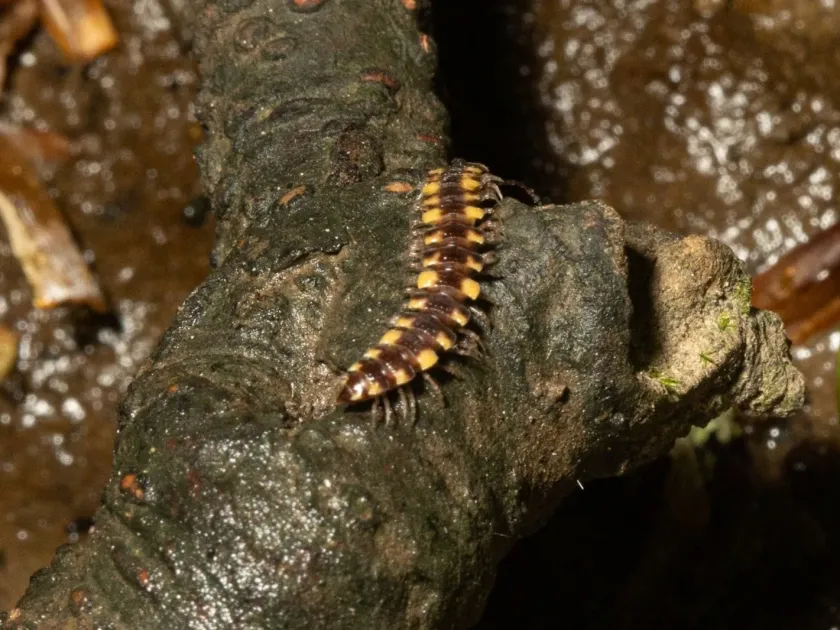
The flat millipede, scientifically known as Polydesmus collaris, belongs to the order Polydesmida and the family Polydesmidae. It is characterized by a flattened, segmented body consisting of 20 segments, typically reaching 10 to 20 mm in length.
Their coloration ranges from light brown to yellowish-tan. A key identifying feature is the presence of lateral extensions on each body segment, which give the organism a serrated, gear-like appearance when viewed from above.
These pests are nocturnal and exhibit strong negative phototaxis, meaning they avoid light at all costs. During the day, they reside in moist soil, under leaf litter, or in crevices to prevent desiccation.
The biology of Polydesmus collaris is highly dependent on ambient humidity. They require damp environments to breathe and remain active, which is why they are often found in irrigation zones or poorly drained fields.
Reproduction involves the deposition of eggs in soil chambers. The larvae develop through several stages, gradually increasing their segment count and size until they reach reproductive maturity in the following season.
What it damages
As a generalist herbivore, the flat millipede feeds on a wide range of plants. They are particularly destructive to vegetable crops, including tomatoes, cucumbers, carrots, and various root vegetables.
They primarily damage the underground parts of plants, such as roots, tubers, and hypocotyls. Young seedlings are at the highest risk, as millipedes can devour the entire root system, leading to rapid plant death.
In mature root vegetables, they create deep, irregular cavities that not only ruin the product's appearance but also lower its market value significantly. These feeding wounds are prone to infection by soil-borne pathogens.
During germination, they can eat the embryo of the seed, causing major crop losses. If the population density is high, the damage can spread across an entire field within a very short period.
Aside from cultivated plants, they feed on decaying organic matter. However, when preferred food sources are scarce, they aggressively switch to healthy, succulent plant tissue to fulfill their moisture and nutrient needs.
Signs of infestation
The first sign of an infestation is the sudden wilting of plants, which occurs despite adequate soil moisture. Inspection of the root zone will typically reveal damaged tissue or small, open lesions.
To verify the presence of the pest, one can use bait traps such as sliced potatoes or carrots placed just beneath the soil surface. After 24 hours, the presence of millipedes around the bait confirms an infestation.
The presence of fine, dark granular feces in the soil near the plant base is another indicator. If you observe gaps in the plant stand immediately after emergence, check the root systems for physical feeding damage.
In greenhouses or high-humidity field areas, you may see the millipedes moving on the soil surface at night or during overcast, rainy weather. Their rapid escape toward moisture is a behavioral clue.
Persistent soil dampness combined with an accumulation of crop debris provides an ideal habitat. Observing these conditions indicates a high likelihood of Polydesmus collaris activity in the area.
Control measures
Effective management begins with cultural practices. Removing crop residues and weeds after harvest reduces the available shelter and food sources for the millipedes during the off-season.
Improving soil drainage is essential. By preventing waterlogged conditions and ensuring good soil aeration, the environment becomes less hospitable for these moisture-dependent pests.
Avoid applying raw, uncomposted manure to the soil. Mature, well-composted organic matter is less attractive to these millipedes and prevents population explosions in the seedbed.
Chemical control is reserved for high-infestation scenarios. Soil-applied insecticides or granular formulations designed for soil pests can be used, provided they are authorized for the specific crop.
- Regular cultivation to disturb their subterranean habitats.
- Crop rotation to break the pest's lifecycle.
- Use of certified insecticides if damage exceeds economic thresholds.
Taxonomy
- Latin name
- Polydesmus collaris
- Family
- Polydesmidae
- EPPO code
- POLDCL
Discussion
No discussions yet — be the first.