
Saithe
Pollachius virens
Description
How to identify
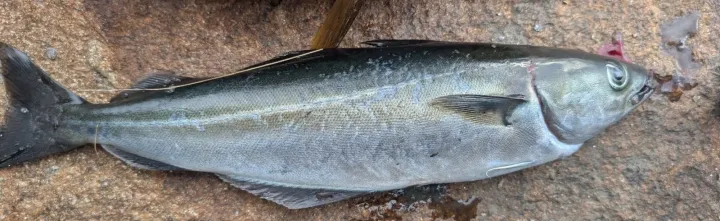
Saithe (scientific name Pollachius virens) is a large marine fish belonging to the Gadidae family. It is easily identified by its streamlined body shape, three dorsal fins, and two anal fins, which are diagnostic traits for this group.
The coloration of the saithe typically involves a dark, greenish-black back that fades into a silvery-grey on the sides. The most prominent feature for identification is the bright lateral line that runs along the length of its body.
Reaching lengths of up to 120–130 cm and significant weights, the saithe is a powerful predatory fish found in the northern parts of the Atlantic Ocean.
As a schooling species, it thrives in deep-water environments, performing extensive migrations to locate prey such as herring, sand eels, and other small fish.
It is crucial to clarify that the saithe is strictly an aquatic species and does not belong to the category of agricultural or horticultural pests.
What it damages
The saithe causes zero damage to agricultural crops, ornamental plants, or forestry. Being a marine organism, it lacks the biological equipment to survive or feed on terrestrial plants.
It is not a phytophagous species; its diet consists exclusively of marine organisms found in the water column. There is no intersection between its feeding habits and crop production.
In agronomy, the saithe is not recognized as a pest because its natural habitat is fully isolated from farming environments and agricultural fields.
Any claim regarding the saithe as a plant pest is biologically inaccurate and lacks scientific foundation.
Farmers do not encounter this fish in their fields, as it cannot exist in soil, greenhouse, or field environments.
When it appears
The life cycle and seasonal activities of the saithe are determined by oceanic conditions, water temperature, and migration patterns between spawning and feeding grounds.
Spawning typically occurs during the winter and early spring months in specific deep-water marine areas, far removed from any agricultural landscape.
These biological cycles do not coincide with crop sowing, planting, or harvesting schedules, as the fish remains in the oceanic environment throughout the year.
There is no seasonal pressure from this species on the agriculture sector, and its ecological presence is restricted to marine ecosystems.
Agronomists do not need to monitor for this species, as its population dynamics have no relation to agricultural performance or crop health.
Signs of infestation
Since the saithe is not an agricultural pest, there are no symptoms of damage, such as leaf chewing, root boring, or stem wilting, associated with this fish.
Any signs of crop deterioration should be attributed to local insect pests, pathogens, or environmental factors rather than marine life.
Confusing a fish species with a plant pest is an error in observation and does not reflect any real threat to crops or plant production systems.
Proper plant diagnostic protocols should focus on known entomological threats or fungal, bacterial, and viral pathogens relevant to the specific crop.
Monitoring efforts for pest control should be directed at terrestrial organisms and those capable of damaging the specific flora in question.
Control measures
There are no control measures for the saithe in an agricultural context, as it does not constitute a threat to crops or plant health.
Attempting to implement pest control strategies against this marine fish is entirely illogical and unnecessary for any agricultural operation.
Saithe is a vital commodity in global fisheries, and its management is entirely within the realm of marine biology and environmental conservation.
For the protection of fields and greenhouses, resources should be allocated to managing genuine threats like insects, weeds, and common plant diseases.
No agronomic guidance for saithe management is required, as the species is irrelevant to plant production practices.
Taxonomy
- Latin name
- Pollachius virens
- Family
- Gadidae
- EPPO code
- PLLCVI
Discussion
No discussions yet — be the first.