
Polistes metricus
Polistes metricus
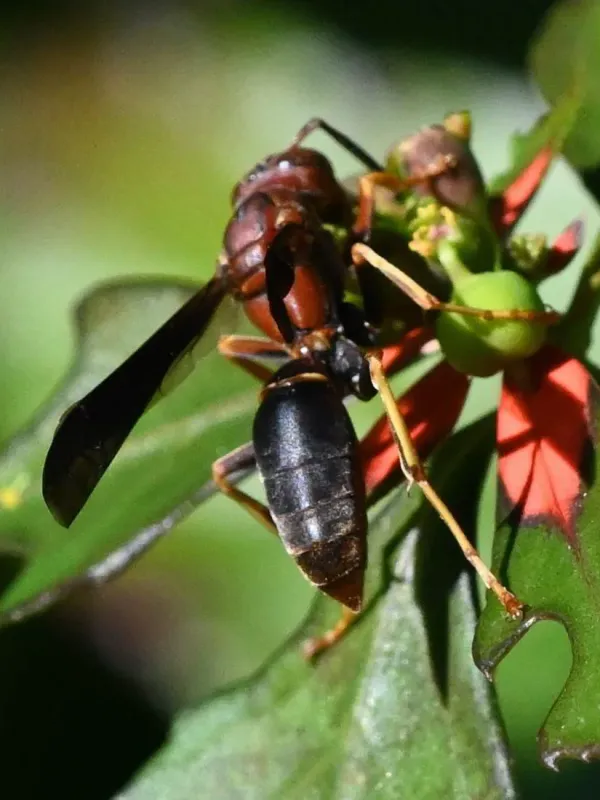
Description
How to identify
Polistes metricus, commonly known as a type of paper wasp, belongs to the family Vespidae. They are eusocial insects recognized for their umbrella-shaped paper nests typically found in sheltered areas.
The adults are reddish-brown in color, often featuring darker markings on their abdomen. They are known for their slender bodies and long legs which hang down while they are in flight.
The colony cycle is initiated by an overwintered queen in early spring. As the season progresses, worker wasps take over the duties of nest maintenance, foraging, and larval care, leading to a larger colony by summer.
While they are generally less aggressive than yellowjackets, they will defend their nests vigorously if disturbed. Their nests are often built on building eaves, under patio covers, or in dense vegetation.
Identifying the species involves checking for the characteristic open-celled nest structure, which distinguishes them from other social wasps that build enclosed, papery envelopes.
What it damages
Paper wasps cause significant economic damage in orchards and vineyards by feeding on ripe fruit. They use their strong mandibles to cut through the skin of berries and stone fruits to reach the sugary juices.
Key crops at risk include grapes, peaches, apples, and various berries like raspberries or blackberries. Once the skin is broken, the fruit is quickly rendered unsellable and suffers from quality loss.
Beyond direct feeding damage, the openings made by wasps serve as entry points for pathogens, including various fungal rots and bacteria, which can cause the entire fruit to spoil rapidly.
Their presence significantly complicates the harvesting process, as workers are at constant risk of being stung, leading to decreased efficiency and potential safety hazards during harvest operations.
In high-density agricultural areas, their population can explode during mid-to-late summer, coinciding with the maturation period of many high-value fruit varieties, thus necessitating intervention.
Control measures
Effective management begins with early detection. Removing queen nests in the spring before workers are produced is the most successful strategy to prevent colony establishment near crops.
Insecticidal sprays are highly effective when applied directly to the nest. It is crucial to perform these applications at night or early in the morning when the wasps are less active and the entire colony is inside.
Wasp traps baited with sugar water, fermented fruit, or specialized attractants are excellent for reducing the number of foraging adults around orchards without relying on broad-spectrum pesticides.
Good orchard hygiene, such as the rapid removal of fallen and overripe fruit, is essential to starve the colony of readily available food sources, forcing them to forage elsewhere.
- Conduct systematic inspections of structures in early spring.
- Use fine-mesh netting to protect grape bunches from wasp access.
- Keep the orchard floor clear of rotten debris.
- Use protective clothing when working near high-activity zones.
Taxonomy
- Latin name
- Polistes metricus
- Order
- Hymenoptera
- Family
- Vespidae
- EPPO code
- POLEME
Discussion
No discussions yet — be the first.