
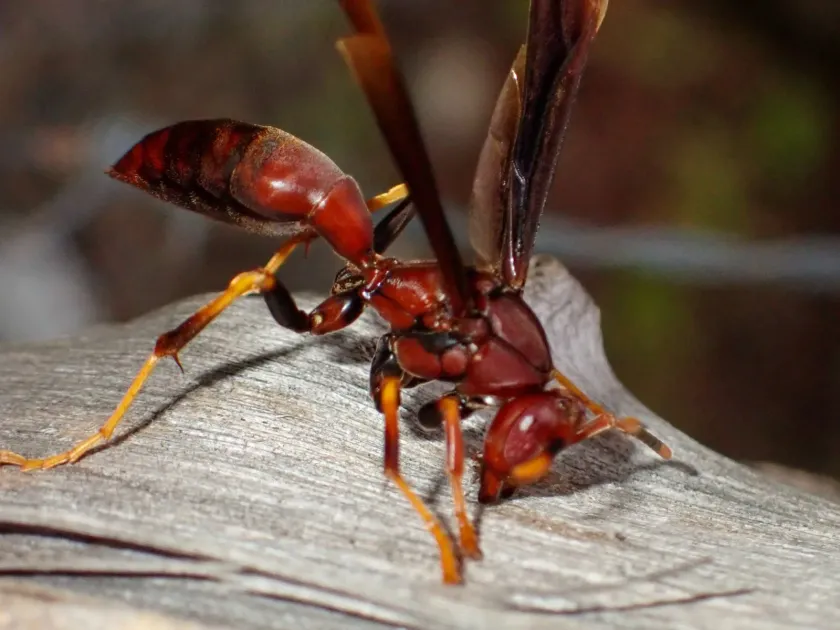
Paper wasp Polistes lanio
Polistes lanio
Description
How to identify
The paper wasp Polistes lanio is a species of social wasp within the Vespidae family, order Hymenoptera. It is recognized by its slender body, distinctive yellow-brown color, and social nesting habits.
They construct open, umbrella-shaped nests made of chewed plant fibers mixed with saliva, which creates a paper-like material, hence their common name.
The colony structure is highly organized, centered around a queen that founds the nest and workers that handle foraging, brood care, and nest defense.
These wasps are known for their warm-climate adaptation and are frequently observed in agricultural areas and gardens where resources are abundant.
Their morphological structure includes powerful mandibles, which they use both for building their nests and for processing food sources, including fruit pulp.
What it damages
While Polistes lanio serves as a biological controller of certain garden pests, they turn into significant crop pests when fruit crops begin to ripen.
They feed on sugar-rich fruits like grapes, figs, peaches, and berries, using their mandibles to penetrate the skin and consume the soft inner tissue.
This feeding behavior causes significant cosmetic damage and creates entry points for secondary pathogens like fungi and bacteria, leading to rot and complete fruit loss.
High populations of this wasp species in vineyards or orchards can result in substantial yield losses, especially in late-season harvests when fruit sugar levels are highest.
The presence of wasps also interferes with harvesting operations, as workers and pickers are at risk of stings when handling damaged fruit clusters.
When it appears
The colony's lifecycle typically begins in the spring, when the queen emerges from diapause to establish a nest and produce the first generation of workers.
The pest pressure from this species is most severe during the late summer and early autumn, coinciding with the peak ripening time of many major fruit varieties.
Colony activity naturally wanes as temperatures drop towards late autumn, though foraging may continue until the first hard frosts, if food remains available.
The seasonal intensity is strongly influenced by local environmental conditions and the availability of both prey insects and carbohydrate sources in the surroundings.
After the cycle finishes, the remaining workers die off, while new, mated queens hibernate in sheltered locations to start the next year's cycle.
Signs of infestation
The most reliable sign of their presence is the visual discovery of their papery, exposed nests, often located under roof eaves, tree branches, or shaded areas of structures.
Observing groups of wasps actively foraging or feeding on fruit surfaces is a definitive indicator of an established colony in the vicinity.
Fruit damage manifests as irregular holes or excavated cavities on the skin, often accompanied by fluid leakage and signs of fermentation near the site.
The characteristic buzzing sound around fruit trees during sunny afternoon hours suggests high activity levels, especially in late summer months.
Secondary signs include the attraction of other insects, such as fruit flies and ants, to the holes previously opened by the wasps in the ripe fruit.
Control measures
Management involves using bait traps filled with sugary solutions, often supplemented with a small amount of vinegar, which helps reduce the wasp population.
For high-value crops like table grapes, physical barriers such as fine-mesh fruit bags or covers are the most effective way to prevent direct access to the berries.
If nest removal is required, it is best performed at night when the wasps are least active and the entire colony is present inside the nest structure.
- Promptly harvesting fruits as soon as they reach maturity.
- Removing fallen, fermenting fruit from the orchard floor.
- Physical destruction of abandoned nests during the winter.
It is crucial to avoid broad-spectrum insecticide usage, as these chemicals can harm beneficial pollinators and disrupt the ecological balance of the garden.
Taxonomy
- Latin name
- Polistes lanio
- Order
- Hymenoptera
- Family
- Vespidae
- EPPO code
- POLELL
Discussion
No discussions yet — be the first.