
Paper wasp
Polistes exclamans
Description
How to identify
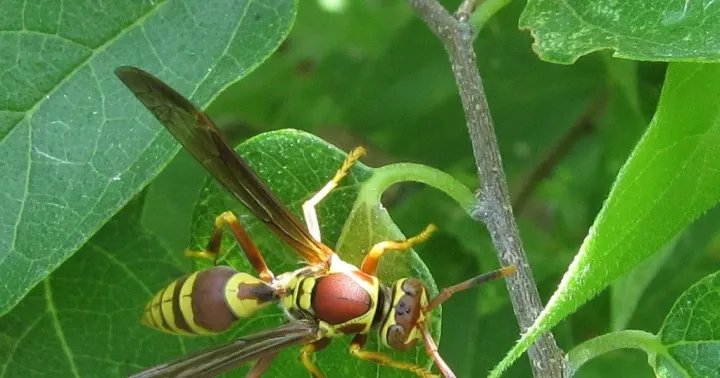
The paper wasp (Polistes exclamans) is a social insect belonging to the family Vespidae. They are easily identified by their slender, elongated abdomens and distinctive yellow-brown bands on their thorax and abdomen.
They build nests out of processed wood fibers, which result in a paper-like material. These nests have an open, umbrella-like structure and are typically attached to plant stems, eaves, or sheltered areas near agricultural sites.
Adults typically measure between 15 and 20 mm in length. The colony is founded by a queen in the spring and undergoes a seasonal growth cycle, reaching maximum population density by mid-to-late summer.
Polistes exclamans is generally considered less aggressive than other wasp species unless their nest is disturbed. However, they are highly territorial, and large colonies can become a nuisance during agricultural activities.
Understanding their lifecycle is crucial for integrated pest management. Since they rely on wood fibers for construction and water sources for cooling, their presence is often localized near garden infrastructure and irrigation systems.
What it damages
The economic damage caused by Polistes exclamans primarily involves the destruction of ripening fruits and berries. Their sharp mandibles allow them to pierce the skin of healthy fruits, feeding on the sweet juices inside.
Once a fruit is compromised, it becomes susceptible to secondary infections, including fungal rots and various molds. This leads to rapid post-harvest spoilage and significant yield losses in commercial orchards.
Grapes, berries, and stone fruits are particularly vulnerable to their feeding habits. Because they can feed on multiple fruits in a short time, the visual and physical damage often results in downgraded produce quality.
Besides direct crop loss, their presence poses a health risk to farm workers during the harvest season. The constant threat of stings can slow down manual labor and increase the cost of harvesting operations.
While paper wasps do consume some insect larvae, the damage they cause to high-value fruit crops significantly outweighs any potential benefits of them acting as natural predators in an agricultural setting.
Control measures
Mechanical control, specifically the removal of nests during the early spring season, is the most effective way to manage populations. Eliminating the queen before the colony grows prevents future infestations.
Installing bait traps filled with fermented juices or sugar-based attractants can divert wasps away from the main harvest areas. These should be strategically placed along the perimeter of the crop rows.
Maintaining orchard sanitation is a vital preventative measure. Promptly collecting fallen and damaged fruits removes the food source that attracts wasps to the area, limiting the colony's growth potential.
Chemical treatments using fast-acting contact insecticides are a last resort for large, inaccessible nests. Such applications must be carried out in the evening to ensure the majority of the colony is present within the nest.
Protective netting for individual fruit clusters is highly recommended in organic production systems. This physical barrier prevents wasps from accessing the fruit, effectively protecting the harvest without chemical exposure.
Taxonomy
- Latin name
- Polistes exclamans
- Order
- Hymenoptera
- Family
- Vespidae
- EPPO code
- POLEEX
Discussion
No discussions yet — be the first.