
Paper wasp
Polistes dominulus
Description
How to identify
The paper wasp belongs to the order Hymenoptera, family Vespidae. These social insects are known for building open, umbrella-shaped nests made of paper-like material, which they create by chewing wood fibers mixed with saliva.
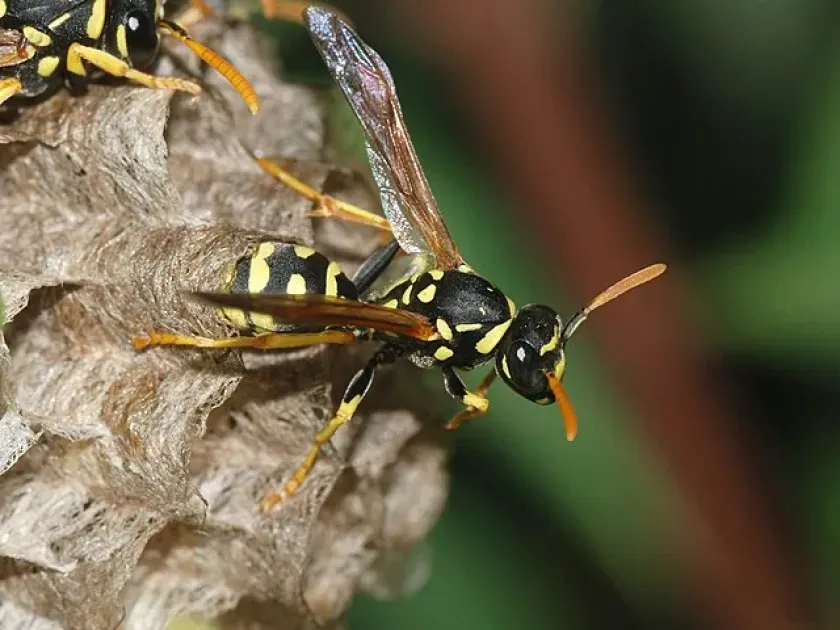
Adult wasps typically measure between 12 and 18 mm in length, featuring a slender body with long legs and a narrow waist. Their coloration ranges from yellow to black with distinct striped patterns on the abdomen.
A key identifying feature of this species is the yellow spot on the clypeus and the orange antennae of the females. Unlike hornets, they are generally less aggressive unless their nest is directly threatened.
The life cycle begins in spring when a queen that has overwintered starts a new colony. The colony grows throughout the summer, reaching peak worker population in late summer.
Nests are commonly found in protected areas such as under building eaves, inside dense shrubs, or attached to high plant stems, often in close proximity to food sources.
What it damages
Paper wasps are considered pests of fruit and berry crops. While they are beneficial predators of caterpillars earlier in the season, their dietary needs shift to sugar sources as fruit matures.
They frequently attack grapes, peaches, pears, and apples. The wasps use their strong mandibles to pierce the skin of the fruit, feeding on the juice and pulp inside.
This feeding activity ruins the commercial value of the fruit and causes cosmetic damage that makes produce unsellable. The holes left by wasps also create entry points for secondary pathogens.
Decay-causing fungi and yeasts easily enter the damaged tissue, leading to widespread rotting of bunches or batches of fruit within a short time frame.
Additionally, their presence creates a hazardous environment for manual labor, as workers may be stung while harvesting fruit from infested bushes or trees.
Signs of infestation
The most obvious sign of an infestation is the discovery of their characteristic open paper nests on structures, fences, or garden plants.
Damage signs on fruits include deep, irregular cavities or holes, often with dried edges if the injury is several days old, resulting from the wasps feeding on the pulp.
High activity of flying insects around ripening fruit, especially during warm and sunny days, is a clear indicator that the crop is currently under attack.
Finding remains of partially eaten, hollowed-out fruit on the ground under trees or vines confirms the activity of these wasps in the immediate area.
Observing a steady stream of wasps flying back and forth between a specific nesting site and the fruit orchard is a strong indicator of an established colony.
Control measures
Early season nest removal is the most effective management strategy. Nests should be destroyed in the evening when the wasps are less active and the entire colony is present.
For high-value crops like table grapes, wrapping individual bunches in protective mesh bags or fine netting provides a physical barrier that prevents wasp access.
Wasp traps baited with fermented juice, sugar syrup, or beer can help reduce the population of foraging workers, although they should be placed away from the crops themselves.
Sanitary practices are crucial; prompt removal of fallen or overripe fruit from the orchard floor minimizes the attractants for foraging wasps.
Insecticide use should be reserved as a last resort and must be managed carefully, respecting pre-harvest intervals to ensure no harmful residues remain on the fruit.
Taxonomy
- Latin name
- Polistes dominulus
- Order
- Hymenoptera
- Family
- Vespidae
- EPPO code
- POLEDO
Discussion
No discussions yet — be the first.