
Pogonocherus penicillatus
Pogonocherus penicillatus
Description
How to identify
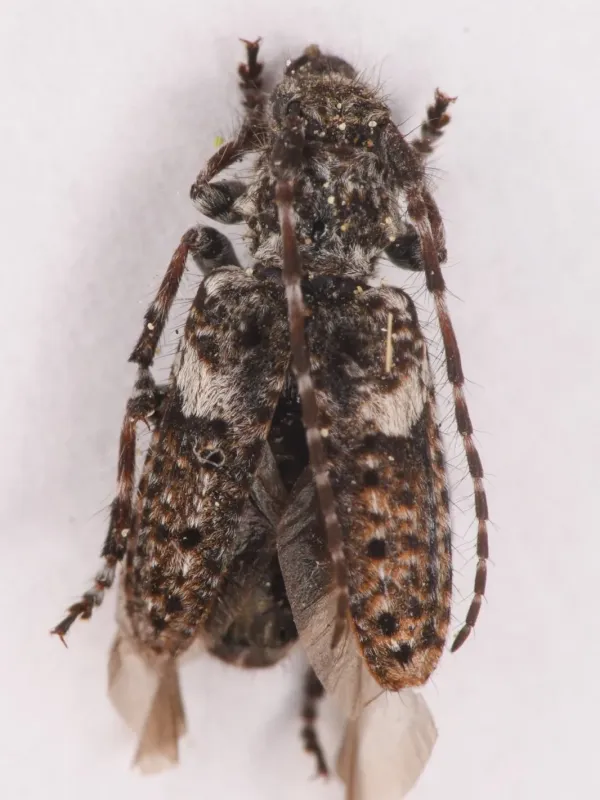
Pogonocherus penicillatus is a small longhorn beetle belonging to the family Cerambycidae, subfamily Lamiinae. Adult beetles range from 5 to 9 mm in length.
The beetle is characterized by distinct tufts of dark hair on its elytra, which provides excellent camouflage against tree bark. Its color ranges from brownish-grey to dark brown.
Larvae are white, legless, and possess strong mandibles, allowing them to bore efficiently into the cambium layer and bark of their host trees.
These beetles are primarily nocturnal, making them elusive and difficult to spot during daylight hours, which often leads to late detection of an infestation.
The species is a known xylophage, contributing to the decomposition of dead wood but potentially impacting the health of weakened living trees.
What it damages
The primary hosts for Pogonocherus penicillatus are conifers such as spruce, pine, and fir, specifically targeting weakened or dying trees.
Larvae feed on the inner bark and phloem, creating galleries that disrupt the flow of nutrients and water within the tree's vascular system.
While often considered secondary pests, their activity on young trees or thin branches can lead to the death of specific branches or even entire saplings.
In forestry, these beetles degrade the commercial quality of logs, causing significant losses if harvested wood is not processed or treated promptly.
In ornamental urban settings, infestation can cause unsightly crown thinning and branches dieback, affecting the aesthetic value of the landscape.
When it appears
The adult flight period typically occurs from late spring through mid-summer, depending on regional climatic conditions and temperature.
Mating occurs soon after emergence, and females deposit eggs into crevices of the bark on suitable host trees or recently fallen logs.
The life cycle is generally completed in one year, although larvae can overwinter under the bark before completing their transformation into pupae.
Pupation takes place within the feeding tunnels, protected by the bark, after the larvae have prepared a special chamber.
Environmental conditions such as drought stress or forest fires can synchronize the emergence of the beetles, leading to localized population outbreaks.
Signs of infestation
One of the most common signs of infestation is the presence of fine wood dust (frass) visible in bark fissures or at the base of the tree trunk.
Small, circular exit holes indicate that the beetles have successfully completed their life cycle and emerged from the wood.
The yellowing and gradual drying of needles on specific branches often indicate that larval feeding has effectively ring-barked that section of the tree.
Peeling back the outer layer of the bark reveals complex, winding galleries and tunneling patterns that are distinctive of this longhorn species.
Increased woodpecker activity on coniferous trees can also be an indirect sign, as birds hunt for the larvae hidden beneath the bark.
Control measures
Sanitation is the most effective management tool; this involves removing and destroying infested, dead, or dying trees to reduce the population.
Avoid leaving fresh coniferous logs in the forest during the peak flight season to prevent beetles from colonizing the timber.
Promoting forest health through silvicultural practices ensures trees remain vigorous and less susceptible to secondary pest attacks.
If necessary, systemic insecticides or bark treatments can be applied to high-value ornamental trees during the adult activity period.
- Regular forest inspections.
- Timely removal of storm-damaged trees.
- Enhancing tree resistance through proper watering.
Taxonomy
- Latin name
- Pogonocherus penicillatus
- Order
- Coleoptera (beetles)
- Family
- Cerambycidae
- EPPO code
- POGNPE
Discussion
No discussions yet — be the first.