
Painted grasshopper
Poekilocerus pictus
Description
How to identify
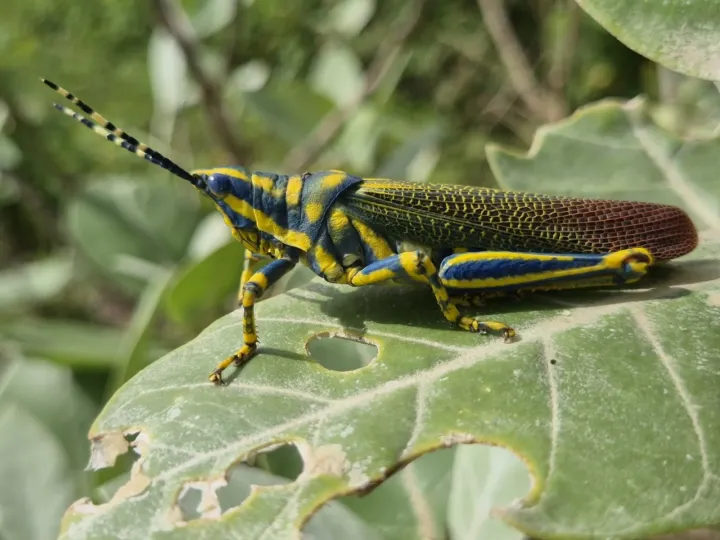
The painted grasshopper (Poekilocerus pictus) belongs to the order Orthoptera, family Pyrgomorphidae. It is a striking insect known for its vibrant yellow, green, and black warning coloration, which indicates its toxicity to potential predators.
Adult insects have a robust body structure with shorter wings. They are not high-flying insects but are highly mobile across short distances, making them persistent pests in agricultural fields once they have established a population.
The life cycle encompasses the egg stage, five nymphal instars, and the adult stage. The species is well-adapted to hot and arid climates, allowing it to thrive in regions where many other grasshoppers might struggle.
A unique biological feature is its defensive mechanism: when threatened, the grasshopper can exude a foul-smelling, toxic fluid from its thoracic glands, which deters most predators and makes physical handling unpleasant.
Females lay their eggs in the soil, protecting them with a specialized frothy mass. This ensures the eggs remain viable throughout the dry or cool seasons, waiting for the optimal environmental conditions to hatch.
What it damages
While the painted grasshopper is a polyphagous insect, it is notorious for causing severe damage to cotton crops. It also feeds on various vegetable crops and other technical plants by consuming leaves and tender stems.
The insect possesses powerful mandibles designed for cutting plant tissues. As they feed, they leave behind characteristic ragged edges on the leaves, which significantly reduces the photosynthetic capacity of the plant.
Heavy infestations lead to complete defoliation, particularly in younger plants. This setback prevents the plant from maturing correctly and can drastically lower the final yield of the affected crop.
Beyond direct feeding, the physical damage created by these insects provides an entry point for various plant pathogens. Fungal and bacterial infections often follow in the wake of an outbreak, complicating crop health management.
The economic impact of this pest is considerable due to its voracious appetite and the speed at which a colony can strip a section of a field. Early intervention is therefore essential for sustainable crop protection.
When it appears
The activity of the painted grasshopper peaks during the warmer months of the year. High temperatures accelerate the development of nymphs and increase the frequency of their feeding bouts, leading to rapid population growth.
Nymphs typically begin to emerge from the soil in early summer, depending on regional soil moisture and temperature patterns. This is the period when agricultural monitors should be on the highest alert.
By mid-summer, adults are present in large numbers, often coinciding with the most critical growth stages of crops, such as flowering and fruit set. This is when the potential for yield loss is at its absolute maximum.
The grasshoppers remain active until the cooler autumn weather arrives. Once temperatures drop, their metabolic activity slows down, and they prepare for the winter period as eggs buried beneath the soil surface.
Continuous monitoring throughout the summer season is necessary to track the progression of the population and to apply controls before the insects reach their most destructive, later nymphal stages.
Signs of infestation
The most immediate sign of an infestation is the presence of large, irregular holes in the leaves. Unlike subtle sap-sucking pests, grasshoppers leave visible, major damage that is difficult to ignore.
The insects themselves are highly visible due to their bright coloration. They can often be seen sitting on the leaves or the central stems of the plants during the daytime, making manual inspection a very effective identification method.
Accumulated frass (feces) found on the foliage or on the ground below the infested plant is a clear indication of a high concentration of feeding insects in that immediate area.
Stunted growth or wilting in specific patches of the field can indicate localized outbreaks. Because these insects often move in small groups, observing patches of damage is common during the early stages of an infestation.
In cases of severe outbreaks, a distinct chemical odor associated with their defensive secretions may be perceptible in the air, serving as a warning sign of a high population density.
Control measures
The primary control strategy involves the targeted application of insecticides. It is most effective to treat the nymphs during their earlier instars before they become highly mobile and widespread throughout the field.
Cultural practices, such as deep plowing after harvest, are highly recommended. This process disturbs the soil, exposing the egg pods to desiccation, frost, or predation, effectively reducing the next generation's population.
Maintaining clean field borders by eliminating weeds and host vegetation is a critical preventative measure. This removes the "bridge" that allows the grasshoppers to migrate from wild areas onto valuable crops.
Barrier treatments, applying pesticides along the edges of the fields, can be highly effective in blocking incoming pests from surrounding landscapes, saving the interior of the crop from broad-spectrum application.
Integrated pest management (IPM) techniques, including monitoring and biological control where applicable, should be prioritized to minimize chemical usage while maintaining effective control over this persistent pest.
Taxonomy
- Latin name
- Poekilocerus pictus
- Order
- Orthoptera (locusts)
- Family
- Pyrgomorphidae
- EPPO code
- POEIPI
Discussion
No discussions yet — be the first.