
Long-legged fly
Poecilobothrus
Description
How to identify
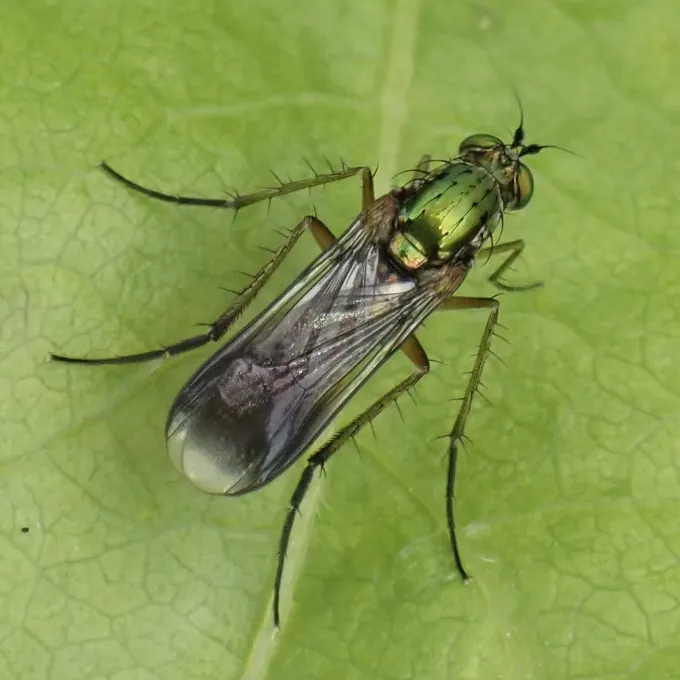
The long-legged fly (genus Poecilobothrus) belongs to the Dolichopodidae family of the order Diptera. These insects are easily recognized by their brilliant metallic, emerald-green, or golden coloration, which reflects sunlight intensely.
Adult flies are slender, typically measuring between 3 to 7 mm in length, characterized by long, delicate legs. Their wings often display distinctive dark markings or patterns, serving as key features for taxonomic identification.
The larval stage consists of small, legless, worm-like organisms with a white or pale yellowish body. These larvae typically reside in moist soil or organic-rich substrates where they undergo their development.
The life cycle is holometabolous, progressing through egg, larval (several instars), pupal, and adult stages. Depending on environmental conditions, the complete development may span from several months to a full year.
While many species within this family are beneficial predators, some populations can transition to phytophagy, particularly when environmental stress or high population density forces them to feed on crop root tissues.
What it damages
The primary damage is caused by the larvae, which feed on the roots and the subterranean stem base of young seedlings. This feeding activity disrupts the plant's nutrient uptake and water absorption.
Cereal crops, such as wheat and barley, are particularly susceptible during the early stages of growth. Severe larval infestation can lead to significant reductions in plant stand density and overall biomass.
Besides cereals, the pest can affect various horticultural and vegetable crops that grow in humid, humus-rich soil environments where these flies prefer to oviposit.
Adult flies may contribute to the spread of plant diseases by acting as mechanical vectors. As they move between infested and healthy plants, they can carry pathogens that infect the wounded leaf tissue.
The total impact on yield is significant when infestations occur early in the season, as the plants are unable to compensate for the lost root system, leading to stunted development.
When it appears
Adult activity begins in late spring, as temperatures consistently climb and soil conditions become favorable for emergence from the pupal stage.
The peak period for egg-laying and larval growth usually occurs throughout June and July, when high soil moisture levels facilitate the activity of the larvae in the rhizosphere.
Activity cycles are highly dependent on rainfall and irrigation schedules; prolonged wet periods often result in a marked increase in the population of these insects.
Overwintering typically occurs in the soil, where larvae or pupae survive at lower depths, shielded from the lethal effects of frost, ready to resume activity once the soil warms in spring.
Agricultural monitoring should be intensified during the seedling emergence phase, as this is the window of maximum vulnerability for the crops.
Signs of infestation
Symptoms of infestation often manifest as localized patches of yellowing or stunted plants that fail to develop at the same rate as the surrounding healthy vegetation.
Root system examination of affected plants frequently reveals physical damage or distinct feeding channels, indicating the presence of larvae in the immediate soil vicinity.
High numbers of iridescent adult flies observed resting on the foliage during cool morning hours often serve as an early warning sign of a pending infestation cycle.
Affected crops exhibit signs of drought stress or nutritional deficiency, even when environmental conditions are optimal for growth, due to the compromised root system.
- Withered or chlorotic leaf tips in young seedlings.
- Visible larval galleries in the roots and root crowns.
- Patchy germination and plant mortality in rows.
Control measures
Crop rotation is the most effective cultural practice for disrupting the life cycle of the pest, preventing the accumulation of high populations in specific soil areas over successive seasons.
Deep autumn tillage helps expose overwintering larvae and pupae to extreme weather conditions and natural predators, significantly reducing the pest density before spring planting.
Seed treatments with systemic insecticides provide a crucial layer of protection, preventing larval feeding during the most critical early establishment stages of the crop.
Chemical control against adult populations should only be implemented based on established economic thresholds to minimize the impact on non-target beneficial insect species.
Field monitoring using sticky traps and periodic soil inspection remains the best strategy for the early detection and timely management of potential outbreaks.
Taxonomy
- Latin name
- Poecilobothrus
- Order
- Diptera (flies)
- Family
- Dolichopodidae
- EPPO code
- POEBSP
Discussion
No discussions yet — be the first.