
American golden plover
Pluvialis dominica
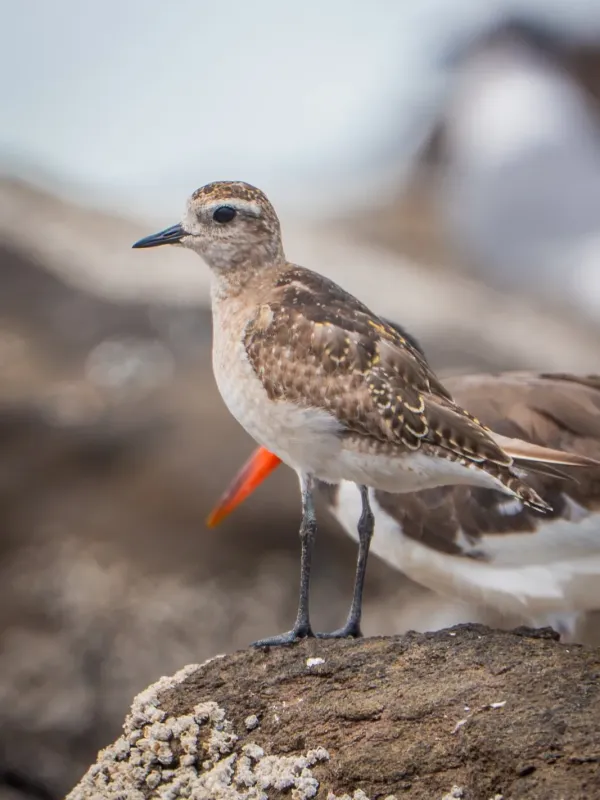
Description
How to identify
The American golden plover (Pluvialis dominica) is a migratory bird belonging to the Charadriidae family. It is medium-sized, with a plumage that shifts from golden-speckled brown in winter to black and white patterns during the breeding season.
The bird has a compact body and a relatively short bill, which is adapted for probing soft soil. Its legs are well-suited for walking across open agricultural fields, allowing it to forage effectively.
In the field, these birds are identified by their distinct behavior: rapid running, followed by short, deliberate pauses to inspect the ground for seeds or insects. They often forage in groups, making them quite conspicuous.
Their call is a characteristic, mournful whistle, often repeated when they are startled. During migration, they favor open habitats, and large-scale agricultural landscapes often mimic their natural tundra environment.
Correct identification is crucial as other species in the plover family share similar characteristics, but the American golden plover’s long-distance migration patterns make it a recurring visitor to specific agricultural regions.
What it damages
Damage primarily occurs during the sowing phase and the emergence of seedlings. Pluvialis dominica will consume seeds directly from the soil, especially if they are shallowly buried or left exposed after planting.
As seedlings emerge, the birds may cause mechanical injury to the young stalks while probing the soil for prey or additional seeds. This can result in localized thin stands or total loss of seedlings in specific patches.
Large flocks can cause secondary damage by trampling the crops. The constant movement of many birds over a field leads to soil compaction and damage to the root zone of fragile plants, making them susceptible to drying out.
The impact is most severe on crops like cereals and certain vegetables that require clear, uninterrupted row establishment. If left unchecked, the birds can significantly reduce the potential plant population density.
The extent of the damage is correlated with the size of the flock and the duration of their stopover. Once the crop reaches a more robust growth stage, the birds generally move on to more accessible food sources.
When it appears
The presence of the American golden plover in agricultural fields is seasonal, dictated by its extensive migratory route. They are most frequently observed during spring and autumn stopovers.
Spring migration coincides with the sowing season in many regions, making fields highly attractive as a quick energy source for the birds. This timing makes them a significant risk to the current year's harvest.
Autumn migration can also coincide with the planting of winter crops or the harvesting of late-season varieties. Birds use these fields to refuel before continuing their long-distance journey south.
Weather patterns heavily influence their stay. Adverse weather, such as heavy rain or cold fronts, can force flocks to remain in one area for several days, concentrating the damage on specific fields.
Agronomists should monitor migratory reports and local weather to anticipate the arrival of these birds and implement preventive measures before the birds settle in the fields.
Signs of infestation
The most prominent sign is the presence of gaps in the crop rows where seeds have been removed. This usually appears as small, localized patches where seedlings failed to emerge despite viable seed input.
Three-toed footprints in damp soil are a strong indicator of plover activity. Nearby, one can often find discarded seed hulls, as the birds strip the outer coat and consume the endosperm.
Flattened areas of soil with minor surface disturbance indicate the movement of a flock. Droppings and feathers left behind in the immediate vicinity confirm the identity of the visitors.
The sudden flushing of a flock from a field, followed by characteristic whistling calls as they take flight, is an immediate warning sign that the field is being used as a foraging site.
A decline in plant density on sections of the field, if not linked to other soil-borne pathogens or pests, suggests bird interference. Regular field scouting is the best way to catch this early.
Control measures
The use of bioacoustic devices that broadcast predator calls or distress signals is highly effective. These systems encourage the birds to vacate the area without causing physical harm to the migratory species.
Visual deterrents, such as raptor decoys or holographic ribbons, can be used to protect fields. However, these must be rotated periodically to prevent the birds from becoming habituated to the objects.
Proper agronomic practices, such as ensuring seeds are buried at the optimal depth, significantly reduce the accessibility of seeds to foraging birds, decreasing the overall attractiveness of the field.
Fast and uniform crop germination is essential. Techniques that promote quick plant emergence minimize the duration that the crop is in its most vulnerable state, effectively reducing the potential window for damage.
- Deployment of timed gas cannons for deterrence.
- Regular manual patrolling of fields in early hours.
- Drone monitoring for rapid identification of flocks.
- Application of seed treatments to mask seed odor.
Taxonomy
- Latin name
- Pluvialis dominica
- Family
- Charadriidae
- EPPO code
- PLUVDO
Discussion
No discussions yet — be the first.