
European golden plover
Pluvialis apricaria
Description
How to identify
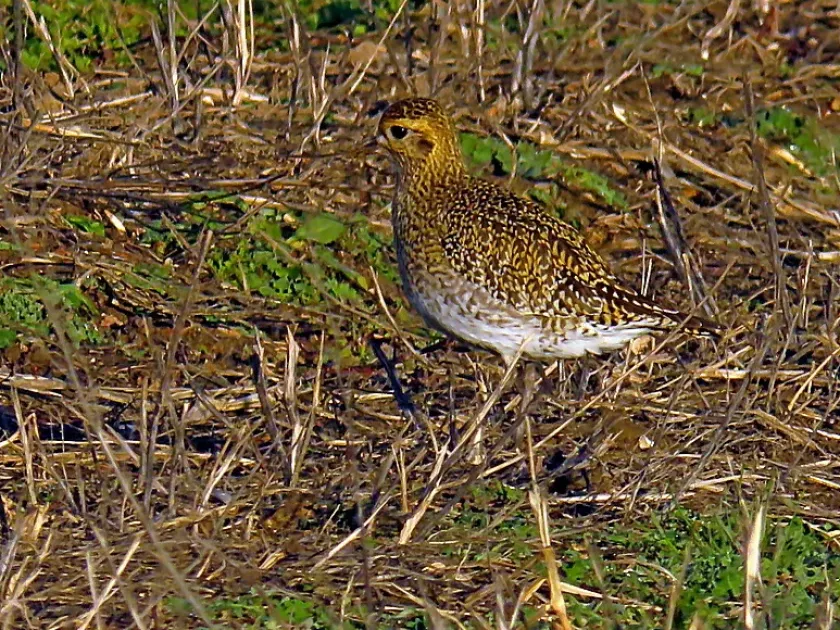
The European golden plover (Pluvialis apricaria) is a bird belonging to the order Charadriiformes, specifically the family Charadriidae. It is characterized by a medium size and a beautiful golden-black speckled plumage.
During their migration periods, these birds frequently stop over on agricultural lands, including pastures and freshly tilled fields, to feed on invertebrates found in the soil.
These plovers are known for their distinct behavior of running, stopping, and then pecking at the soil, which makes them quite easy to identify during the daytime hours.
They usually gather in large flocks, which can number from dozens to hundreds of individuals, significantly impacting the specific areas of fields where they choose to land.
As migratory birds, their presence in agricultural regions is seasonal, yet they can cause significant disturbance to crop development during critical growth stages.
What it damages
The primary damage caused by European golden plovers to agricultural crops is not direct herbivory, but rather the mechanical trampling of young seedlings.
When a large flock settles on a field of early crops or forage grasses, their constant movement causes the breaking or burying of fragile plant sprouts.
In wet or loose soil conditions, the activity of the flock leads to the disruption of the topsoil structure, which can expose the roots of young plants and inhibit their growth.
Significant economic loss may occur in localized patches of the field where the concentration of birds is highest, often necessitating supplemental planting or replanting.
Their presence can also lead to local soil compaction, which negatively affects the aeration and water infiltration required for healthy crop development.
When it appears
The birds appear on farmland mainly during their spring migration toward nesting grounds and their autumn migration toward wintering areas.
These periods often overlap with critical agricultural cycles, such as the initial growth phases of winter crops or the early spring sowing of cereals.
Weather conditions, such as early snowmelt or heavy rainfall, can influence the duration of their stopover, as they prefer accessible feeding grounds.
The peak activity is generally observed during the spring months, when the birds are under high physiological stress and require consistent energy intake.
The length of their stay on a single plot can range from a few days to over a week, depending on the availability of insects and the local weather conditions.
Signs of infestation
The presence of European golden plovers is indicated by the sight of large flocks on fields, typically near water bodies or in areas with damp, nutrient-rich soil.
Small, regular holes in the ground are telltale signs of their feeding activity, as they probe the soil to extract larvae and earthworms.
Damage to the crop is manifested as patchy areas of suppressed, crushed, or entirely missing seedlings within the field.
Bird droppings and footprints in the soft mud or between rows are clear indications that the site has been used as a foraging ground.
Visible disturbance of the top layer of soil, combined with the scattered remnants of seedlings, points to a recent visit by a large feeding flock.
Control measures
The most effective management approach involves bioacoustic devices that emit the distress calls of the plovers, causing them to leave the field immediately.
Visual deterrents, such as shiny reflective tapes, holographic disks, or kites shaped like raptors, can be used to prevent flocks from landing on vulnerable plots.
Integrated pest management strategies often combine sound and visual methods to ensure that birds do not become habituated to a single deterrent.
Gas-powered cannons are also used in large-scale farming to create intermittent noise bursts that startle the birds without causing long-term harm.
- Bioacoustic distress call systems.
- Reflective tapes and holographic streamers.
- Raptor-shaped kites and decoys.
- Intermittent sound-based repellent cannons.
- Proactive field monitoring during migration peaks.
Taxonomy
- Latin name
- Pluvialis apricaria
- Family
- Charadriidae
- EPPO code
- PLUVAP
Discussion
No discussions yet — be the first.