
Little ringed plover
Charadrius dubius
Description
How to identify
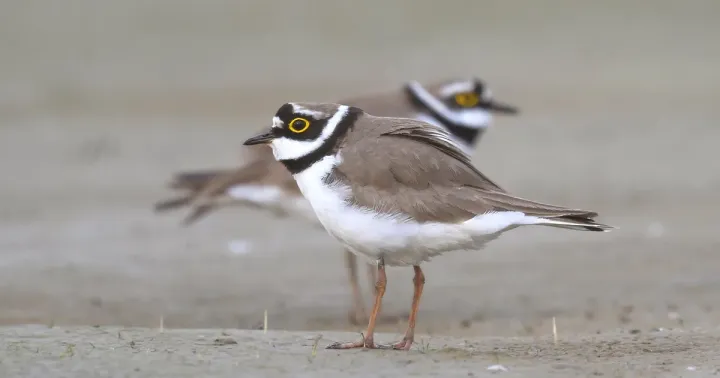
The little ringed plover (Charadrius dubius) is a small bird of the plover family. Weighing around 30–50 grams, it is characterized by its brownish-grey back, white underside, and a distinctive black band across its forehead and breast.
A key identifying feature is the bright yellow eye ring, which is visible at close range. It possesses a short, dark beak and pale, sometimes pinkish, legs, which are traits essential for identification when spotting them on open arable land.
The bird's lifecycle is strongly linked to water bodies where it seeks sustenance. Despite their small size, these plovers are highly active and move quickly across the ground, making them difficult to track across large agricultural fields.
Their reproductive cycle involves nesting in shallow scrapes on the ground. The female lays 3–4 eggs that mimic the color of gravel or bare soil. Chicks are precocial and capable of foraging shortly after hatching, increasing their exposure to crops.
Their natural camouflage makes them nearly invisible against bare soil or recently seeded fields, posing a challenge for farmers during the critical early growth stages of cultivated plants.
What it damages
The little ringed plover causes agricultural damage primarily through mechanical harm to seedlings rather than direct consumption. As they forage for insects, their movement and scratching can uproot or damage the delicate stems of vegetable and cereal crops.
In fields with low vegetation density, the activities of plovers can lead to patchy crop stands. This uneven emergence often necessitates replanting, which increases labor and input costs for the agricultural operation significantly.
Additionally, the birds' nesting habits can cause localized soil compaction in small areas. This compaction can restrict root aeration and hinder the development of plants in those specific zones, leading to reduced uniformity in the overall yield.
Damage is most severe in fields adjacent to wetlands or irrigation ponds. During dry periods, the birds often congregate in large numbers on irrigated farmland, leading to increased physical pressure on the young plants.
While the birds do consume some invertebrate pests, the physical damage inflicted on the crops during the foraging process often outweighs the benefits provided by their predatory behavior toward agricultural insect pests.
When it appears
The migratory arrival of the little ringed plover begins in early spring. This timing is critical because it often aligns with the sowing and emergence phases of major crops, making seedlings highly susceptible to physical disturbance.
During the summer months, activity remains high as the birds focus on feeding their offspring. During this time, they are frequently found in fields that provide enough open space for foraging and nesting, requiring constant field monitoring.
The autumn migration occurs from late August through October. As the birds prepare to move to warmer climates, their presence on agricultural land declines, effectively ending the period of potential conflict with crop development.
The species exhibits peak foraging activity during daylight hours. Farmers can best observe the impact of these birds during the day, as they use their vision to locate prey, leading to higher levels of activity in open field spaces.
Seasonal patterns are influenced by local weather conditions. Heavy rains that flood nesting areas near water bodies may push the birds to migrate towards higher-ground agricultural fields, temporarily increasing their population density in those locations.
Control measures
Protecting crops from little ringed plovers is best achieved through non-lethal deterrents, as many populations are protected by conservation laws. Visual deterrents, such as reflective tapes or predator decoys, are commonly employed to discourage foraging.
Bioacoustic deterrents, which simulate the distress calls of the birds or the cries of raptors, are highly effective when deployed correctly. It is essential to rotate the location and frequency of these sounds to prevent habituation.
- Installing protective mesh for sensitive areas.
- Using advanced bioacoustic devices for bird management.
- Deploying wind-powered rotating scarecrows with reflective surfaces.
- Optimizing planting times to bypass the most vulnerable emergence phases.
- Maintaining buffer zones to attract birds away from productive crop fields.
Agrotechnical practices, such as regular inter-row cultivation, can disturb nesting sites and make the surface of the soil less appealing for foraging. This effectively encourages the birds to relocate to non-crop areas.
Monitoring nesting activity in nearby riparian zones allows for proactive protection. By integrating visual, acoustic, and agrotechnical methods, farmers can successfully mitigate the impact of the little ringed plover on their harvests.
Taxonomy
- Latin name
- Charadrius dubius
- Family
- Charadriidae
- EPPO code
- CHDRDU
Discussion
No discussions yet — be the first.