
Snow bunting
Plectrophenax nivalis
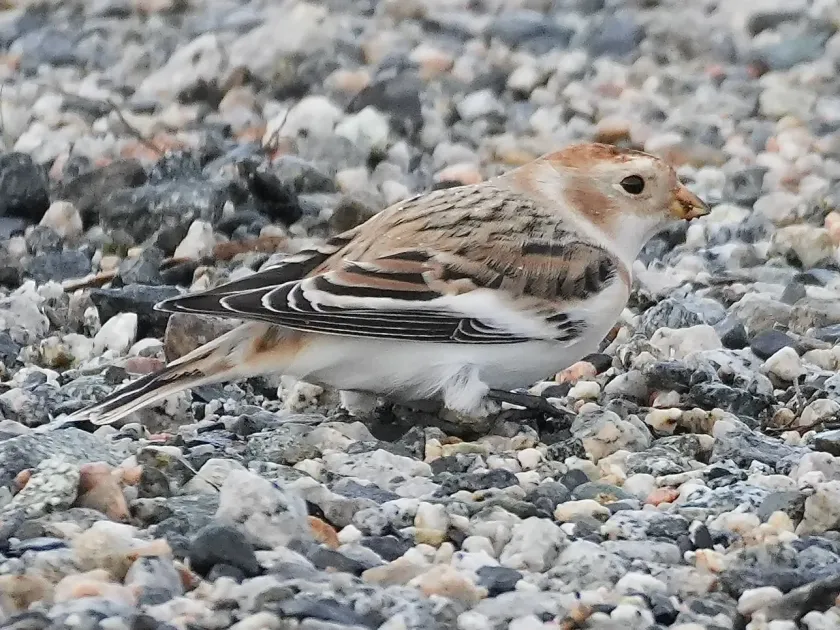
Description
How to identify
The snow bunting (Latin Plectrophenax nivalis) belongs to the order Passeriformes and the family Calcariidae. It is a small songbird characterized by striking plumage that changes with the seasons.
Adult birds grow to 15–18 cm in length with a wingspan of up to 35 cm. In the breeding season, males display contrasting black and white patterns, while females have a more subtle, brownish appearance.
This species is a native of the Arctic that migrates to lower latitudes during winter, where it may occasionally interact with agricultural landscapes.
They have a robust build and a short, sturdy beak adapted for feeding on seeds and small invertebrates in harsh environments.
In field conditions, they are easily recognized by their fluttering flight pattern and the distinct white patches on their wings visible during movement.
What it damages
The primary impact of the snow bunting on agriculture occurs during spring and autumn migrations, when flocks pause in agricultural fields to forage.
They pose the greatest threat to winter cereal crops by consuming germinating seeds and damaging tender seedling shoots.
In regions with intensive farming, snow buntings can damage rapeseed and other oilseed crops, often gathering along field edges near forest strips.
Birds actively utilize fields as feeding grounds, scavenging grain left over from harvest; however, they readily switch to emerging crops when natural food is scarce.
Mass gatherings of birds on small areas lead to crop thinning, which often necessitates additional reseeding efforts.
When it appears
Snow bunting activity in fields is closely tied to their migration schedule, occurring during the transitional seasons of spring and autumn.
Their spring arrival often overlaps with early sowing periods, making sprouted seedlings highly vulnerable to damage from their beaks.
Autumn migration coincides with the emergence of winter grain seedlings, designating them as a prime target for foraging flocks during this time.
The duration of the risk period depends on climatic variables, as prolonged cold spring weather can cause birds to linger in fields for extended periods.
Since migration cycles are predictable, agronomists can plan protection measures in advance during critical crop development phases.
Signs of infestation
A typical indicator of snow bunting presence is the appearance of localized patches where seedlings have been destroyed or pecked out.
Upon inspecting the soil surface, one can often find bird tracks and characteristic droppings, confirming the location of a foraging flock.
Visual observation of flocks flying over fields acts as an early warning sign to begin monitoring crop damage.
Mechanical damage to shoots usually appears as precise cuts or complete deformation of the above-ground plant parts at the "spiking" stage.
Increased bird restlessness and specific behavioral patterns upon take-off, accompanied by vocal signals, serve as secondary indicators of their presence.
Control measures
To protect crops from snow buntings, farmers primarily use deterrent methods designed to create an uncomfortable environment for the birds.
Effective solutions include acoustic systems that mimic raptor calls or generate sharp, irregular sound signals.
Visual deterrents such as reflective tapes, predator decoys, and dynamic devices creating an illusion of human presence are widely employed.
Agronomic strategies include maximizing the speed of sowing operations and using seed dressings with repellent properties.
- Deployment of automated propane cannons.
- Utilizing drones for regular field surveillance.
- Applying crop rotation to decrease field attractiveness.
Taxonomy
- Latin name
- Plectrophenax nivalis
- Family
- Emberizidae
- EPPO code
- PLEXNI
Discussion
No discussions yet — be the first.