
Meadow Bunting
Emberiza cioides
Description
How to identify
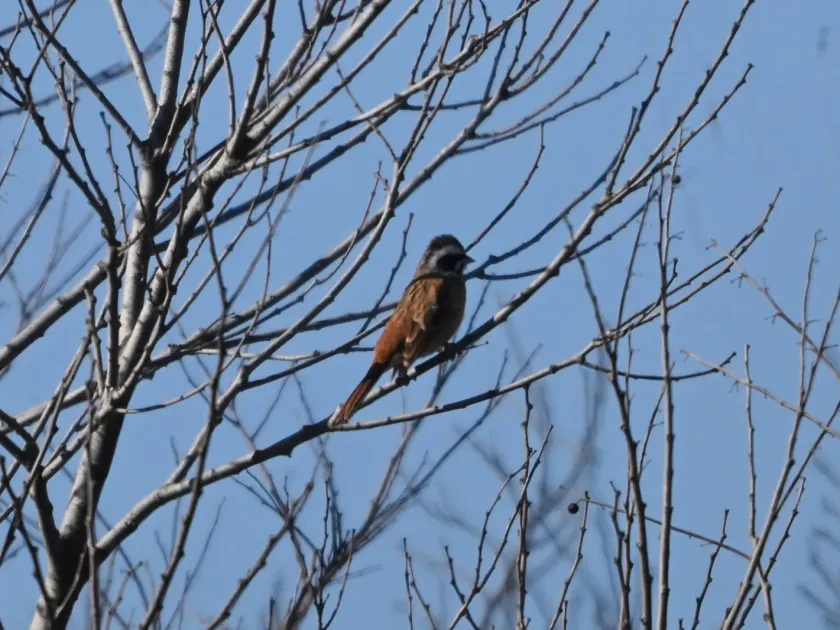
The Meadow Bunting (Emberiza cioides) is a small passerine bird belonging to the bunting family. It is easily recognized by its distinctive facial pattern, which includes dark brown patches on the sides of the head.
Adult birds typically measure about 15 to 16 centimeters in length. They possess a short, conical, and robust bill, which is specifically adapted for cracking hard seeds and grains found in their environment.
Their plumage is characterized by a streaked brown back, providing excellent camouflage against soil, dry grass, and stubble. This allows them to forage safely in open agricultural landscapes.
The species prefers habitats consisting of open fields, grasslands with scattered bushes, and forest edges. These areas often overlap with intensive farming regions, bringing the birds into direct contact with crops.
Males are known for their clear, repetitive songs during the breeding season. Monitoring these vocalizations is a reliable method for identifying their presence and potential density on farmland.
What it damages
Meadow Buntings primarily cause economic damage during the milk-wax stage of cereal ripening. They flock to fields of wheat, barley, and millet to feed on the developing grains.
They consume grain directly from the ear, which leads to significant yield losses. In cases of high population density, these birds can strip large portions of a field if left unchecked.
Mechanical damage occurs as birds land on crops to feed. The weight of the flocks can cause stems to bend or break, leading to lodging and complicating the mechanical harvesting process later on.
During the spring, they may feed on newly sprouted seedlings, reducing crop density and forcing farmers to consider potential replanting or supplemental fertilization to compensate for stunted growth.
The severity of the damage is often amplified during dry seasons when natural seed sources in wild grasslands are scarce, forcing the birds to rely almost entirely on cultivated crops.
When it appears
The birds begin their activity on agricultural lands in the early spring, typically around March and April, when they establish their territories and begin the nesting process.
The critical period for crop protection is during the maturation of cereals, which occurs in the summer months of July and August. At this time, the availability of ripening grain attracts large flocks.
After the harvest, buntings often remain in agricultural areas to scavenge for spilled grain in the stubble, which can impact the efficiency of soil preparation for winter crops.
During the winter, the species becomes nomadic. While they are less destructive to crops at this time, large congregations can still be found in areas where grain is stored or left in fields.
Effective pest management relies on understanding these seasonal patterns, allowing farmers to implement defensive measures before the birds reach high-density foraging levels.
Signs of infestation
A primary indicator of infestation is the presence of empty or partially eaten grain husks on the ears. This indicates that the birds have been actively feeding in the vicinity.
Patches of flattened or broken stems are common near the edges of fields or near cover areas such as hedgerows, indicating where the birds have spent significant time feeding.
The accumulation of bird droppings on the foliage and soil provides clear evidence of heavy activity. This can sometimes lead to localized sanitary issues within the crop stand.
Frequent movement of birds between nearby shrubs or trees and the center of the field suggests that the area is being used as a primary feeding ground during the early morning and late evening.
Visual observations of the birds perching on fences or power lines surrounding the fields are strong indicators that a flock is targeting the ripening crop.
Control measures
The use of bioacoustic devices that mimic the distress calls of the species or the presence of predators is a highly effective way to discourage birds from lingering in the fields.
Visual deterrents, such as reflective tapes, spinning mirrors, or life-sized bird-of-prey silhouettes, should be deployed and rotated frequently to prevent the birds from habituating to them.
Agricultural management should focus on removing weeds along field margins, as these areas often provide shelter and nesting sites that make the adjacent crop more accessible to birds.
Maximizing the speed and efficiency of the harvest is the best long-term strategy for minimizing losses, as it limits the duration during which the grain is susceptible to bird damage.
- Regular monitoring of bird activity during maturation.
- Deployment of propane cannons for large fields.
- Maintenance of clean field edges to reduce bird cover.
Taxonomy
- Latin name
- Emberiza cioides
- Family
- Emberizidae
- EPPO code
- EMBRCD
Discussion
No discussions yet — be the first.