
African field cricket
Platygryllus viator
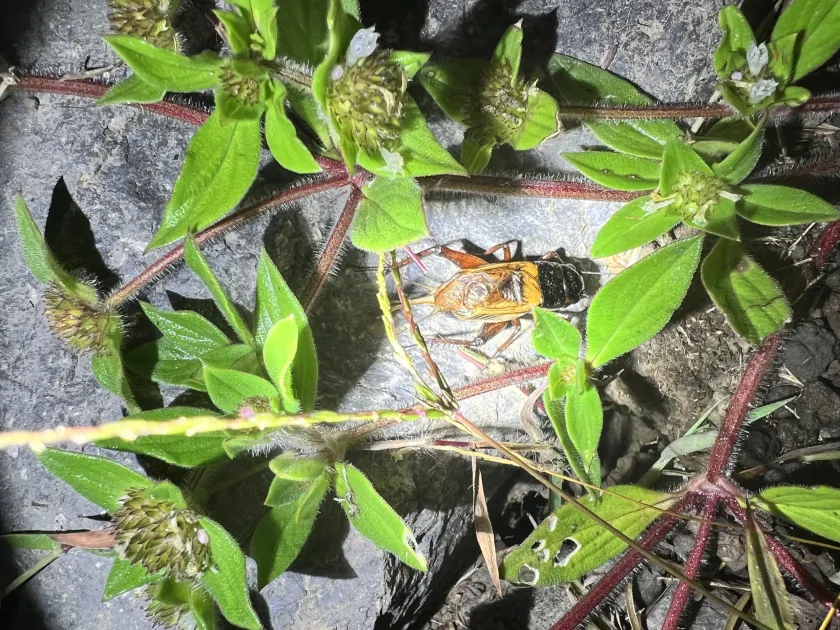
Description
How to identify
The African field cricket (Platygryllus viator) is a species of orthopteran insect belonging to the family Gryllidae. These crickets have a robust, dark-colored body and powerful hind legs adapted for jumping and quick movement across the soil surface.
Their anatomy includes large, strong mandibles specifically developed for chewing through tough plant fibers. Their antennae are thin and long, functioning as essential sensory organs for navigation and finding food during their nocturnal activity.
African field crickets are ground-dwelling insects that typically construct deep burrows. These subterranean tunnels serve as protective shelters against extreme daytime temperatures and predators.
Females possess a long, needle-like ovipositor used to deposit eggs deep within the soil. This strategy protects the offspring during the development process until the young nymphs emerge.
The life cycle involves several nymphal stages that gradually resemble adults. The lack of fully developed wings in early stages distinguishes nymphs from mature, capable-of-flight adults.
What it damages
Being a generalist pest, the African field cricket targets a wide range of agricultural crops, often causing severe damage during the critical early growth stages of plants.
Maize, sorghum, millet, and other cereal crops are primary targets. The crickets typically cut the stems of young seedlings near the soil surface, leading to plant mortality and significant stand reduction.
Apart from stem-cutting, they can consume newly sown seeds before germination or damage the leaf tissue, which drastically stunts the growth of the young crops.
In cases of high infestation, these insects can be responsible for destroying large patches of crops in a very short amount of time, jeopardizing the yield potential of the entire field.
Damage is often more severe in arid environments where natural vegetation is scarce, forcing the crickets to migrate towards irrigated or cultivated fields in search of succulent biomass.
When it appears
The activity and lifecycle of the African field cricket are highly dependent on soil moisture levels and temperature patterns. Their population peaks often coincide with the planting season.
Adult crickets are most active at the beginning of the growing season when environmental conditions support egg hatching and rapid development of nymphs.
Multiple generations can occur annually depending on the climatic conditions of the region. Breeding is largely concentrated in the soil, which provides a stable microclimate for the eggs.
They are primarily nocturnal, hiding in their burrows during the heat of the day. They emerge to feed and breed only when the temperature drops during the night.
Monitoring should be continuous throughout the planting and early vegetative stages, as the rapid population growth can lead to sudden outbreaks that are hard to manage.
Signs of infestation
A primary indicator of their presence is the appearance of small, circular holes (approximately 1-1.5 cm in diameter) in the soil, which are the entrances to their subterranean burrows.
Growers should look for patches of missing or cut seedlings. The stems often appear cleanly severed, which is a classic sign of cricket feeding activity compared to other pests.
The characteristic chirping sound of males is a very reliable acoustic indicator of a high population density, especially during evening hours after the sun goes down.
Accumulations of plant debris and insect frass around the burrow entrances often confirm the presence of a thriving cricket colony in the field.
Light traps are highly effective tools for monitoring adult populations. By capturing individuals at night, farmers can assess the risk level and decide if chemical intervention is required.
Control measures
Integrated Pest Management (IPM) is essential for controlling the African field cricket, utilizing a blend of mechanical practices and chemical tools for best results.
- Deep plowing or mechanical tillage during the off-season to disrupt burrows and destroy egg clusters in the soil.
- Rigorous weed control in surrounding areas, as weeds provide alternative food and habitat for cricket populations.
- Use of insecticidal seed treatments to provide long-lasting protection during the vulnerable seedling stage.
- Application of bait formulations containing stomach-acting insecticides, which are most effective when placed in the evening.
- Foliar spraying with pyrethroid-based insecticides when monitoring shows that populations have exceeded economic thresholds.
Proactive management is key, as once the damage is widespread, it is often too late to save the affected crop stands, making prevention the most cost-effective strategy.
Taxonomy
- Latin name
- Platygryllus viator
- Order
- Orthoptera (locusts)
- Family
- Gryllidae
- EPPO code
- GRYLVI
Discussion
No discussions yet — be the first.