
Lucerne longhorn beetle
Plagionotus floralis
Description
How to identify
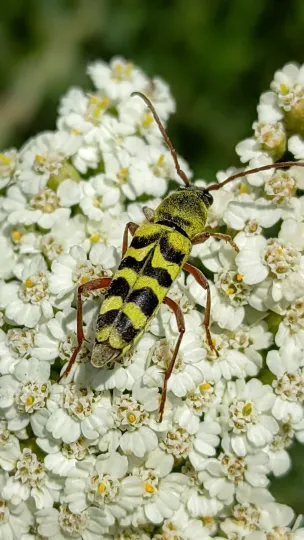
The adult lucerne longhorn beetle (Plagionotus floralis) is a member of the Cerambycidae family within the order Coleoptera. Adult beetles typically reach 10 to 18 millimeters in length.
The species is easily recognized by its distinctive black coloration marked with bright yellow transverse stripes on the elytra and pronotum.
The larvae are approximately 20–25 millimeters long, characterized by a legless, cylindrical body shape and a brownish, well-defined head.
Eggs are small, oval-shaped, and usually deposited by females directly onto the stems of host plants or near the crown, making them difficult to spot.
Pupae develop inside the stems of the host plant; they display a pale, whitish color and possess a structure typical of the Cerambycinae subfamily.
What it damages
Alfalfa (lucerne) is the primary host for the larvae of this species, although it may also infest other perennial leguminous forage crops.
Adult beetles primarily feed on pollen and nectar from various flowering plants, causing minimal damage unless their population density is exceptionally high.
Significant economic losses are caused by larvae that bore into the stems, creating tunnels that disrupt nutrient transport and plant physiological processes.
Heavy infestation leads to stem lodging, a significant reduction in green mass yield, and a decrease in the quality of hay produced from the field.
In cases of severe outbreak, the beetle can cause premature wilting of specific field patches, eventually reducing the overall lifespan of the alfalfa stand.
When it appears
Adult activity is typically observed in field conditions from late spring throughout the summer months, specifically May, June, and July.
Mating and egg-laying occur during the period of active vegetative growth when stems are sufficiently sturdy to support larval development.
The life cycle of this beetle lasts one year, with larvae over-wintering inside the stems of the host plants, where they can survive harsh winter temperatures.
In spring, as soil temperatures rise, the larvae finalize their development and pupate, eventually emerging as new adult beetles.
The prevalence of this pest is largely dependent on regional climatic conditions and the specific agronomic practices used in forage cultivation.
Signs of infestation
The most reliable sign of an infestation is the presence of small entry and exit holes in the lower parts of the alfalfa stems where larvae have been feeding.
- Wilting of plant tops without any associated signs of root disease.
- Premature yellowing and drying of stems despite adequate moisture levels.
- Deep longitudinal grooves or internal cavities found inside the stem when split open.
- Increased fragility of stems near the base, leading to widespread lodging.
- Presence of fine, brownish frass (larval excrement) inside the infested stem sections.
Control measures
Strategic crop rotation is the most effective agronomic measure, as it prevents the continuous cultivation of alfalfa on the same plot for more than 3–4 years.
Regular and timely mowing of the forage crop at the optimal growth stage prevents larvae from completing their development cycle inside the stems.
Deep plowing of alfalfa fields after their final harvesting season helps destroy a large portion of the overwintering larval population.
If the pest population exceeds the economic threshold, the application of systemic insecticides during the peak adult emergence phase is recommended.
Regular monitoring of beetle populations via visual field checks allows for proactive decision-making regarding the application of control measures.
Taxonomy
- Latin name
- Plagionotus floralis
- Order
- Coleoptera (beetles)
- Family
- Cerambycidae
- EPPO code
- PLGIFL
Discussion
No discussions yet — be the first.