
Three-spotted psyllid
Phylloplecta trisignata
Description
How to identify
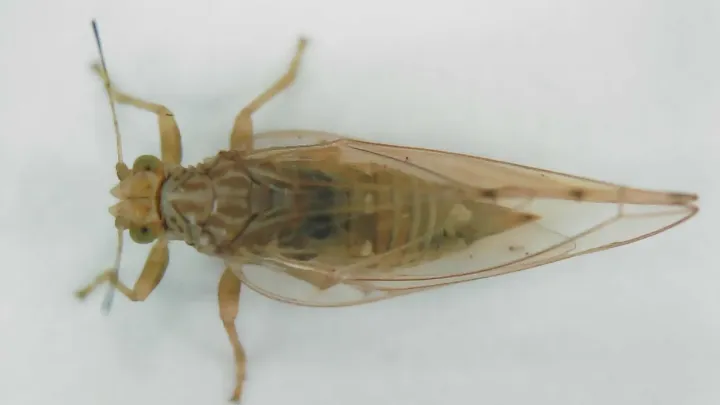
The three-spotted psyllid (Phylloplecta trisignata) is a small jumping insect belonging to the family Psyllidae, order Hemiptera. These insects are easily identified by their specialized hind legs designed for jumping and, most notably, the three distinctive dark spots on their forewings, which give the species its common name.
The adult form typically has a yellowish-brown to tan coloration, which camouflages them effectively against the bark and leaves of their host plants. Their head features prominent, complex eyes and long antennae that are sensitive to chemical cues from the surrounding environment.
The life cycle involves incomplete metamorphosis: egg, five nymphal stages, and adult. The nymphs are the primary life stage associated with foliage damage. Unlike adults, they are relatively stationary and spend most of their development on the undersides of leaves or within plant crevices.
During the nymphal stage, these insects produce waxy secretions or "fluffy" white filaments. These secretions serve as a protective barrier against predators and adverse environmental conditions, often covering the entire colony and making them look like white patches on the leaf surface.
The population dynamics of this pest are highly dependent on spring temperatures and the availability of young, succulent growth. Multiple generations can occur in a single growing season if conditions are mild, allowing the population to increase rapidly within a few months.
What it damages
The primary host for Phylloplecta trisignata is the genus Salix (willows). Both adults and nymphs feed on the plant sap using their piercing-sucking mouthparts. This feeding process drains essential nutrients, which leads to the weakening of the tree's health.
Feeding often results in noticeable leaf curling, distortion, and growth stunting. In some cases, the plant's response to the psyllid's saliva induces the formation of galls or abnormal growths on the foliage, which permanently disrupts the photosynthetic efficiency of the affected areas.
A significant secondary issue caused by these psyllids is the production of honeydew. This sweet, sticky substance accumulates on leaves and branches, creating a perfect habitat for sooty mold. This fungus darkens the leaves, further blocking sunlight and interfering with the tree's gas exchange.
In nursery settings, heavy infestations are particularly problematic as they can ruin the aesthetic value of ornamental willows. The combined effect of sap loss, physical distortion, and sooty mold coverage often leads to premature leaf senescence and early autumn defoliation.
Young trees are especially vulnerable. Severe, repeated annual infestations can compromise the structural integrity of twigs and branches, leading to dieback. While rarely lethal to mature, healthy trees, it significantly reduces their overall vitality and increases susceptibility to other pathogens.
Control measures
Managing the three-spotted psyllid requires a combination of preventive and interventionist techniques. The most effective approach starts with good sanitation: pruning and removing heavily infested branches early in the season can significantly lower the overall population pressure on the tree.
Chemical control should be targeted and applied during the early nymphal stages when the insects are most vulnerable. Systemic insecticides, such as those belonging to the neonicotinoid or spinosyn classes, are particularly effective as they are translocated through the plant's vascular system.
Biological control is a crucial component of sustainable management. Encouraging natural enemies like lady beetles, lacewings, and hoverfly larvae is often sufficient to keep psyllid numbers below the economic injury level, provided that broad-spectrum pesticides are avoided.
Water management is also a form of control. Using high-pressure water sprays to wash off nymphs from the undersides of leaves can dislodge the colony and disrupt their feeding. This method is safe for beneficial insects and can be repeated as needed without leaving chemical residues.
- Monitor leaf development closely in late spring.
- Use yellow sticky traps to track adult activity peaks.
- Apply horticultural oils during the dormant season to kill overwintering stages.
- Promote predatory insect habitats by planting companion flowers.
- Ensure adequate tree hydration to boost natural immune responses.
Taxonomy
- Latin name
- Phylloplecta trisignata
- Order
- Hemiptera (bugs, aphids, leafhoppers)
- Family
- Triozidae
- EPPO code
- PHPLTR
Discussion
No discussions yet — be the first.