
Pale brindled beauty
Phigalia titea
Description
How to identify
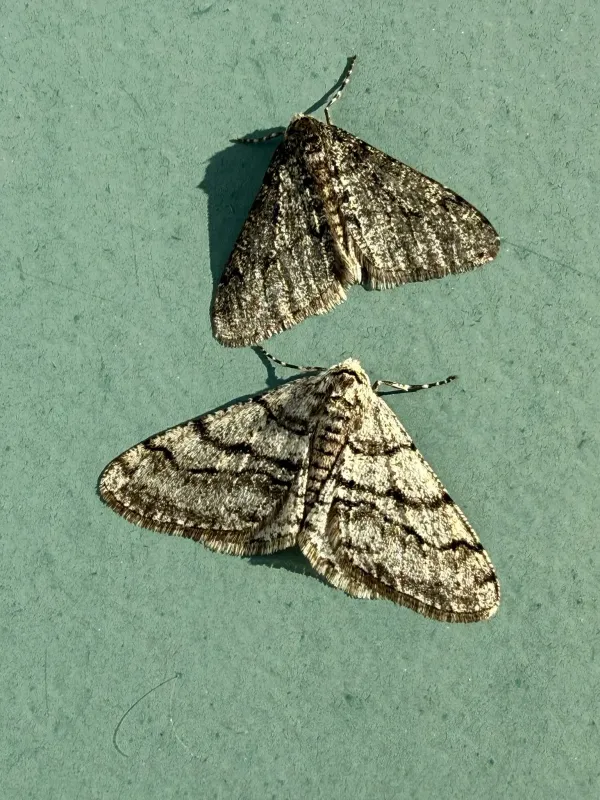
The pale brindled beauty (Phigalia titea) is a moth belonging to the family Geometridae. This species displays extreme sexual dimorphism, which is a key identifying factor for gardeners and orchardists. While males possess fully functional wings, females are flightless and resemble wingless, hairy, spider-like insects.
The male moth typically has a wingspan of about 40 mm, with wings featuring shades of grey, brown, and black wavy lines. Their appearance is designed for camouflage against tree bark. The females are greyish-brown with dark patches and spend their life crawling along trunks.
The eggs of this pest are small, oval, and yellowish-green. They are typically laid in small clusters or singly within the crevices of tree bark. This placement provides the eggs with shelter from late winter weather conditions until they hatch in the spring.
The caterpillars have the characteristic body plan of inchworms, moving in a looping fashion. Their body color often matches the twigs or leaves of the host tree, making them highly effective at hiding from predators during the daytime.
Pupation occurs in the soil beneath the host plant, inside a firm silken cocoon. The insect stays in the pupal stage throughout the summer and autumn, waiting for the return of favorable spring temperatures to emerge as an adult.
What it damages
The pale brindled beauty is a polyphagous pest, meaning it feeds on a wide range of host plants. It is particularly problematic in fruit orchards, where it commonly affects apple, pear, plum, and cherry trees, as well as various deciduous forest species like oak, linden, and birch.
The primary damage is caused by the larvae during the early spring. As soon as they emerge, the caterpillars begin feeding on the developing buds, which can destroy the entire floral prospect for the season if infestations are severe.
As the larvae mature, they consume the leaves of the host tree. They are capable of stripping foliage entirely or leaving behind only the skeleton of the leaf (skeletonizing), which severely disrupts the plant's ability to photosynthesize and store energy for future growth.
Heavy infestations can lead to significant defoliation, leaving the trees vulnerable to secondary stress factors. This weakening effect often results in reduced fruit yield, poor fruit quality, and, in cases of repeated annual attacks, branch dieback.
Beyond the direct impact on harvest, the removal of foliage makes the tree less resilient to drought or diseases, highlighting the importance of early intervention in any commercial or home orchard setting.
When it appears
The pale brindled beauty is one of the earliest active moths of the year. Adult emergence typically begins in late winter or very early spring, often coinciding with the first mild temperatures of February or March, even if frost is still occurring at night.
During the mating period, flightless females climb up the trunks of trees to signal and find mates. This climbing activity is the most critical window for monitoring and prevention before the eggs are laid.
Larval emergence is perfectly synchronized with the budburst phase of the host trees. This ensures that the newly hatched caterpillars have an immediate food source, making the timing of their activity highly dangerous for the fruit crop.
The caterpillars feed actively throughout April and May, undergoing several molts. By the time the weather warms significantly in late spring, they have typically finished their development and are ready to descend to the ground.
The remainder of the year, from early summer through mid-winter, is spent in the pupal stage buried in the soil. This dormancy protects the species from the harsh summer heat and ensures it remains undetected until the following spring cycle.
Control measures
The most effective physical control measure involves applying grease bands or glue traps to the trunks of trees. These should be placed in autumn to capture wingless females as they attempt to crawl upward to lay their eggs.
Mechanical interventions, such as cultivating the soil under the tree canopy in late autumn or early spring, can destroy pupae located in the ground. This reduces the number of adults that emerge in the following season.
Biological controls are highly recommended, including the encouragement of insectivorous birds in the orchard, as well as the application of biological insecticides based on Bacillus thuringiensis if larvae are spotted early.
Chemical control should be considered only when populations exceed established economic thresholds. Treatments are most effective when applied at the green-cluster stage of buds, ensuring maximum protection for the developing foliage.
- Apply sticky glue bands to trunks in autumn.
- Cultivate the soil surface to disrupt overwintering pupae.
- Introduce or protect native insectivorous bird species.
- Monitor for adults using pheromone traps.
- Target larvae with insecticides during the early budburst period.
Taxonomy
- Latin name
- Phigalia titea
- Order
- Lepidoptera (butterflies)
- Family
- Geometridae
- EPPO code
- PHIGTI
Discussion
No discussions yet — be the first.