
Pale brindled beauty
Phigalia plumogeraria
Description
How to identify
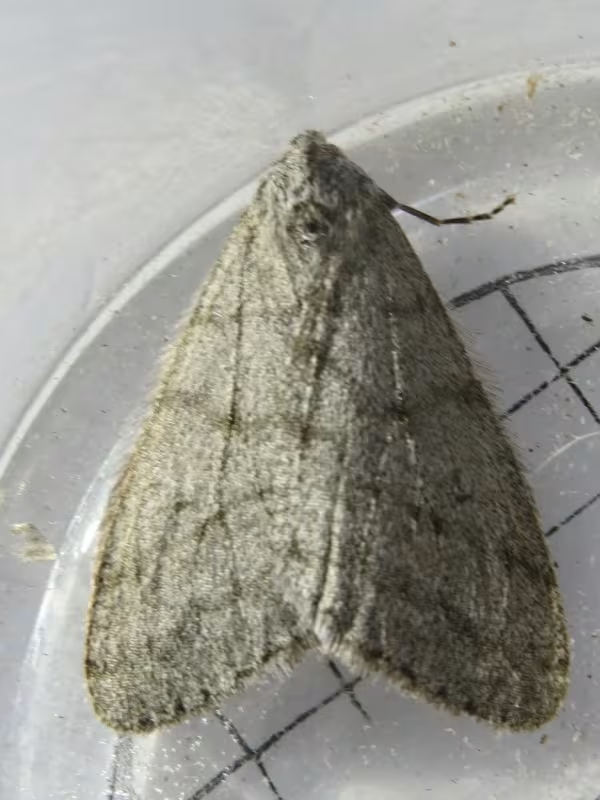
The pale brindled beauty (Phigalia plumogeraria) is a moth belonging to the family Geometridae. This species is characterized by significant sexual dimorphism.
Males possess wings with a span of up to 40 mm, exhibiting a grayish-brown pattern with dark lines that provide excellent camouflage against tree bark.
Females are flightless, possessing only vestigial wings. Their bodies are stout and hairy, which helps them survive in early spring conditions before foliage appears.
The larvae are typical geometrid caterpillars, reaching up to 35 mm in length. They are color-variable, ranging from green to brown, mimicking twigs perfectly.
Pupae overwinter in the soil within robust earthen cocoons located several centimeters deep beneath the host trees.
What it damages
This pest is a polyphagous insect that causes significant damage to various fruit trees and deciduous forest species.
It primarily infests pome fruits like apples and pears, as well as stone fruits including cherries and plums, consuming buds and new leaves.
Besides fruit orchards, it also feeds on various forest trees, including oak, elm, and beech, which can lead to high population densities in nearby areas.
The main damage occurs in the early spring, coinciding with the tree's budding phase, often resulting in severe defoliation of the crown.
Heavy infestations can significantly weaken tree health, reduce annual growth, and lead to substantial yield losses in orchards.
When it appears
The life cycle is univoltine, meaning there is only one generation per year, precisely timed to the host tree's phenology.
Adult moths emerge very early in the season, typically from March to April, and are often active even in cold weather.
After mating, females crawl up the tree trunk to lay clusters of eggs in bark crevices or near bud bases.
Larvae hatch exactly when buds begin to swell and open, ensuring they have immediate access to soft, nutritious tissue.
Feeding continues for about 4 to 6 weeks, after which the mature larvae descend to the soil to pupate and remain dormant until the following year.
Signs of infestation
Early symptoms include damaged buds that appear hollowed out or have small entry holes, which is a key indicator of larval activity.
As leaves unfold, irregular notches on leaf margins appear, leading to total defoliation of leaves if the larvae are present in high numbers.
Observing the tree closely may reveal caterpillars resting in a rigid, stick-like posture, a defensive behavior that makes them difficult to spot.
The accumulation of frass (small dark pellets) on the ground under the canopy is a clear sign that a significant colony is feeding above.
In some cases, the presence of light webbing on foliage indicates that larvae are using leaves as shelters or feeding retreats.
Control measures
Tilling the soil around the base of trees in autumn or early spring is highly effective at destroying overwintering pupae.
Applying sticky adhesive bands to trunks in early spring prevents flightless females from climbing the tree to lay eggs.
Biological control agents, such as formulations of Bacillus thuringiensis, can be used to manage larval populations with minimal environmental impact.
Chemical intervention should be timed to the early larval stages, as mature caterpillars are more resistant to contact insecticides.
- Encouraging natural predators such as insectivorous birds and parasitic wasps within the orchard ecosystem.
- Mechanical removal of egg clusters from bark if spotted during winter maintenance pruning.
Taxonomy
- Latin name
- Phigalia plumogeraria
- Order
- Lepidoptera (butterflies)
- Family
- Geometridae
- EPPO code
- CONDPL
Discussion
No discussions yet — be the first.