
Pale brindled beauty
Phigalia pilosaria
Description
How to identify
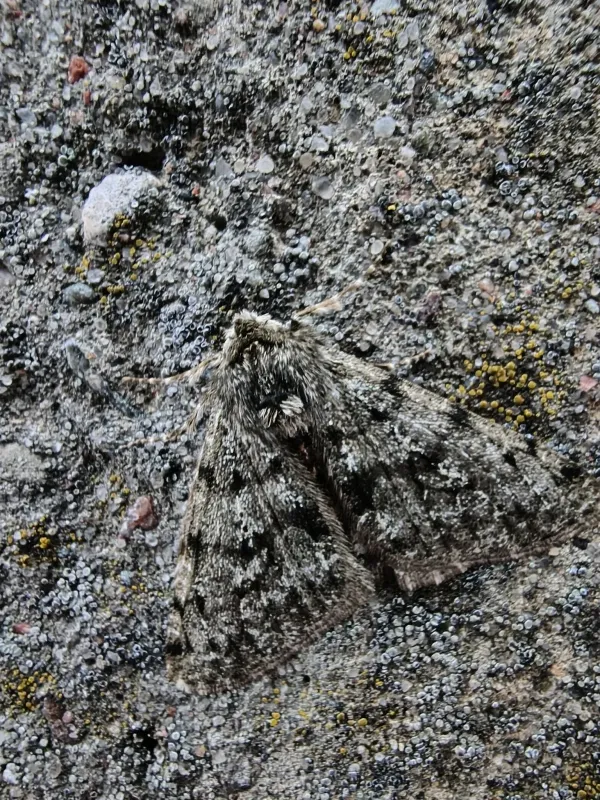
The pale brindled beauty (Phigalia pilosaria) is a moth belonging to the Geometridae family, known for its distinct sexual dimorphism.
Adult males are winged with a wingspan of up to 40 mm, featuring mottled grey or brown coloration with faint cross-lines on their wings.
Females are flightless and possess only vestigial wing structures, meaning they must crawl up tree trunks to reach the upper branches.
The larvae are typical geometrid caterpillars, growing up to 40 mm in length and displaying a greyish-green or brownish skin with dark markings.
Their body is covered with sparse hairs, and they exhibit a characteristic looping movement that makes them recognizable during inspection.
What it damages
This species is polyphagous, targeting a wide range of deciduous trees, including many common orchard fruit and ornamental species.
It frequently infests apple, pear, plum, and cherry trees, as well as native broad-leaved trees like oak, birch, and lime in surrounding areas.
During outbreaks, the larvae can cause significant defoliation, consuming leaf tissue and leaving only the skeletonized veins behind.
Feeding typically occurs when trees are most vulnerable, during the budburst and early leaf development stages, causing immediate stress.
Persistent damage impacts the tree's photosynthetic capacity, which can lead to reduced fruit yield and decreased vigor over time.
When it appears
The life cycle is univoltine, meaning there is only one generation per year, with the pupal stage occurring underground near the host tree.
Adult emergence happens very early in the year, often starting in late winter or early spring, even when temperatures are quite low.
Females climb the tree trunks shortly after emergence to lay their eggs in bark crevices or near the developing buds of the host tree.
Larvae hatch in synchronization with the opening of buds, allowing them to begin feeding on tender young leaves immediately.
By late spring or early summer, the caterpillars finish their growth cycle and descend into the soil to pupate, remaining dormant until the next year.
Signs of infestation
The first signs of infestation include the presence of caterpillars on the underside of leaves or on young shoots early in the season.
Damaged leaves show irregular holes and jagged edges, which progress into severe leaf tissue loss if the population density is high.
One might observe the small, flightless females crawling slowly up the trunks of trees during the very early spring months.
Large quantities of frass (caterpillar droppings) accumulating on the leaves or on the ground beneath the tree indicate a substantial infestation.
Visible thinning of the canopy and exposed bare branches during the late spring are clear indicators of extensive larval feeding activity.
Control measures
Sticky grease bands applied to tree trunks effectively trap the flightless females, preventing them from climbing into the canopy to lay eggs.
For smaller infestations, manual removal of caterpillars or shaking the branches to dislodge them onto a collection sheet can be highly effective.
When monitoring indicates a high population, targeted insecticide applications during the early leaf-out phase can help protect the foliage.
Biological control agents, such as Bacillus thuringiensis-based products, provide an environmentally friendly option for managing larval populations.
Cultivating the soil around the base of the trees in the autumn helps disturb and destroy the overwintering pupae, breaking the life cycle.
Taxonomy
- Latin name
- Phigalia pilosaria
- Order
- Lepidoptera (butterflies)
- Family
- Geometridae
- EPPO code
- PHIGPI
Discussion
No discussions yet — be the first.