
Lace bug
Phatnoma
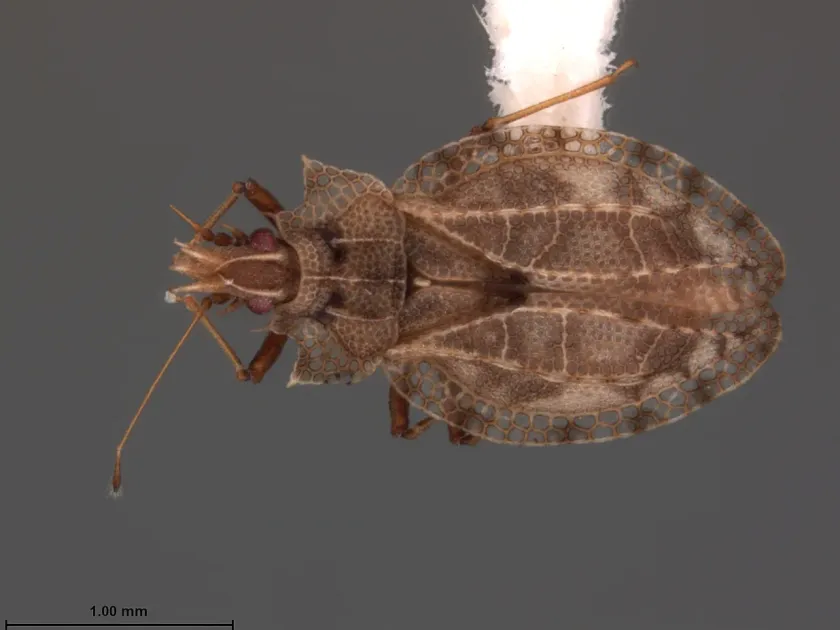
Description
How to identify
The genus Phatnoma belongs to the family Tingidae, commonly known as lace bugs. These small insects get their name from the intricate, lattice-like reticulation on their wings and pronotum, resembling fine lace or netting.
Adults typically have a flattened body measuring between 3 to 5 mm in length. Their coloration ranges from pale brown to nearly translucent, which serves as effective camouflage on the undersides of leaves.
Their mouthparts are of the piercing-sucking type, specialized for feeding on plant sap. Eggs are often laid in clusters and covered with protective secretions, making them difficult to detect without close inspection.
Nymphs resemble the adults in appearance but are smaller and lack fully developed wings. They are often adorned with small spines or outgrowths that function as a defense mechanism against potential predators.
Systematically, the genus Phatnoma is classified within the order Hemiptera. The high level of specialization in these insects allows them to successfully colonize various ecological niches in tropical and subtropical regions.
What it damages
These lace bugs are highly specialized phytophages. Depending on the specific species, they can infest a wide range of host plants, including fruit trees, ornamental shrubs, and certain forest tree species.
Damage is caused by both adults and nymphs that feed by extracting sap from leaf tissues. This process disrupts photosynthesis and significantly weakens the physiological health of the plant.
Young leaves and shoots are particularly sensitive to infestations. When colonized by high numbers of these pests, they lose turgor pressure, become deformed, and often drop prematurely.
Puncture sites are frequently prone to secondary infections, as pathogens like fungi and bacteria can easily penetrate the damaged plant tissues, leading to further decline of the host.
In cases of severe infestation, Phatnoma can cause partial or total canopy defoliation, which critically reduces the yield of fruit crops and the aesthetic value of ornamental landscaping.
Signs of infestation
The primary symptom of a Phatnoma infestation is the appearance of light-colored, chlorotic stippling on the upper surface of the leaves. These spots correspond exactly to the feeding sites located on the underside.
On the leaf underside, one can find characteristic black or dark brown fecal spots, which appear as tiny sticky dots, often found in close proximity to discarded nymphal exuviae (molted skins).
Severe infestations lead to a marbled appearance on the foliage, where coalescing white spots change the leaf color to yellow or brown, eventually resulting in necrosis of the leaf tissue.
Visually, the leaves may look dusty or dull due to the destruction of the epidermis and the loss of chlorophyll. In advanced cases, the leaf margins may curl inward.
Occasionally, sooty mold may develop on the affected areas, feeding on organic debris or honeydew (if secreted), which gives the plant an unkempt and darkened appearance.
Control measures
Cultural control methods involve maintaining plant vigor, performing timely pruning of infested branches, and sanitizing the area by removing fallen leaves where adults may overwinter.
Biological control relies on preserving natural enemies of lace bugs, such as predatory bugs (e.g., Orius spp.), lacewings, and lady beetles, which actively prey upon the nymphs.
When pest populations are high, the application of systemic insecticides is highly effective. Products based on neonicotinoids or organophosphates often provide the most consistent results.
It is essential to direct the spray toward the undersides of the leaves, as that is where the primary population resides, shielded by the canopy and the structural features of the foliage.
- Regular monitoring of leaf undersides for early detection.
- Use of biopesticides during the early stages of infestation.
- Adherence to pre-harvest intervals when applying chemical treatments.
Taxonomy
- Latin name
- Phatnoma
- Order
- Hemiptera (bugs, aphids, leafhoppers)
- Family
- Tingidae
- EPPO code
- PHAZSP
Discussion
No discussions yet — be the first.