
Common pheasant
Phasianus colchicus
Description
How to identify
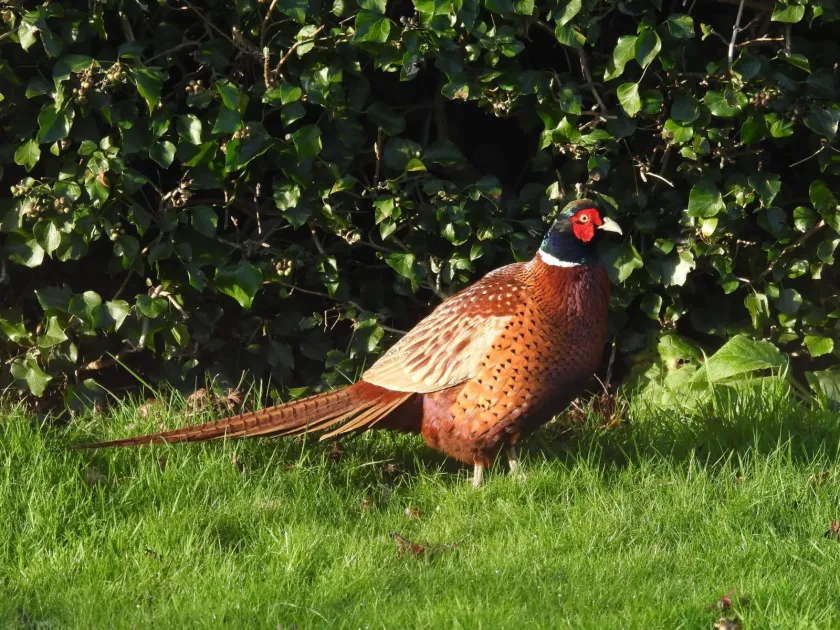
The Common pheasant (Phasianus colchicus) is a member of the order Galliformes and the family Phasianidae. This bird exhibits strong sexual dimorphism: males possess brilliant plumage, long tail feathers, and distinctive red wattles, while females have cryptic brown feathers that provide camouflage in the fields.
Adult birds can weigh up to 2 kilograms. Phasianus colchicus is primarily a terrestrial species, moving by walking or running; however, they can flush suddenly when disturbed. They are highly adaptable to agricultural landscapes adjacent to shrublands or forest edges.
Breeding occurs in spring, with nests typically built on the ground in dense vegetation. They are prolific layers, with clutches often reaching 15 eggs, which allows populations to recover quickly despite predation pressure in natural environments.
Seasonal activity is heavily dependent on food availability. In winter, pheasants tend to congregate in flocks near grain stores or winter crops, creating significant localized pressure on agricultural resources.
Their biology is characterized by an omnivorous diet, consuming seeds, grains, berries, and insects. This versatility makes them successful survivors in agricultural areas, frequently leading to conflicts with farmers during critical crop growth stages.
What it damages
The primary damage caused by the Common pheasant involves the consumption of cereal and legume seeds shortly after planting. They dig into the soil to retrieve the seeds, resulting in thinning stands and requiring farmers to re-sow the affected areas.
During the milking and dough stages of grain development, pheasants feed on wheat, barley, and corn ears. Their pecking at corn cobs can damage the kernels and facilitate the growth of mold and the accumulation of mycotoxins in the crop.
Sunflower crops are particularly vulnerable during the germination stage. Pheasants peck at the cotyledons of young seedlings, destroying the plant at the root and significantly reducing the overall plant population per hectare.
In addition to grain losses, they may damage vegetable crops and legumes. When large flocks enter fields, they cause physical damage to plants through trampling, breaking stems, and damaging foliage, which diminishes the quality of the marketable product.
Damage intensity often spikes during drought years when natural food sources are scarce. In these instances, pheasants rely more heavily on irrigated and highly productive agricultural lands for survival, causing extensive economic losses.
Signs of infestation
One of the earliest signs of pheasant presence is the occurrence of small, conical pits in the soil where they have excavated seeds. These pits are distinct in shape and depth, typically matching the planting depth of the crops.
Three-toed tracks are often visible in the soil, providing a clear indicator of the species' presence. These tracks, combined with droppings found in foraging areas, allow agronomists to confirm the source of the crop damage.
Damaged seedlings appear uprooted or partially consumed, with missing cotyledons or mangled roots. Broken stems and debris left behind in the field are common symptoms of an active feeding flock.
As crops reach maturity, one may observe patches of grain that have been stripped or threshed directly on the stalk. The presence of chaff, bird feathers, and trampled paths near these patches is a strong indicator of pheasant feeding activity.
Direct observation during dawn or dusk is the most reliable way to identify the pest. Pheasants often emerge from hedgerows to forage, leaving visible trails or runways in taller vegetation along the field boundaries.
Control measures
Effective management strategies include the use of acoustic deterrents, such as gas cannons or ultrasonic devices that emit variable frequencies. It is crucial to relocate these devices periodically to prevent the birds from habituating to them.
Visual deterrents, including reflective tape, holographic spheres, and artificial raptor silhouettes, can provide protection for young crops. These should be moved regularly to maintain a high level of efficacy against the birds.
Agronomic control involves ensuring proper seed depth during planting and applying repellent coatings to seeds. These substances make the seeds unpalatable to birds, deterring them from digging without causing harm to the pheasants.
For high-value crops, physical exclusion through netting is the most reliable method. While this requires an investment in materials and labor, it effectively prevents birds from accessing the crop during sensitive growth phases.
It is important to manage populations according to local wildlife regulations, as the Common pheasant is often classified as a game species. Using toxic baits is strictly prohibited, as it creates unnecessary ecological risks and violates environmental protection laws.
Taxonomy
- Latin name
- Phasianus colchicus
- Family
- Phasianidae
- EPPO code
- PHSNCO
Discussion
No discussions yet — be the first.