
Common pheasant
Phasianus
Description
How to identify
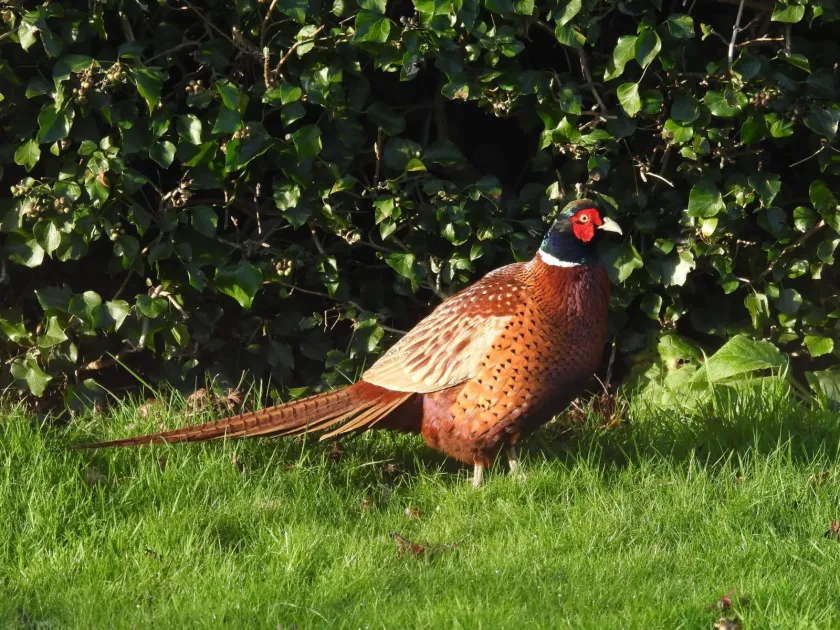
The common pheasant (Phasianus colchicus) belongs to the order Galliformes and the family Phasianidae. It is a large bird with significant sexual dimorphism: males have vibrant, iridescent plumage and long tails, while females possess protective sandy-brown coloration.
These birds are primarily ground-dwelling, favoring thickets, forest edges, and tall grasses adjacent to agricultural land. Despite their ability to fly, they prefer running to escape danger, which makes them frequent visitors to crop fields.
Pheasants are equipped with strong beaks adapted for foraging on the soil surface and digging into the ground to reach seeds or insects. Their diet is highly versatile, allowing them to thrive in various agroecosystems.
Their high adaptability enables them to breed successfully near farmlands, where they find both essential food sources and cover for nesting.
Common pheasants are known for their caution and intelligence, which often makes them difficult to manage in large open fields during the peak growth stages of cultivated plants.
What it damages
Pheasants cause the most significant damage during seed germination and crop ripening stages for cereals and legumes. They actively dig up newly sown seeds of corn, sunflower, wheat, and peas.
Extensive seed consumption during the early growth phase leads to thin stands, often necessitating the reseeding of affected areas by farmers.
Beyond seeds, birds damage young seedlings by pecking at tender leaves and growing points, which stunts plant development or leads to the total loss of the crop.
During the dough stage of grain development, pheasants peck grains from corn cobs or wheat heads, causing weight reduction and quality degradation of the final harvest.
Mechanical damage to stems caused by flocks moving through fields also contributes to lodging and creates entry points for fungal diseases in the damaged plant tissues.
When it appears
The damage is most severe in the spring when seeds are newly sown and in the summer-autumn period when crops are reaching maturity.
During April and May, pheasants concentrate on fields with row crops where loose soil makes it easier for them to excavate seeds.
The summer season involves a shift in diet toward vegetative parts and ripening grains, ensuring their constant presence on plantations until harvest time.
Winter damage is generally lower, though birds may frequent haystacks or remnants of unharvested crops if natural food sources become scarce due to snow cover.
Seasonal migration patterns of local populations often correlate with the development phases of major crops, which become their primary energy source.
Signs of infestation
The primary sign of pheasant activity is the presence of numerous small holes, 2-5 cm deep, left in the soil where they have excavated seeds.
Distinctive three-toed footprints are frequently found on the field surface, clearly indicating the presence of Galliformes rather than other pest types.
An abundance of droppings in foraging areas and scattered feathers along field borders serve as definitive evidence of flock activity.
Damaged seedlings appear neatly cut at the base or uprooted, often surrounded by small depressions from pecking.
Corn cobs damaged by pheasants show torn husks and missing grains with characteristic indentations from the bird's beak, distinguishable from insect damage.
Control measures
To protect fields, farmers use visual and acoustic deterrents such as bio-acoustic systems mimicking predator calls or propane cannons during peak activity hours.
Reflective tapes and predator decoys are effective only for short periods, as birds quickly habituate to static stimuli.
- Regular relocation of deterrent devices to minimize habituation.
- Installing protective netting on highly vulnerable areas.
- Application of chemical repellents for seed treatment prior to planting.
Agronomic measures include early sowing to accelerate the transition past the vulnerable seedling stage and weed management in field margins to reduce available cover.
An integrated strategy combining regular monitoring and multiple deterrent techniques is essential to minimize yield losses throughout the growing season.
Taxonomy
- Latin name
- Phasianus
- Family
- Phasianidae
- EPPO code
- PHSNSP
Discussion
No discussions yet — be the first.