
Phasgonophora sulcata
Phasgonophora sulcata
Description
How to identify
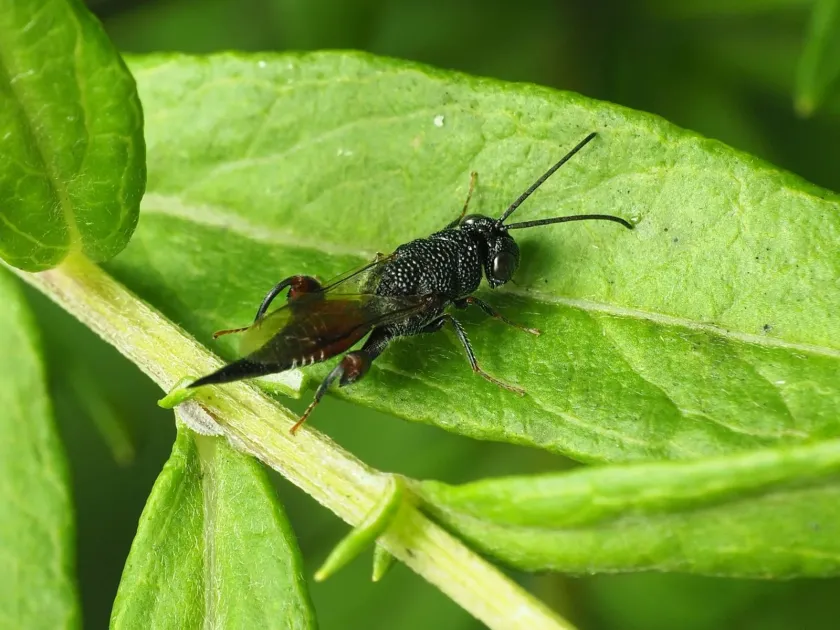
Phasgonophora sulcata is a species of parasitic wasp belonging to the family Chalcididae. These insects are easily recognized by their stout bodies and, most notably, their enlarged hind femora, which are typical for the family.
The adult wasps are predominantly black with a distinct metallic sheen. The thorax is heavily sculptured with deep pits or grooves, giving the insect a rugged, furrowed appearance, which is reflected in its scientific name.
Identification is usually performed by entomologists using microscopic features such as the structure of the antennae and the specific morphology of the scutellum. The female possesses an ovipositor used for inserting eggs into wood.
These wasps are closely tied to the lifecycle of their hosts. As they are part of the complex Chalcidoidea superfamily, they have evolved highly specialized methods for locating hosts hidden under tree bark.
Active during warm, sunny periods, the adults are agile flyers, scouting for suitable wood-boring larvae to act as hosts for their developing offspring.
What it damages
The primary hosts for Phasgonophora sulcata are larvae of wood-boring beetles, particularly the Buprestidae (jewel beetles). It acts as an endoparasite, meaning the wasp larvae develop inside the host.
While the wasp targets pests, it can sometimes behave as a hyperparasitoid, attacking other beneficial wasps that also regulate pest populations. This makes its role in the ecosystem complex and dual-natured.
Damage is observed in various deciduous trees such as oak, maple, and elm. The host larvae are consumed from within, which prevents them from completing their life cycle and emerging as adult beetles.
Economic impact is difficult to quantify because the presence of this wasp often correlates with existing pest outbreaks. It is considered a secondary actor in the decline of forest health.
In managed forests or plantations, the wasp's presence is a biological indicator of the existing population density of wood-boring beetles that it parasitizes.
When it appears
Adult emergence typically occurs in late spring or early summer, aligning with the peak activity period of the wood-boring beetles it targets. This synchronization is crucial for the survival of the species.
Warm temperatures are essential for the development of the wasp. The life cycle consists of egg, larva, pupa, and adult stages, with most of the cycle spent inside the woody tissue of the host plant.
Overwintering occurs primarily at the larval stage, safely encased within the host's gallery deep under the bark or in the wood, protected from cold temperatures.
The emergence of adults is triggered by rising temperatures in the spring. Once emerged, the lifespan of the adult wasp is relatively short, usually lasting only a few weeks.
There is typically one generation per year. The timing of each life stage is closely regulated by environmental cues such as cumulative heat units and humidity.
Signs of infestation
The most visible sign of Phasgonophora sulcata activity is the presence of small, round exit holes on the bark of infested trees, created by emerging adults.
These exit holes are often accompanied by the debris left by the host beetles. Upon closer inspection, one may find mummified host larvae within the wood galleries.
Forest pathologists often use rearing cages in the lab to confirm the presence of the wasp, collecting bark samples from trees that show signs of infestation by wood-boring beetles.
The presence of this species is usually localized, appearing only where host populations have reached sufficient density to support a parasitic colony.
Visible decline of the tree, such as wilting or branch dieback, is usually attributed to the primary wood-boring beetles, with the wasp being found as an associated species.
Control measures
Direct control of Phasgonophora sulcata is rarely recommended as it is an integral part of the natural forest ecosystem. Management focuses on maintaining tree health to prevent primary pest outbreaks.
Sanitation measures, such as the removal and proper disposal of heavily infested, dying, or dead trees, serve as the most effective method to regulate pest populations naturally.
Chemical control via broad-spectrum insecticides is discouraged, as it often causes more harm to beneficial parasitoids and predators than to the target pests themselves.
Forest management should prioritize maintaining ecological balance, ensuring that natural enemies have enough habitat to persist and regulate wood-borer populations.
For ornamental trees or high-value plantations, keeping the plants well-watered and free from mechanical stress minimizes their attractiveness to wood-boring insects, indirectly preventing wasp infestation.
Taxonomy
- Latin name
- Phasgonophora sulcata
- Order
- Hymenoptera
- Family
- Chalcididae
- EPPO code
- PHSGSU
Discussion
No discussions yet — be the first.