
Dirhinus giffardii
Dirhinus giffardii
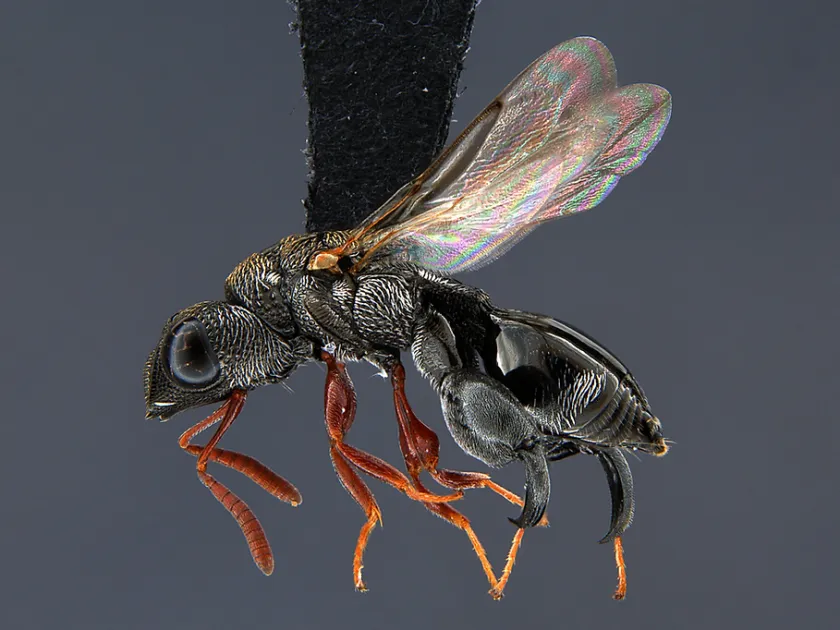
Description
How to identify
Dirhinus giffardii is a species of parasitic wasp belonging to the family Chalcididae within the order Hymenoptera. The adult insect is characterized by a robust body, typically measuring between 3 to 5 millimeters in length.
A distinctive morphological feature of this species is the presence of enlarged, thickened hind femora, which are adapted for navigating through soil or debris to locate host pupae.
The body surface is densely punctured, giving the insect a dull, matte appearance. This structure is well-suited for its specialized lifestyle as an endoparasitoid.
Females are equipped with a strong ovipositor, allowing them to penetrate soil and the tough cuticles of host pupae to deposit eggs internally.
The life cycle involves larval development entirely within the pupa of the host, consuming its tissues until the wasp emerges as a fully developed adult.
What it damages
Dirhinus giffardii primarily targets pupae of various tephritid fruit flies, which are significant agricultural pests. Its impact is complex, as it functions as a natural regulator of fly populations.
While it can suppress pest numbers, its presence can be detrimental if it acts as a hyperparasitoid or destroys beneficial natural enemies that provide more effective control of crop pests.
Orchards containing stone fruits, citrus, and tropical fruits like mango are the primary areas where this species is active, as these environments support high densities of fruit fly hosts.
Indirect damage occurs when the balance of the orchard's ecosystem is disrupted, potentially leading to an increase in fruit fly outbreaks if the parasitoid outcompetes more beneficial species.
The overall level of damage is heavily dependent on the local agroecosystem's complexity and the specific population dynamics of both the target pests and their natural enemies.
When it appears
The activity of this species is largely dictated by temperature, with peak performance occurring during the warmer months when soil temperatures exceed 20 degrees Celsius.
During the summer, synchronization between the emergence of the parasitoid and the pupation of fruit flies leads to the highest rates of infestation and reproduction.
In temperate zones, the species overwinters in the pupal stage of its host, remaining in diapause within the soil until environmental conditions improve in the spring.
In tropical and subtropical regions, development can be continuous throughout the year, allowing for multiple overlapping generations in a single season.
The first adult wasps appear in early spring, triggered by rising soil temperatures and the onset of host availability in the surrounding orchard soil.
Signs of infestation
Directly observing Dirhinus giffardii is difficult due to its cryptic, soil-dwelling nature during its immature stages. Detecting its presence often requires examining host pupae for exit holes.
Empty pupal cases found in the soil near the base of host plants often show circular emergence holes, indicating that a parasitoid has successfully completed its cycle inside.
Dissection of fruit fly pupae recovered from soil samples can reveal the presence of the parasitoid’s larvae or pupae inside the host's structure.
Monitoring programs using soil-level traps or emergence cages can provide quantitative data on the presence and density of the parasitoid population in an orchard.
A decline in the efficacy of other beneficial parasitoids, despite high host availability, may serve as a bio-indicator of the presence of this competitive species.
Control measures
Management strategies focus on disrupting the lifecycle of the host insects and maintaining a balanced population of natural enemies to minimize negative interference.
- Implement mechanical soil cultivation to destroy pupae residing in the upper layers of the soil.
- Practice strict sanitation by collecting and properly disposing of fallen, infested fruits to remove breeding substrates.
- Use appropriate soil-applied biological agents that target fruit fly pupae without harming the broader ecosystem.
- Cover the soil beneath orchard trees with landscape fabric to prevent emerging adults from flying into the tree canopy.
- Monitor the parasitoid population levels to ensure that biocontrol programs remain effective and do not favor the hyperparasitic species.
Taxonomy
- Latin name
- Dirhinus giffardii
- Order
- Hymenoptera
- Family
- Chalcididae
- EPPO code
- DIRHGI
Discussion
No discussions yet — be the first.