
Dirhinus anthracia
Dirhinus anthracia
Description
How to identify
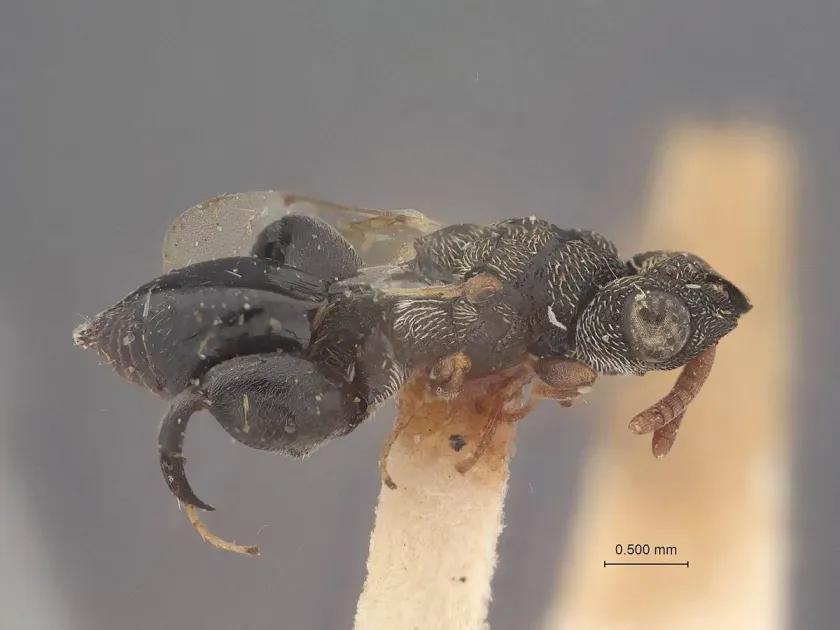
Dirhinus anthracia is a parasitic wasp belonging to the family Chalcididae (order Hymenoptera). These insects are distinguished by their compact, black bodies and noticeably enlarged hind femora, which often carry a row of small teeth.
The adults are typically small in size and possess a heavily punctured exoskeleton, giving them a matte appearance. They are agile insects capable of navigating complex substrates to locate hosts.
The female wasp uses a well-developed ovipositor to penetrate the outer shell of fly pupae, where she deposits her eggs to initiate the larval development process.
Larvae develop as endoparasitoids, consuming the contents of the host pupa until they reach the pupal stage themselves, effectively killing the host.
The identification in the field is usually performed through trap samples or by rearing pupae collected from infested crops to observe the emergence of parasitoids.
What it damages
The damage caused by Dirhinus anthracia is primarily ecological, as it acts as a parasitoid that may target beneficial flies or natural enemies of agricultural pests.
By parasitizing pupae, it reduces the population of flies, which can be beneficial in controlling harmful dipteran species, but it can also interfere with biological control programs if it parasitizes beneficial species.
In commercial greenhouses, an uncontrolled population can disrupt established Integrated Pest Management (IPM) protocols by reducing the density of beneficial insects.
The economic impact is indirect, manifesting as a decline in the effectiveness of other natural enemies which are essential for crop protection against major pests.
Producers must assess whether the presence of this insect is detrimental to their specific biological control strategy or if it serves as a natural regulator.
When it appears
Active phases of Dirhinus anthracia coincide with the presence of host fly populations, typically spanning from late spring to early autumn in outdoor conditions.
In greenhouses, where temperatures are maintained year-round, multiple generations can occur sequentially, provided that host pupae are constantly available.
The overwintering strategy involves remaining as a pupa inside the host case or in the soil, allowing the insect to survive winter cold and low humidity.
The lifecycle duration is highly dependent on ambient temperature and the availability of suitable host pupae in the soil or decaying organic matter.
Populations tend to peak during the mid-season when the reproduction of dipteran flies is most intensive, creating a surplus of available hosts.
Control measures
Management of Dirhinus anthracia is generally not required in open fields, where it functions as part of the natural community of parasitoids.
In sensitive greenhouse environments, control measures focus on habitat modification to prevent the buildup of host fly populations that attract the parasitoid.
Chemical control is strongly discouraged as it usually results in the collateral death of beneficial biocontrol agents and leads to pest outbreaks.
Effective management includes proper crop sanitation, such as removing infested plant debris and maintaining soil hygiene to limit host availability.
- Regular monitoring using yellow sticky traps and soil sampling.
- Implementation of crop rotation to break host development cycles.
- Maintenance of beneficial insect refugia in adjacent areas.
Taxonomy
- Latin name
- Dirhinus anthracia
- Order
- Hymenoptera
- Family
- Chalcididae
- EPPO code
- DIRHAN
Discussion
No discussions yet — be the first.