
Phasgonophora
Phasgonophora
Description
How to identify
Phasgonophora is a genus of parasitic wasps belonging to the family Chalcididae. These insects are recognized for their specialized role as parasitoids, predominantly targeting various species of wood-boring insects found in agricultural and forest ecosystems.
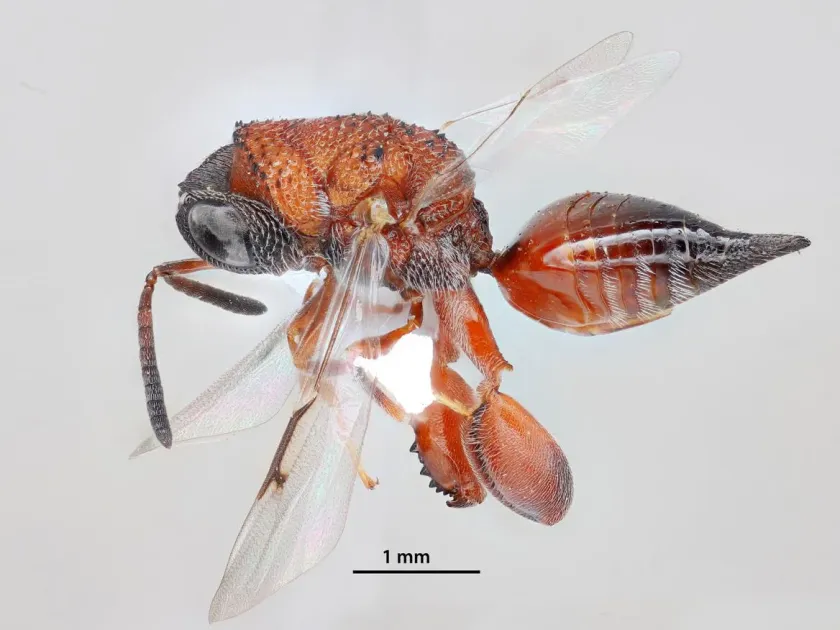
Physically, these wasps are identified by their robust bodies and characteristically enlarged hind femora, which are often equipped with small teeth. Their coloration is typically dark, facilitating camouflage against tree bark.
The life cycle of Phasgonophora follows a complete metamorphosis: egg, larva, pupa, and adult. Females are highly efficient at locating hosts hidden within plant tissues using olfactory and vibration sensors.
Larvae develop as endoparasitoids, living inside the bodies of their hosts. This process eventually kills the host, which is often a significant pest of woody plants, thus positioning Phasgonophora as a natural regulatory agent.
Identification in the field requires specialized knowledge, as adult specimens are often small and resemble other chalcid species. Microscopic examination of structural features is usually required for species-level confirmation.
What it damages
Phasgonophora itself does not feed on plant tissues. The "damage" associated with it is intrinsically linked to the presence of host insects, such as wood-boring beetles, that tunnel through trunks and branches.
Common hosts include various species of metallic wood-boring beetles and weevils that infest fruit trees and hardwood species. These hosts cause direct structural damage to the plant's vascular system.
While Phasgonophora acts as a natural check on these populations, its presence serves as a diagnostic indicator of a pre-existing pest infestation that is already compromising plant health.
In cases of high pest density, the parasitoid activity alone is often insufficient to prevent tree decline, necessitating further human intervention to protect the orchard or timber stand.
The economic impact is indirect: the parasitoid is beneficial for natural control, but its presence confirms that trees have been attacked by wood-boring pests, potentially leading to long-term structural weakness.
When it appears
Adult activity typically occurs during the spring and summer months, coinciding with the active flight periods of their primary hosts. This is when mating and oviposition occur.
Environmental conditions, particularly temperature, significantly influence the emergence of adults. Optimal activity levels are usually observed during warmer days with temperatures consistently above 18–20°C.
Larvae remain active throughout most of the year while sheltered inside the galleries of the host insects. This internal environment provides protection from extreme winter or summer temperatures.
In most temperate regions, Phasgonophora completes one generation per year. However, in warmer climates or specific micro-habitats, the life cycle may be accelerated, potentially leading to two generations.
Monitoring for adults should be prioritized during the post-flowering stage, using sticky traps or manual inspections of tree trunks to track population trends throughout the growing season.
Signs of infestation
The presence of Phasgonophora is best indicated by the signs left by its hosts. These include small, round or oval exit holes on the bark and visible tunneling beneath the surface of the bark.
Infested trees often exhibit signs of physiological stress, such as yellowing leaves, premature fruit drop, and canopy dieback, which are caused by the destruction of the cambium layer by host larvae.
Visual spotting of the adult wasps on tree trunks during sunny intervals provides evidence of their search for host larvae. They are often seen vibrating their wings and scanning the bark surface.
Detection can be confirmed through rearing: collecting infested wood samples and placing them in emergence cages to observe which insects emerge over time.
Field inspectors should look for a combination of tree decline symptoms and the physical evidence of boring insects to determine if the local population of Phasgonophora is active.
Control measures
Integrated Pest Management (IPM) is the preferred approach. The most effective control measure is rigorous orchard sanitation, which involves the pruning and destruction of infested branches to remove host habitats.
Chemical intervention should be used judiciously. Avoid broad-spectrum insecticides that may kill beneficial parasitoids; instead, target specific applications to manage wood-boring larvae when they are vulnerable.
Maintaining biological diversity around the orchard or nursery helps support local populations of natural enemies, which can effectively reduce the reliance on chemical pesticides.
Preventive measures, such as maintaining tree health through proper irrigation and nutrition, reduce the attractiveness of trees to wood-boring pests and consequently decrease the host population.
Use pheromone traps to identify the exact flight windows of pests, allowing for targeted timing of necessary protective measures while preserving the balance of the ecosystem.
Taxonomy
- Latin name
- Phasgonophora
- Order
- Hymenoptera
- Family
- Chalcididae
- EPPO code
- PHSGSP
Discussion
No discussions yet — be the first.