
Brachymeria intermedia
Brachymeria intermedia
Description
How to identify
Brachymeria intermedia is a member of the Chalcididae family within the order Hymenoptera. This parasitoid wasp is known for its robust and compact build.
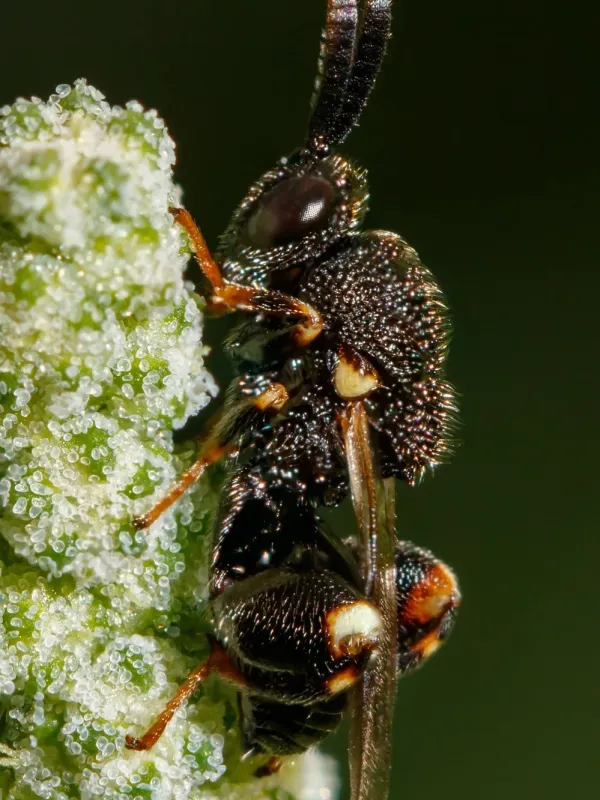
The most distinctive morphological feature of this species is the enlarged hind femora, which contain a row of small teeth on the inner side.
Adult wasps are generally black in color, often exhibiting yellow or reddish-brown markings on the legs and antennae, which are key identification traits.
The head and thorax possess dense pitting, giving the insect a matte appearance compared to many other metallic chalcid wasps.
The wings are clear with well-defined venation, and the overall body structure allows for swift and agile movement during flight.
What it damages
Brachymeria intermedia is an endoparasitoid that primarily targets the pupae of various Lepidoptera species, including the gypsy moth.
From an agronomic perspective, this insect serves as a beneficial natural enemy, helping to suppress pest populations in orchards and forests.
It does not typically damage plant tissues directly; its ecological impact is primarily through the regulation of herbivorous insect populations.
In cases where it targets populations of beneficial or neutral insects, its impact is usually localized and mitigated by its role as a natural regulator.
The wasp oviposits into the host pupa, and the developing larva consumes the host's interior, effectively preventing the pest from completing its life cycle.
When it appears
Adult activity typically peaks during the summer months, aligning with the pupation period of their preferred lepidopteran hosts.
The developmental rate is heavily influenced by ambient temperature, with warmer conditions facilitating faster generation times.
Overwintering occurs primarily as adults or mature larvae within the host pupa, which provides essential protection from cold weather.
Depending on the climatic zone, multiple generations can occur within a single growing season, enhancing the wasp's effectiveness as a biological control agent.
The emergence of the adult wasp from the host pupa follows a period of larval development and metamorphosis inside the pupal shell.
Signs of infestation
The primary sign of Brachymeria intermedia presence is the discovery of host pupae featuring a small, perfectly round emergence hole.
Visual inspections of tree trunks, branches, or leaf litter where pest pupae are common can reveal affected shells that have been parasitized.
A reduction in the number of emerging adult moths in orchards, coupled with the presence of exit holes, serves as strong evidence of successful parasitism.
Field monitoring involving the collection and dissection of pupal samples provides an accurate assessment of the parasitoid's impact on local pest populations.
The absence of the host moth indicates that the parasitoid has successfully completed its development at the expense of the pest.
Control measures
Effective management strategies focus on preserving habitat conditions that support the survival and reproduction of this parasitoid wasp.
Reducing the frequency and toxicity of broad-spectrum insecticide applications, especially during peak flight times, is crucial for protecting the population.
Maintaining floral strips or hedgerows near crops provides necessary nectar sources for adult wasps, increasing their longevity and fertility.
Integrating biological control by encouraging natural parasitoids allows for a significant reduction in the need for chemical intervention in orchards.
Regular monitoring of pest pupae ensures that the timing of necessary chemical applications does not unnecessarily harm the populations of beneficial insects.
Taxonomy
- Latin name
- Brachymeria intermedia
- Order
- Hymenoptera
- Family
- Chalcididae
- EPPO code
- BRARIN
Discussion
No discussions yet — be the first.