
Honeysuckle leaf miner
Perittia herrichiella
Description
How to identify
The honeysuckle leaf miner (Perittia herrichiella) is a tiny moth belonging to the family Elachistidae. These moths are characterized by their extremely small size and narrow wings, which makes them difficult to identify in the field without close observation.
The adult moth is typically dark brown or grayish, allowing it to blend seamlessly into the bark of its host plant. Because they are mostly nocturnal or crepuscular, they remain hidden during the day, avoiding detection by gardeners and predators.
The larvae are the most recognizable stage to the average observer. They are small, light-colored caterpillars that feed internally within the leaf tissue, which is why they are referred to as leaf miners.
The pupal stage is often spent within a delicate, spindle-shaped cocoon. These are usually found attached to the underside of the leaf or tucked away in the crevices of the host plant's bark, providing a safe haven for metamorphosis.
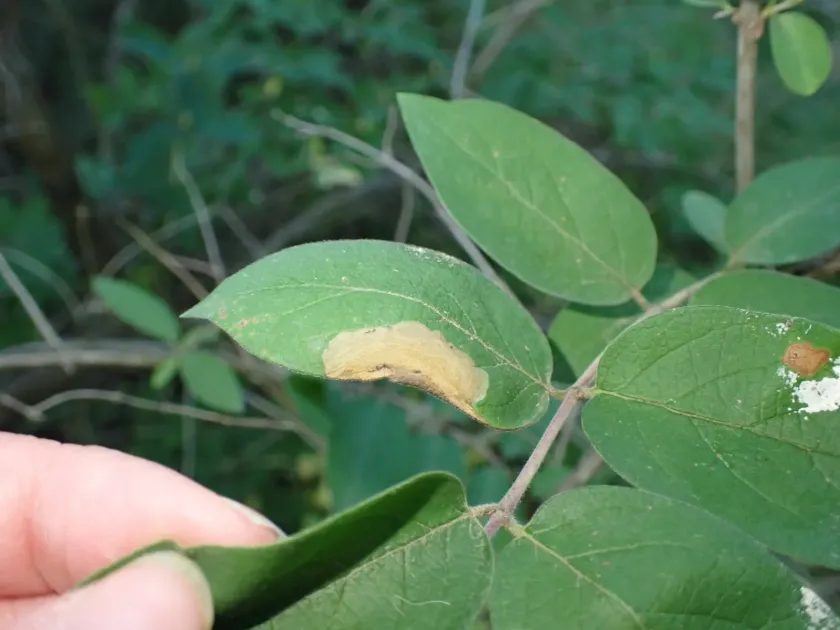
Accurate identification of the species often requires examining the characteristic mines left on the leaves. Since these mines are unique to the species, they serve as the primary diagnostic tool for presence in the garden.
What it damages
This pest specifically targets honeysuckle (Lonicera) plants. By mining the interior of the leaf, the larvae disrupt the plant's ability to carry out photosynthesis effectively, which can lead to significant physiological stress.
The larvae consume the mesophyll (middle layer) of the leaf while leaving the outer epidermis intact. This results in the formation of visible tunnels, or mines, which eventually turn brown and necrotize as the leaf tissue dies.
Heavy infestations can lead to substantial defoliation. When a large percentage of the leaf area is compromised, the plant's growth is stunted, and its overall vigor decreases, making it more susceptible to environmental stress.
For gardeners growing honeysuckle for fruit, the damage can lead to lower yields. The reduced photosynthetic surface area prevents the plant from producing the sugars necessary for fruit development and ripening.
The mines serve as entry points for secondary pathogens. Bacteria and fungi can easily invade the damaged leaf tissue through the gaps created by the larvae, leading to further decay and worsening the health of the plant.
When it appears
The life cycle of the honeysuckle leaf miner is synchronized with the growth of its host plant. Adult moths emerge in the spring as soon as the weather warms up, coinciding with the appearance of new foliage on the honeysuckle bushes.
The larval stage is most active during the late spring and early summer. During this time, the mines grow rapidly as the caterpillars consume more tissue to support their development toward the pupal stage.
Depending on the climatic zone, the pest may undergo one or two generations per year. Warmer summers typically result in more generations, leading to a higher population density and more visible damage by the end of the season.
As summer progresses, the larvae complete their development and pupate. The life cycle ensures that the species can survive through the winter months, typically in a dormant state in protected areas of the plant.
Early season monitoring is crucial for successful management. By tracking the first signs of larval activity in the spring, gardeners can intervene before the population reaches damaging levels.
Signs of infestation
The most telltale sign of an infestation is the presence of winding, erratic tunnels or patches on the leaves. These start as thin, light-colored lines and gradually expand as the larva grows inside.
If you hold an infested leaf up to the light, you can often see the larva itself or its frass (waste material) inside the mine. This confirms the presence of a leaf-mining insect rather than a fungal infection.
- Winding, pale-colored trails (mines) on leaf surfaces.
- Brown, withered patches where the leaf tissue has died.
- Premature yellowing and dropping of infected leaves.
- Evidence of small cocoons attached near the leaf veins.
Severe infestations often result in the entire plant looking scorched or unkempt. This aesthetic impact is a major concern for those growing honeysuckle as an ornamental feature in their gardens.
Control measures
Cultural control is the first line of defense. Collecting and disposing of fallen leaves in the autumn is essential, as this reduces the overwintering population of the pest significantly.
Pruning is another effective method. Removing and destroying infested stems and foliage during the growing season helps to disrupt the life cycle of the pest and limits its spread throughout the shrub.
When chemical control is necessary, systemic insecticides are the most effective choice. These products are absorbed by the plant and reach the larvae inside the leaves, where contact sprays would otherwise be ineffective.
Biological control methods are gaining popularity. Using products containing bacteria such as Bacillus thuringiensis can selectively target larvae while preserving beneficial insects that prey on the moths.
Always maintain a regular inspection schedule for your honeysuckle. Early detection is key, as managing a small number of affected leaves is much easier than treating a bush that has been completely overwhelmed by miners.
Taxonomy
- Latin name
- Perittia herrichiella
- Order
- Lepidoptera (butterflies)
- Family
- Elachistidae
- EPPO code
- PIIAHE
Discussion
No discussions yet — be the first.