
Cereal leaf miner moth
Elachista argentella
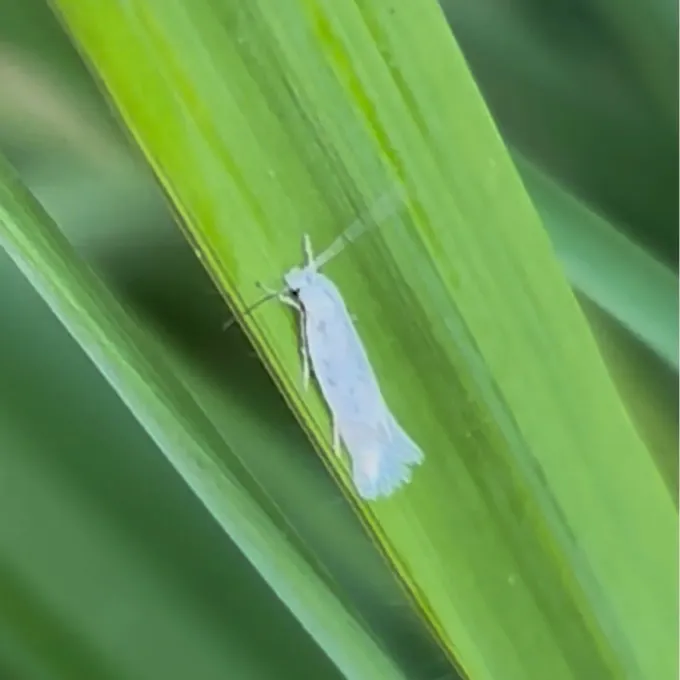
Description
How to identify
The Cereal leaf miner moth (Elachista argentella) is a small moth belonging to the family Elachistidae. The adult has a wingspan of approximately 9–11 mm.
The forewings are distinctively pale, silvery-grey or whitish with some darker markings. The hindwings are narrow and heavily fringed, which is a characteristic feature of this genus.
The larvae are internal feeders, living as miners within the leaf tissue of host plants. They are typically yellowish-white with a small, darker head capsule.
Pupation occurs on the surface of the host plant leaves, often protected by a light, silk-like cocoon that attaches to the leaf blade or stem base.
The species generally completes one generation per year, although climatic variations in specific regions may allow for partial second generations in late summer.
What it damages
The primary hosts of this pest include major cereal crops such as wheat, barley, rye, and oats. It also infests various wild grasses found in field margins.
Larvae consume the mesophyll (parenchyma) tissue inside the leaf, leaving the upper and lower epidermis intact. This feeding behavior results in elongated, translucent mines.
As the larvae grow, the mines expand, often leading to the wilting and browning of the leaves. Severe infestations significantly reduce the plant's photosynthetic capacity.
The damage directly impacts the grain-filling process, leading to lower yields and poor grain quality in heavily infested fields.
Plants weakened by leaf miner damage are also more susceptible to secondary infections, such as fungal pathogens that can enter through the damaged leaf tissues.
When it appears
Adult moths emerge in late spring, typically during May, coinciding with the tillering and stem elongation phases of cereal crop development.
Eggs are laid singly on the leaves of host plants. The hatching larvae immediately bore into the leaf tissue, beginning the mining process that will last for several weeks.
Feeding activity is most intense during the late spring and early summer months when the crops are actively growing and the leaf tissue is nutrient-rich.
Pupation takes place mid-summer. The pupal stage is a crucial period where the insect remains stationary on the plant, making it vulnerable to certain natural enemies.
Seasonal weather conditions, particularly warm and dry springs, can accelerate the development cycle and potentially lead to higher population densities.
Signs of infestation
The most visible sign of infestation is the presence of white or pale grey streaks on the leaves. These mines are initially narrow but become wider as the larva develops.
When held up to the light, the "mine" is clearly visible, often revealing dark frass (larval excrement) deposited inside the leaf cavity.
Heavily infested leaves tend to dry out and wither from the tip downwards, giving the field a scorched appearance in severe cases.
- Pale, translucent longitudinal lines on leaf blades.
- Presence of dried, curled leaf tips in early stages of infestation.
- Small emergence holes on the leaf surface where the adult moth has exited the pupa.
Scouting should focus on field edges and areas with higher weed pressure, where the moth population often establishes itself before spreading into the crop.
Control measures
Effective management requires integrated pest management strategies, starting with the control of grassy weeds that act as alternative hosts.
Deep plowing after harvest is an essential cultural practice to bury infested plant debris and reduce the number of overwintering pupae.
When the economic threshold is reached, systemic insecticides are recommended to target the larvae while they are still feeding within the leaf tissue.
Preservation of natural predators, such as parasitic wasps, is vital as they provide significant biological control by parasitizing the moth larvae.
Crop rotation helps interrupt the life cycle, ensuring that fields are not continuously suitable for the pest population to build up over consecutive years.
Taxonomy
- Latin name
- Elachista argentella
- Order
- Lepidoptera (butterflies)
- Family
- Elachistidae
- EPPO code
- ELCHAR
Discussion
No discussions yet — be the first.