
Perittia
Perittia
Description
How to identify
The genus Perittia belongs to the family Elachistidae, commonly known as the grass leaf-mining moths. These are small moths whose larvae are specialized in mining the tissues of various herbaceous plants.
Adult moths are characterized by their small size and narrow, fringed wings, which are adapted for flight in sheltered habitats. Their morphology is consistent with other members of the Elachistidae family.
The life cycle involves complete metamorphosis. Adult females lay eggs on the leaves of host plants, where the newly hatched larvae begin their mining activity immediately.
As leaf miners, these larvae possess flattened bodies and specialized mandibles that allow them to consume the parenchyma between the upper and lower leaf surfaces.
Identifying the specific species within the genus often requires examination of genitalia due to the high morphological similarity among individuals.
What it damages
Larvae of the Perittia genus primarily feed on the leaves of specific host plants, such as honeysuckle (Lonicera) and other botanical families. The mining activity creates internal tunnels that disrupt the leaf's normal function.
By consuming the internal leaf tissues, the larvae reduce the photosynthetic capacity of the plant. This loss of green matter can significantly stress the host, especially in young plants.
While a single mine might not kill a leaf, a high density of larvae can lead to widespread necrosis, causing the leaves to dry out, curl, or drop prematurely.
The damage caused by these miners creates openings in the leaf surface, making the plant more susceptible to opportunistic secondary infections by fungi and bacteria.
In ornamental or fruit-bearing crops, the presence of these mines is considered a cosmetic and physiological defect that lowers the overall quality and vitality of the plant.
When it appears
The seasonal appearance of Perittia is closely tied to the vegetative growth of its host plants. Activity typically begins in the early spring as temperatures rise.
Overwintering usually occurs as a pupa, protected within a cocoon attached to leaf litter, plant stems, or within the soil surface, awaiting favorable conditions.
Adults emerge in spring to mate and lay eggs, initiating the first generation of larvae that coincide with the flush of new, nutrient-rich leaves.
Depending on the local climate, the life cycle may be univoltine or bivoltine, with the second generation appearing during the warmer mid-summer months.
The timing of the larvae's active feeding phase is critical, as it aligns with the most vulnerable growth stages of the host plants.
Signs of infestation
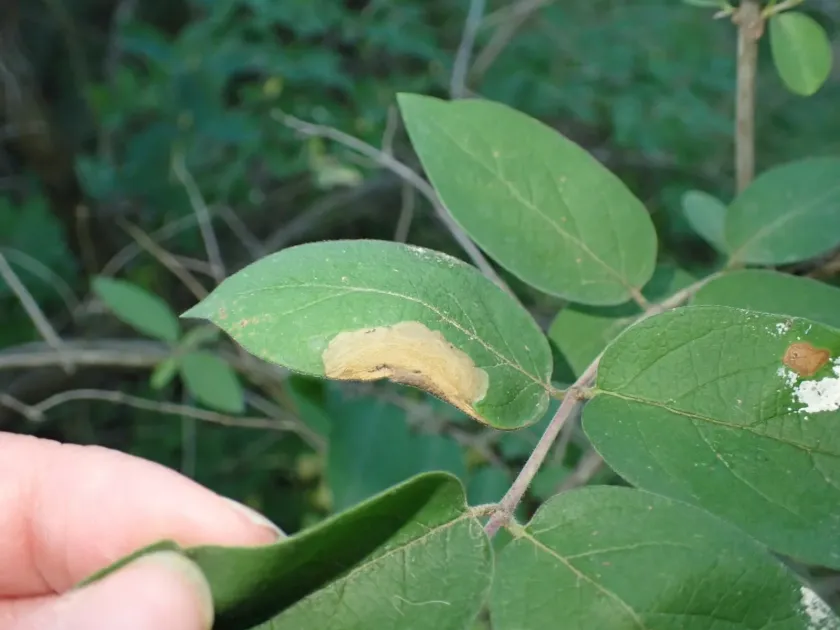
The most distinctive sign of Perittia infestation is the presence of pale, serpentine mines within the leaf blade. These mines are the tracks left by feeding larvae.
Microscopic examination of these mines often reveals linear arrangements of frass (larval excrement), which are specific to the feeding patterns of these leaf-mining moths.
The epidermis over the mine often becomes transparent or papery, eventually turning brown as the internal tissue is completely consumed and the leaf begins to wilt.
Deformation of the leaf, such as curling or folding along the midrib, is common as the leaf loses its structural integrity due to the internal mining activity.
Observers might find small, oval-shaped exit holes in the leaf surface where the mature larvae have emerged to pupate in the surrounding environment.
Control measures
Sanitation is a primary method of control; removing and destroying fallen leaves during autumn eliminates the overwintering pupae and reduces the next year's population.
Maintaining plant vigor through balanced fertilization and adequate watering helps the host plant tolerate minor feeding damage without significant loss of productivity.
If chemical intervention is necessary, systemic insecticides are generally more effective against leaf miners because they are absorbed into the leaf tissue where the larvae feed.
Biological control using parasitoid wasps is often the most sustainable approach, as these natural enemies naturally suppress the moth population levels.
Monitoring the flight of adult moths with sticky traps or pheromone lures can help in timing any necessary interventions to coincide with the susceptible larval stage.
Taxonomy
- Latin name
- Perittia
- Order
- Lepidoptera (butterflies)
- Family
- Elachistidae
- EPPO code
- PIIASP
Discussion
No discussions yet — be the first.