
Peritrechus convivus
Peritrechus convivus
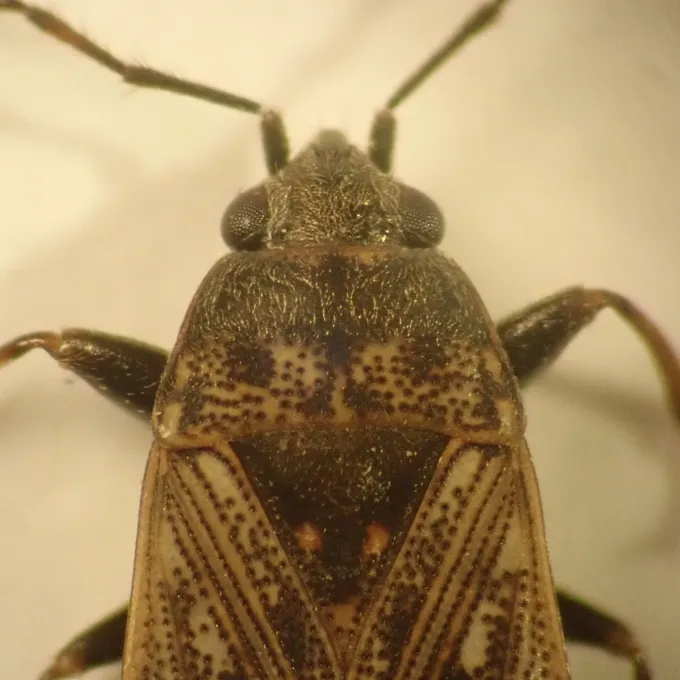
Description
How to identify
Peritrechus convivus is a species of ground bug belonging to the family Rhyparochromidae within the order Hemiptera. These insects are relatively small, typically measuring between 4 and 6 millimeters in length, with a dark, brownish-black color that provides effective camouflage.
The morphology of this insect includes a flattened head tightly attached to the thorax and four-segmented antennae, which are key features for correct taxonomic identification. Their bodies are often covered with short, sparse setae, giving them a slightly textured appearance under magnification.
Larvae resemble the adults in body shape but lack fully developed wings and are usually lighter in color during their early developmental stages. They progress through several instars, gradually darkening and increasing in size as they feed on available vegetation.
These bugs are primarily terrestrial and prefer to stay hidden near the soil surface. They are rarely seen in the open, preferring the shelter provided by plant debris, soil crevices, or the dense base of crop plants during the day.
Their life cycle is highly dependent on environmental conditions, particularly soil moisture and temperature. They are adapted to survive in various habitats, ranging from field edges to dense cereal crop stands, making them resilient pests in agricultural landscapes.
What it damages
Peritrechus convivus is a polyphagous pest, meaning it feeds on a variety of plant species. Its primary targets in agricultural settings are cereal crops such as wheat, barley, and rye, although it can also utilize various grass weeds found on field boundaries.
The damage is caused by both nymphs and adults using their piercing-sucking mouthparts to feed on plant sap. They primarily target the stems and leaves, extracting vital nutrients and fluids necessary for plant growth and development.
Feeding during the tillering and stem elongation stages of cereals is particularly detrimental. The punctured areas of the plant tissue can become discolored and necrotic, leading to stunted growth, reduced tillering capacity, and lowered overall vigor of the crop.
In cases of heavy infestation, fields may exhibit patchy growth and overall plant weakness. While individual damage might seem minor, the cumulative effect of a large population can lead to significant yield reductions and lower grain quality at harvest.
Furthermore, the physical damage to plant tissues acts as a pathway for secondary infections. Fungi and bacteria can easily penetrate the plant through these feeding sites, potentially leading to additional disease complications within the crop stand.
When it appears
The activity of Peritrechus convivus begins in early spring as soon as soil temperatures reach a threshold that triggers emergence from hibernation. Adults typically become active and start colonizing grain fields as soon as spring growth begins.
The mating and oviposition period usually occurs during the late spring and early summer. Females lay their eggs in protected environments, such as the soil or near the base of host plants, to ensure the survival and development of the next generation.
Nymphs are most active during the summer months, undergoing their development while feeding on the growing cereal crops. This coincides with the peak growth phase of the plants, making the crops particularly sensitive to the pressure exerted by the insect population.
By late summer, the new generation of adults is fully developed. They continue to feed, accumulating energy reserves required for the upcoming winter diapause, often moving towards field margins or debris-rich areas as crops mature and are harvested.
As temperatures drop in the autumn, these bugs seek shelter for hibernation. They overwinter in the adult stage, hiding in leaf litter, stubble, or dense perennial vegetation, where they remain dormant until the following spring.
Control measures
Managing Peritrechus convivus effectively requires an integrated approach. Cultural practices are the most sustainable form of control, starting with crop rotation to disrupt the pest's life cycle and reduce its reliance on specific grain crops.
Post-harvest soil management is crucial for destroying potential overwintering sites. Deep plowing helps bury plant debris and stubble, which significantly reduces the survival rate of the population entering the cold season.
Chemical control may be necessary if monitoring reveals population levels that exceed the economic threshold. Applying approved insecticides during the active feeding stages of nymphs and adults can effectively manage the infestation and protect the developing crop.
Monitoring should be conducted regularly throughout the growing season, with a focus on field edges where these bugs tend to congregate. Early detection allows for targeted treatments, which are both more economical and environmentally friendly.
- Implement diverse crop rotation schedules.
- Perform deep fall plowing to destroy habitats.
- Control weeds on field margins and boundaries.
- Use selective insecticides at the right stage of development.
- Maintain optimal crop health through proper fertilization.
Taxonomy
- Latin name
- Peritrechus convivus
- Order
- Hemiptera (bugs, aphids, leafhoppers)
- Family
- Lygaeidae
- EPPO code
- PRCSCO
Discussion
No discussions yet — be the first.