
American cockroach
Periplaneta americana
Description
How to identify
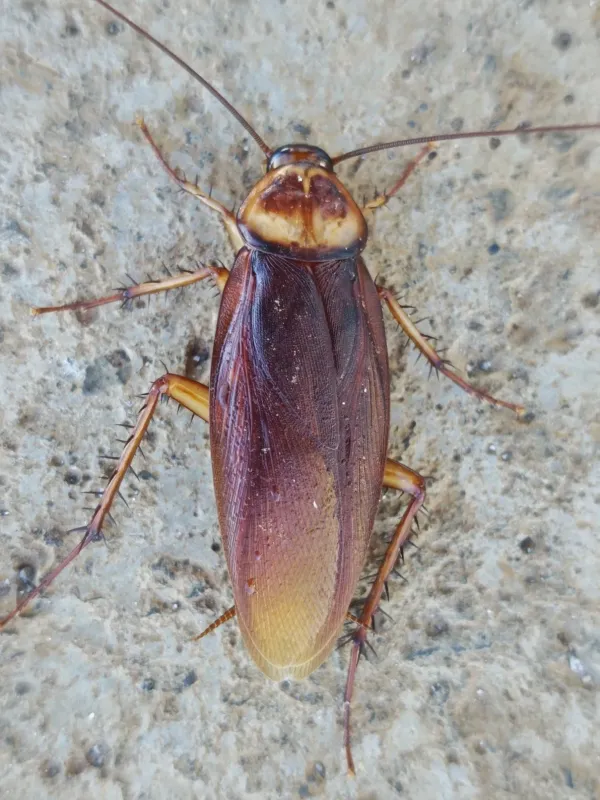
The American cockroach (Periplaneta americana) belongs to the order Blattodea, family Blattidae. It is a large insect, typically measuring 35–45 mm in length, characterized by a reddish-brown color and fully developed wings that allow adults to make short flights.
The life cycle consists of three stages: egg, nymph, and adult. Females deposit eggs in protective cases called oothecae, each containing approximately 16 eggs. Development thrives in temperatures ranging from +25°C to +30°C.
These insects prefer environments with high humidity and warmth. In agricultural settings, they are commonly found in greenhouses, nurseries, and storage facilities, hiding in structural crevices, heating systems, and organic waste piles.
Nymphs resemble adults but are smaller and wingless. Throughout their development, they undergo 10 to 13 molts before reaching maturity, gradually increasing in size and darkening in color.
They are primarily nocturnal, which makes early detection difficult. During the day, they remain in dark, secluded, and moisture-rich areas, emerging only when it is quiet or dark.
What it damages
In greenhouse environments, this pest acts as a generalist, feeding on a wide range of plant species. They pose a significant threat to seedlings, often chewing through tender leaves and stems.
The pest frequently feeds on fruits such as cucumbers and tomatoes, creating deep cavities that render the produce unmarketable and susceptible to rotting from secondary pathogens.
Beyond direct feeding, these cockroaches serve as mechanical vectors for various phytopathogens, including harmful bacteria and fungal spores, spreading infections throughout the greenhouse.
Storage facilities are also highly vulnerable. The presence of these insects leads to the contamination of seeds and stored grains with their droppings and shed skins, causing severe economic losses.
In container-grown plants, where the substrate contains organic matter, high populations of cockroaches may occasionally feed on fine root hairs, potentially weakening the plant's uptake of water and nutrients.
Control measures
Sanitation is the cornerstone of control. Regular removal of plant debris, consistent cleaning of greenhouse floors, and the elimination of standing water are essential to reduce their habitat.
The use of insecticidal baits, particularly those containing fipronil or hydramethylnon, is highly effective. Baits should be placed strategically in harborage areas, ensuring they are protected from irrigation water.
Sticky traps should be deployed to monitor population levels and track the effectiveness of control measures. These traps help identify "hot spots" where more intensive treatment is required.
During periods when no plants are present, space sprays or cold fogging with broad-spectrum insecticides can be utilized to reach deeply hidden populations and reduce overall density.
Physical exclusion remains a vital strategy. Installing fine-mesh screens on ventilation openings and sealing structural cracks in the greenhouse foundation effectively prevents the migration of individuals from outside.
Taxonomy
- Latin name
- Periplaneta americana
- Family
- Blattidae
- EPPO code
- PERIAM
Discussion
No discussions yet — be the first.