
Harlequin cockroach
Neostylopyga rhombifolia
Description
How to identify
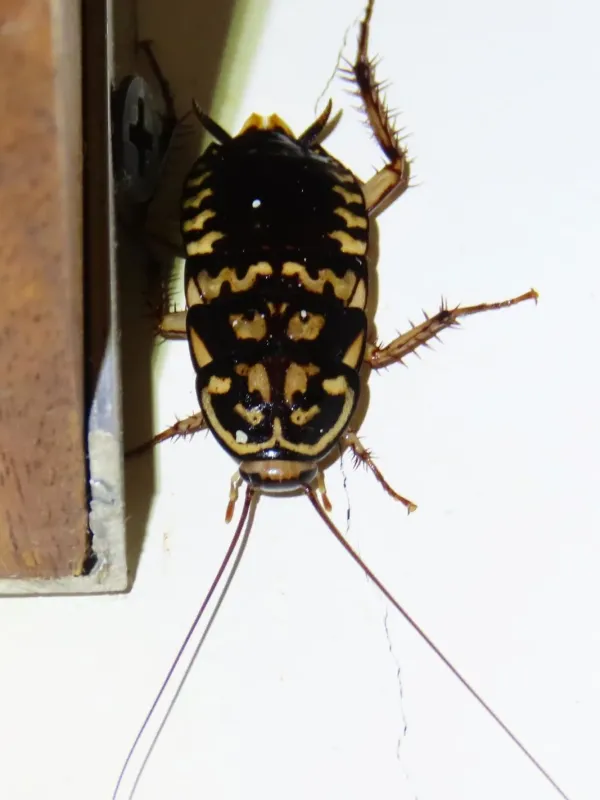
The Harlequin cockroach (Neostylopyga rhombifolia) belongs to the order Blattodea and the family Blattidae. Adults are easily identified by their shiny, dark brown or black bodies adorned with a distinctive bright yellow or orange border around the pronotum and abdomen.
Unlike many household species, these cockroaches are wingless as adults, restricting their movement to terrestrial crawling. Adults typically measure between 20 and 30 millimeters in length, with females being notably larger than males.
Their life cycle includes egg, nymph, and adult stages. Eggs are encased in a protective ootheca (egg capsule). Nymphs resemble miniature versions of the adults but lack wings and sexual maturity, progressing through several molts before becoming full-grown.
They thrive in warm, humid environments, making them common inhabitants of tropical and subtropical regions, as well as greenhouses and indoor botanical settings in temperate climates.
Being opportunistic feeders, they are often found hiding in leaf litter, mulch, or moist soil, which places them in direct proximity to young or sensitive plant roots and stems.
What it damages
This species is a generalist feeder that can cause significant damage to various plants in humid conditions. It is particularly destructive to greenhouse vegetable seedlings, ornamental potted plants, and tender plant shoots.
The insects feed on leaves and stems, leaving behind ragged holes and damaged foliage. Under high population densities, they can rapidly strip young seedlings, leading to stunted growth or total plant mortality.
Beyond physical consumption of plant material, the Harlequin cockroach acts as a vector for various plant pathogens. Fungal spores and bacteria can be transmitted to healthy plants as the cockroaches crawl across surfaces.
Root systems and the root crown are also susceptible, especially when the insects dwell within the potting substrate or accumulate under debris inside growing containers.
In commercial greenhouse operations, their presence can lead to aesthetic damage in ornamental crops and significant production losses, requiring immediate intervention to maintain plant health and marketability.
Signs of infestation
The first sign of an infestation is often the presence of frass (excrement) on the soil surface or plant leaves, appearing as small, dark, granular deposits. Their nocturnal activity often leads to sightings in or near plant containers after dark.
Feeding damage is characterized by irregular notches or holes in the leaf blades, often appearing as if sections have been chewed away from the edges. This pattern differs from the specialized damage caused by sucking insects.
Locating oothecae is a definitive sign of an established breeding population. These capsules are often tucked away in hidden corners, underneath plant pots, or within cracks in greenhouse infrastructure.
Infestations are frequently accompanied by a distinct, musty odor produced by the cockroaches, which serves as a secondary indicator of high population levels within an enclosed space.
Frequent daytime sightings of nymphs or adults crawling on the substrate usually indicate a severe overpopulation issue, suggesting that their preferred shelters are already overcrowded and resources are depleted.
Control measures
Effective management of the Harlequin cockroach requires an integrated pest management (IPM) approach. The primary strategy involves maintaining strict sanitation by removing decaying organic matter, leaf litter, and unnecessary debris from the growing area.
Managing humidity is critical; reducing moisture levels in the growing environment makes the habitat less suitable for egg deposition and nymphal survival, effectively slowing down the rate of infestation.
The use of insecticidal baits containing stomach poisons is highly effective. Since these cockroaches are nocturnal foragers, they readily consume treated baits, which significantly reduces the population without widespread chemical spraying.
Biological control options, including the use of entomopathogenic fungi, can be employed as a sustainable method to manage populations in greenhouses where chemical use must be restricted.
In severe infestations, the application of targeted insecticides may be necessary. It is crucial to choose products compatible with the crops being grown and to follow safety guidelines to prevent phytotoxicity and ensure crop safety.
Taxonomy
- Latin name
- Neostylopyga rhombifolia
- Family
- Blattidae
- EPPO code
- NESYRH
Discussion
No discussions yet — be the first.