
Grey partridge
Perdix perdix
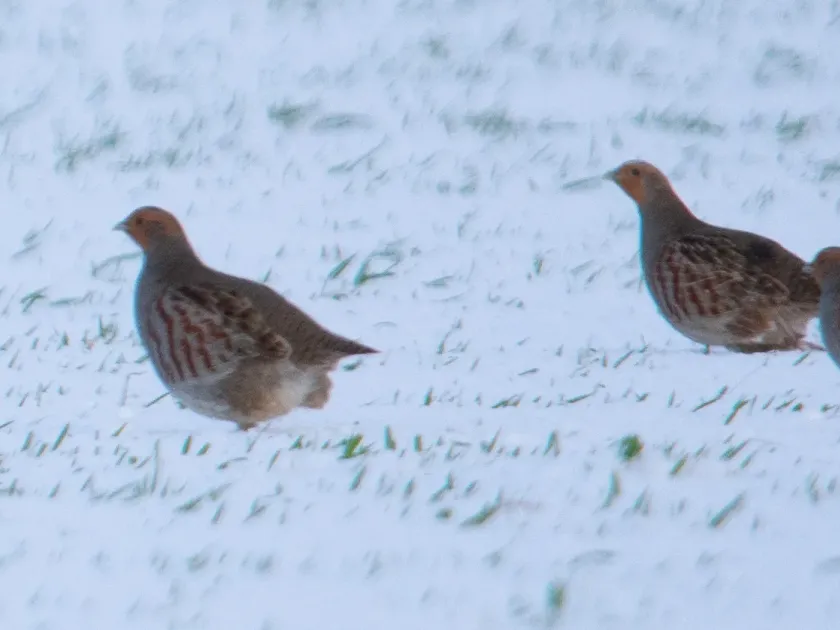
Description
How to identify
The Grey partridge (Perdix perdix) belongs to the order Galliformes and the family Phasianidae. It is a medium-sized bird with a round body, short tail, and grey-brown plumage that provides excellent camouflage in agricultural landscapes.
These birds primarily lead a terrestrial life. During the breeding season, they form pairs, while for the rest of the year, they stay in groups called coveys, which allows them to efficiently forage across fields.
The biology of this species is characterized by high adaptability to human-modified habitats. They nest directly on the ground in shallow depressions lined with grass, making their nests susceptible to farming operations.
Their life cycle includes one brood per year. Chicks quickly begin to forage for themselves, shifting from an insect-based diet to plant matter, which increases the impact on crops as the season progresses.
The population of the Grey partridge fluctuates based on spring weather conditions and winter food availability, but in favorable years, their density per hectare can increase significantly.
What it damages
The primary damage caused by the Grey partridge involves cereal crops such as wheat, barley, oats, and millet. Flocks are particularly harmful during the milky and dough stages of grain ripening when they consume ears.
They also cause significant damage to sunflower crops by pecking seeds out of the heads and can harm vegetable sprouts in the spring by feeding on young, succulent seedlings.
Beyond direct consumption, partridges cause mechanical damage by trampling plants in areas where they congregate, leading to crop lodging and localized yield losses in fields.
Damage occurs not only during the ripening phase but also early in the season when birds dig up recently sown seeds from the soil, reducing plant stand density and requiring re-seeding.
The severity of damage is correlated with the proximity of the field to natural habitats such as hedgerows, bushes, and abandoned lands that provide shelter for the birds during the day.
Signs of infestation
Signs of partridge presence include trampled areas in the field where stalks are broken or pushed down, creating irregular gaps within the crop canopy.
Evidence of eaten grain heads with discarded glumes (husks) scattered on the ground indicates that a flock has been actively foraging in that specific part of the field.
Small depressions in the soil, known as dust baths, where birds clean their feathers, are clear indicators of a resident flock in the vicinity.
Droppings left in fields, along with distinct tracks in soft soil similar to small domestic chicken footprints, are reliable markers of recent activity.
A sudden, noisy take-off accompanied by the loud flapping of wings when birds are disturbed by field machinery or human approach is a common behavioral signal of their presence.
Control measures
Visual deterrents, such as raptor decoys, reflective tapes, and brightly colored streamers, can be effective in discouraging birds from entering specific field sections.
Acoustic deterrents that play recordings of predator calls or gunshot sounds are used to reduce the pressure on crops during the most critical stages of grain development.
Cultural control methods involve creating buffer strips, harvesting crops promptly to minimize exposure time, and maintaining clean fields to avoid attracting birds with weed seeds.
While netting can protect small plots, it is often impractical for large-scale farming, where integrated management using deterrents and sound field preparation is preferred.
Controlling weeds is essential, as the abundance of wild seeds is a primary attraction for Grey partridges; removing this food source often forces flocks to move to other foraging grounds.
Taxonomy
- Latin name
- Perdix perdix
- Family
- Phasianidae
- EPPO code
- PERDPE
Discussion
No discussions yet — be the first.