
Grey partridge
Perdix
Description
How to identify
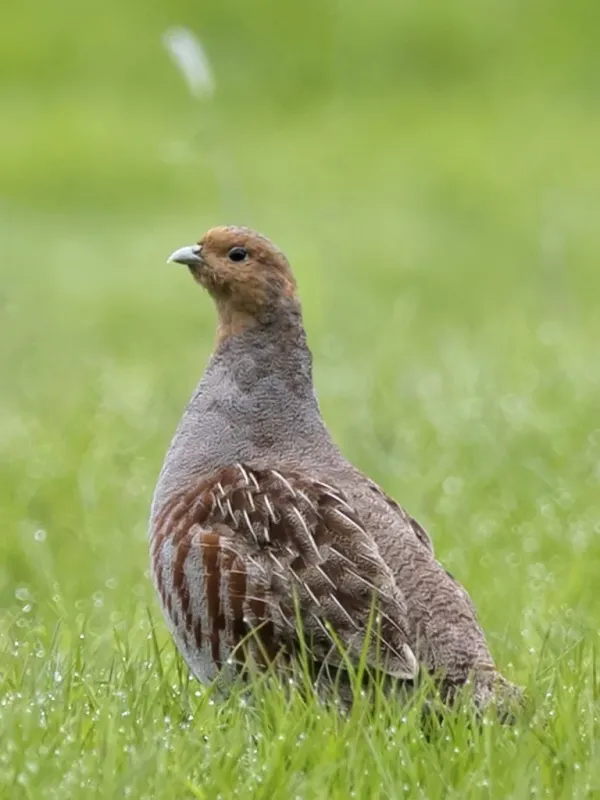
The grey partridge (Perdix perdix) belongs to the order Galliformes and the family Phasianidae. It is a ground-dwelling bird of medium size with a stocky build, short tail, and rounded wings. The plumage is grey-brown with cross-patterns, providing excellent camouflage among stubble and crops.
Adult birds weigh between 300 and 500 grams, featuring a characteristic orange-brown throat patch and a dark brown horseshoe-shaped mark on the belly of the males. These birds are primarily sedentary, living in coveys, which makes them a constant factor for agricultural land.
The species is biologically adapted to open spaces, fields, and steppe zones. Their high reproductive rate allows populations to recover quickly, and their social grouping behavior increases the efficiency of foraging on arable land.
The life cycle of the grey partridge is closely tied to agricultural landscapes, where they find both shelter in hedgerows and abundant food sources. While they consume insects during spring and summer, their impact on grain crops is often classified as negative due to active feeding on young plants.
Behavioral traits include shyness and caution, which is why their presence in fields is often discovered only through visible damage to crops during early developmental stages.
What it damages
The grey partridge can damage a wide spectrum of field crops, especially during seed germination and seedling emergence. The primary damage is inflicted on winter and spring cereals, such as wheat, rye, barley, and oats.
Birds also actively feed on legumes, including peas and vetch, as well as vegetable crops and sunflowers. Their diet includes both young sprouts and maturing seeds, which reduces plant density and overall yield.
Significant damage occurs during the milk stage of grain development, when coveys of partridges can peck away a large portion of the harvest from ears or seed heads. This causes not only direct loss of production but also the risk of stem lodging as birds reach for the grain.
Beyond consuming plant mass, partridges damage seedlings by pulling them from the soil, leading to bare patches in fields. Fields bordering nesting sites, such as abandoned areas, hedgerows, or shrubbery, are particularly vulnerable.
The intensity of damage directly depends on the covey size and the availability of alternative food resources in the vicinity. During dry years, when natural food is scarce, the pressure of partridges on cultivated crops increases significantly.
When it appears
Partridge activity as a pest is spread throughout the growing season, but critical phases occur in spring and late summer. In spring, birds feed en masse on tender cereal sprouts immediately after they appear above the soil surface.
During the summer, as grain matures, there is a peak in the consumption of plant reproductive organs. Adults teach their young to forage in fields, leading to larger coveys and increased damage volume as harvest time approaches.
In winter, if snow cover is present, partridges often gather near haystacks or winter cereal fields, attempting to extract accessible green mass or remaining grain. This period is critical for the survival of winter crops.
The cyclical appearance of this pest often correlates with weather conditions: mild winters favor high population survival, which inevitably leads to increased pressure on crops at the beginning of the following season.
The autumn period is characterized by birds shifting to post-harvest residues, but if unharvested patches remain, they continue to concentrate in fields, feeding on residues and potentially damaging newly sown winter crops.
Signs of infestation
Visual signs of partridge activity include specific "bald patches" in a field where seedlings are missing over several square meters. Such areas often have ragged edges, indicating the plants were pecked or pulled out.
The presence of bird droppings in damaged areas is direct evidence of the culprit. Grey partridge droppings are firm, cylindrical, and often contain particles of undigested plant fiber and seeds.
Finding a large number of tracks on moist soil in rows or field edges confirms active movement by a covey. A partridge track has three distinct forward-facing toes and one shorter toe positioned higher up.
A characteristic sign is scattered ear residues and grain husks on the soil, suggesting the covey has been feeding on the maturing harvest. Plants often appear trampled, especially in areas used for roosting or daytime resting.
The presence of birds can be detected by characteristic calling sounds or the sudden, noisy flight of a group when approached by machinery or humans. They prefer to take flight from a low start, flying a short distance above the ground.
Control measures
Control measures for the grey partridge are primarily preventative and deterrent in nature, as the species is often protected or limited by hunting legislation. An important method is the use of acoustic deterrents that mimic the calls of raptors.
An effective protection method is the installation of visual deterrents: predator decoys (hawks, falcons), bright ribbons, reflective elements, or moving figures that disturb the birds and force them to change their foraging grounds.
Agronomic methods include proper seed placement at an optimal depth, which makes it harder for birds to peck at the seeds. Using seed treatments with repellent properties can also reduce the attractiveness of seedlings to birds.
Organizing field protection with dogs or patrolling during critical growth phases helps reduce covey concentration in fields. Maintaining clean field edges by removing weeds where birds can hide is also essential.
A complex approach combining deterrence and the creation of unfavorable nesting conditions near crop areas allows for minimizing yield losses without harming the population of these birds.
Taxonomy
- Latin name
- Perdix
- Family
- Phasianidae
- EPPO code
- PERDSP
Discussion
No discussions yet — be the first.