
Pedostrangalia revestita
Pedostrangalia revestita
Description
How to identify
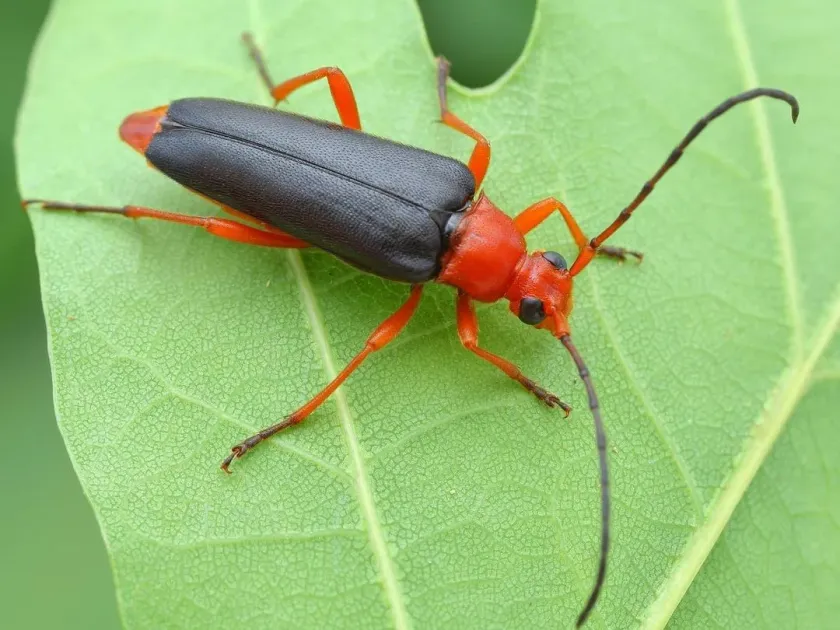
Pedostrangalia revestita is a member of the longhorn beetle family (Cerambycidae). The adult beetle is typically 10 to 16 mm in length and features an elongated, slender body.
The most distinctive feature is the dense, golden-brown or reddish hair covering the elytra, which masks the underlying black cuticle. The head and pronotum are dark, often appearing black.
The antennae are thread-like and moderately long, characteristic of the Lepturinae subfamily. The legs are well-developed, allowing the beetle to move efficiently across bark surfaces and flowers.
The larvae are white, cylindrical, and possess robust mandibles designed for boring through wood. They are rarely seen, as they spend their entire development period inside the host tree.
Adults are often encountered in sunny areas where they feed on pollen from various flowers, acting as pollinators, while their offspring serve as wood-inhabiting saproxylic larvae.
What it damages
The larvae of this beetle primarily attack broad-leaved trees, including species like oak, chestnut, and beech. In some instances, they may infest old or stressed fruit trees in traditional orchards.
Larval feeding activity creates winding galleries within the sapwood and cambium layer, which disrupts the transport of water and nutrients, eventually leading to branch dieback.
Severe infestations weaken the structural integrity of the tree, creating pathways for secondary pathogens such as wood-decaying fungi and bacteria to enter the host.
While an individual tree might survive minor infestations, high populations of the beetle can lead to the widespread decline of woodlots and old-growth trees.
In the timber industry, the presence of these beetles degrades the quality of the wood, making it unsuitable for high-value uses due to the tunnel damage within the logs.
When it appears
Adult beetles are typically active during the summer months, specifically June and July, which is the optimal period for mating and egg deposition.
During the day, the adults are quite mobile and visit flowers to feed, while the females actively seek out suitable host trees with cracked or damaged bark for oviposition.
The life cycle of Pedostrangalia revestita is multi-year, often taking two to three years for the larvae to fully develop into adults depending on the local climate.
Pupation occurs inside the wood during the spring. After metamorphosis, the adult beetle chews a clean, round exit hole to emerge from the wood surface.
Temperature plays a crucial role in the development rate, with warmer summers potentially accelerating the life cycle and increasing the survival rate of the larvae.
Signs of infestation
The most visible sign of infestation is the presence of small, circular exit holes on the surface of the tree bark, which are created by the emerging adults.
Frass, which is a mixture of wood dust and excrement, may be found accumulating in bark crevices or at the base of the tree, indicating active boring by larvae.
Canopy thinning, yellowing of leaves, and the progressive death of individual limbs are strong indicators of significant vascular system damage caused by larval tunneling.
Soft or loose bark patches can often be peeled away to reveal the winding galleries filled with sawdust, confirming the presence of longhorn beetle larvae.
Increased woodpecker activity on specific trees can also be an indirect sign, as birds often locate and extract large wood-boring larvae from their galleries.
Control measures
The primary control strategy is sanitation, which involves the prompt removal and destruction of heavily infested, dying, or wind-fallen trees to reduce beetle populations.
Maintaining tree vigor through proper irrigation, fertilization, and careful pruning helps trees resist colonization by the females searching for suitable egg-laying sites.
Promptly sealing wounds and applying protective coatings to damaged bark can help prevent the beetles from accessing the deeper layers of the wood.
In some commercial settings, trap trees can be used to attract adult beetles; these trees are then removed and destroyed before the new generation of adults emerges.
While chemical control is generally impractical for deep-seated larval populations, systemic insecticides may be used as a preventative measure in highly valuable ornamental trees.
Taxonomy
- Latin name
- Pedostrangalia revestita
- Order
- Coleoptera (beetles)
- Family
- Cerambycidae
- EPPO code
- STRLRE
Discussion
No discussions yet — be the first.