
Pauropsylla
Pauropsylla
Description
How to identify
Pauropsylla is a genus of jumping plant lice belonging to the family Psyllidae, order Hemiptera. These insects are known for their specific association with host plants and the formation of characteristic galls.
Adult insects have wings and strong hind legs adapted for jumping. They are typically small, with body shapes and colors that allow them to blend into the foliage of their host plants seamlessly.
The nymphs are the stage responsible for the most significant damage. They are often flattened and produce protective waxy secretions that cover their bodies while they feed on the plant tissues.
The taxonomic classification of this genus includes several species, many of which are host-specific, meaning they only target certain families of plants, particularly in tropical and subtropical regions.
Understanding their life cycle is crucial for effective control, as the eggs are laid on developing leaves, and the nymphs settle in place to initiate gall development almost immediately after hatching.
What it damages
Pauropsylla species primarily attack a range of ornamental and woody plants, with members of the Moraceae family, such as Ficus species, being common hosts in many parts of the world.
The pest feeds by inserting its stylets into the plant tissue, extracting nutrients, and injecting saliva that triggers the host to form galls, which serve as protection and a food source for the nymphs.
Heavy infestations can cause significant stunting of young shoots, leading to irregular growth patterns and a loss of overall aesthetic value for landscape and nursery plants.
The loss of nutrients from the sap results in yellowing, necrosis, and premature leaf drop, which significantly weakens the host plant over time if left unmanaged.
Additionally, the feeding process creates entry points for secondary pathogens, such as fungi or bacteria, which can exacerbate the health decline of the affected plant.
Signs of infestation
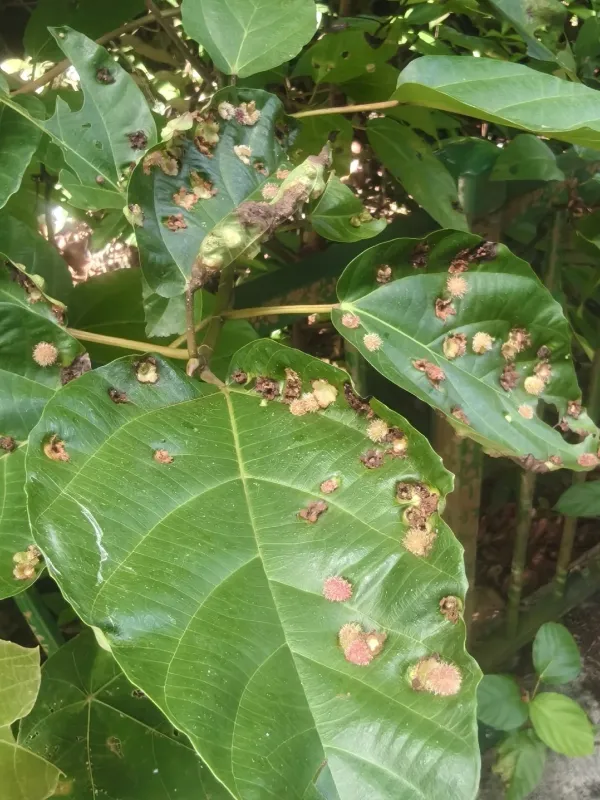
The most distinctive symptom of a Pauropsylla infestation is the appearance of leaf galls — raised, tumor-like swellings or pustules on the leaf surface where nymphs are developing.
Affected foliage often exhibits curling, crinkling, or chlorosis, as the plant's resources are diverted to sustain the insects within the galls instead of supporting normal leaf development.
Honeydew, a sticky substance excreted by the insects, is often present on the lower leaves, creating a suitable environment for the growth of sooty mold, which appears as a black coating.
Close inspection of the underside of the leaves or the interior of the galls will reveal the nymphs, which may appear as small, stationary, wax-covered discs.
Terminal growth may cease entirely, and the accumulation of damaged leaves can result in a "witches' broom" effect, characterized by a dense cluster of stunted, deformed shoots.
Control measures
Integrated pest management starts with the physical removal of heavily infested leaves and branches to reduce the initial population of nymphs before they reach adulthood.
Systemic insecticides, particularly those containing neonicotinoids or similar systemic agents, are highly effective because they are absorbed by the plant and kill the insects inside the galls.
Applications should be timed to coincide with the period of egg hatching and the emergence of first-instar nymphs to prevent the formation of new, protective galls.
- Maintain plant health with balanced irrigation and nutrients to promote vigor.
- Use horticultural oils to smother nymphs on the leaf surface early in the season.
- Conserve natural enemies such as ladybeetles, lacewings, and parasitic wasps.
Regular monitoring of nursery stock is essential to detect early signs of infestation and prevent the spread of the pest to healthy plants within the collection.
Taxonomy
- Latin name
- Pauropsylla
- Order
- Hemiptera (bugs, aphids, leafhoppers)
- Family
- Triozidae
- EPPO code
- PAURSP
Discussion
No discussions yet — be the first.