
Apollo
Parnassius apollo
Description
How to identify
The Apollo (Parnassius apollo) belongs to the order Lepidoptera and the family Papilionidae. It is a large butterfly with a wingspan of up to 90 mm.
The upper wings are white with distinct black spots, while the hindwings feature large red or orange "eyespots" surrounded by black rings.
The body of the butterfly is densely covered with hair, which assists in survival within the cool mountain climates that this species typically inhabits.
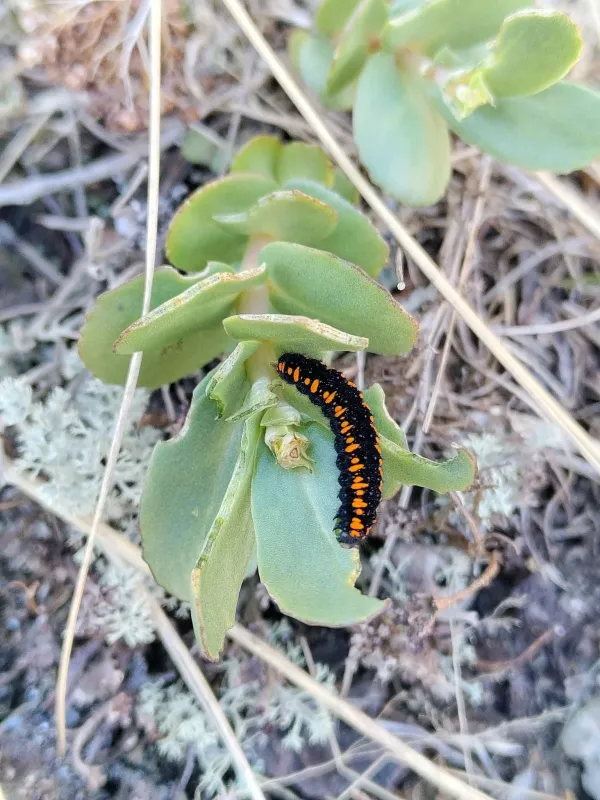
The Apollo caterpillar is velvety black in color with rows of bright red spots along the sides of its body, covered in sparse hairs.
It is important to note that this species is rare and is legally protected in many countries, thus it is not considered an agricultural pest.
What it damages
In agronomic terms, the Apollo is not considered a crop pest, as its dietary specialization is extremely narrow and specific.
The caterpillars feed exclusively on plants of the family Crassulaceae, primarily species of the genera Sedum and Sempervivum found in rocky habitats.
While they may occasionally feed on adjacent vegetation in their natural environment, damage to commercial crops or orchards is virtually non-existent.
Given the extremely low population density of this species, the impact on wild host plants does not threaten the local ecosystem.
The economic significance of the species is negligible, so no pest control strategies are developed for it within the agricultural sector.
When it appears
The life cycle of the Apollo butterfly shows a strong seasonal dependency typical of high-altitude and foothill regions.
Adult butterflies appear in summer, with the peak flight period usually occurring in July and August when stable, warm weather sets in.
The caterpillar stage occurs in spring when host plants actively regrow, providing the larvae with sufficient food.
The overwintering stage is the egg, which remains in the soil or under plant debris until favorable spring temperatures arrive.
Only one generation develops per year, so population levels remain low even in the absence of human interference.
Signs of infestation
A sign of the species' presence can be the appearance of velvety black caterpillars with red spots on patches of sedum plants.
Damage to host plants manifests as the jagged consumption of leaf edges, which is typical for the large caterpillars of the Papilionidae family.
The presence of these butterflies on a site indicates a clean ecosystem, as the species is highly sensitive to chemical pollution.
Finding signs of their activity in agricultural fields is almost impossible, as the species avoids heavily managed landscapes.
Visual identification is challenging because the caterpillars are primarily active during the day but hide quickly when threatened.
Control measures
Specialized control measures for the Apollo butterfly are neither required nor permitted by law, as the species is strictly protected.
The use of insecticides in areas inhabited by this butterfly is strictly prohibited, as it leads to the loss of rare entomofauna.
In the unlikely event that these butterflies fly onto agricultural property, agronomists should not take any action to eliminate them.
Maintaining natural biodiversity is a primary goal, and the presence of rare species like the Apollo is a key indicator of environmental health.
Any interference with the life cycle of this insect contradicts the principles of sustainable agriculture and environmental protection laws.
Taxonomy
- Latin name
- Parnassius apollo
- Order
- Lepidoptera (butterflies)
- Family
- Papilionidae
- EPPO code
- PRNSAP
Discussion
No discussions yet — be the first.