
Paratrichodorus renifer
Paratrichodorus renifer
Description
How to identify
Paratrichodorus renifer belongs to the order Dorylaimida and the family Trichodoridae. These are microscopic, free-living soil nematodes commonly referred to as "stubby root nematodes" in agricultural contexts.
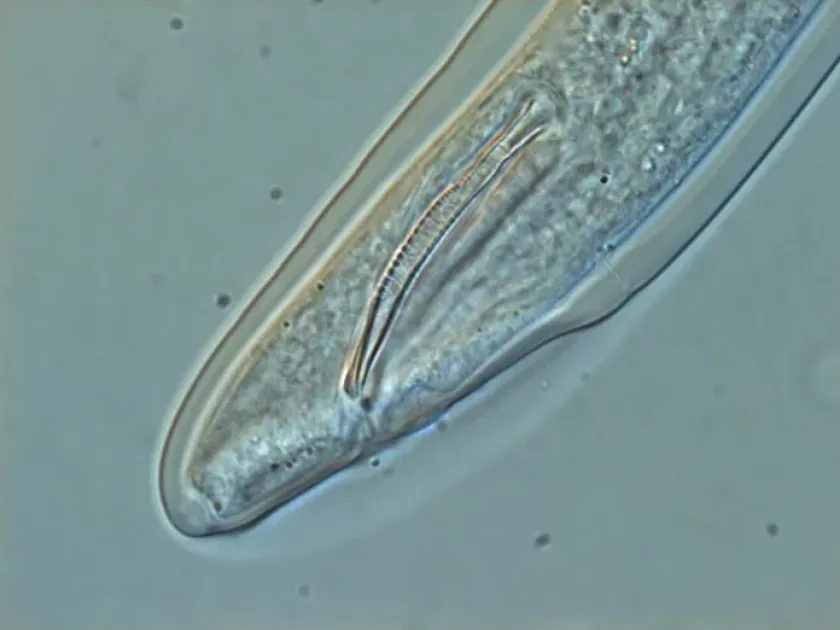
They possess a specialized feeding apparatus known as an onchiostyle, which is a curved, hollow tooth used to puncture plant cell walls. This morphology is distinct for the family and is used for precise classification.
Detection in the field is impossible with the naked eye. Diagnosis requires extraction from soil samples followed by microscopic examination by trained nematologists using specific staining techniques.
These organisms thrive in well-aerated, sandy, or light-textured soils. Their distribution and population density are heavily influenced by soil moisture levels and the availability of suitable host plant roots.
The life cycle encompasses eggs, four juvenile stages, and adults. All life stages take place within the soil, where they exhibit continuous activity during the vegetation period of host plants.
What it damages
Paratrichodorus renifer is a polyphagous pest, meaning it attacks a wide variety of crops including potatoes, vegetables, sugar beets, and various ornamental plants.
The primary damage results from feeding on root tips, which inhibits elongation and causes the roots to become stunted, thickened, and stubby. This severely reduces the plant's nutrient and water uptake efficiency.
Crucially, these nematodes are vectors of tobacco rattle virus (TRV) and other tobraviruses. The viral damage often leads to more significant economic losses than the physical feeding itself.
Affected plants exhibit symptoms like leaf yellowing, stunting, and overall lack of vigor. In severe cases, large patches of the crop may show reduced growth, resulting in significant yield loss.
Marketable quality is also compromised. For tuber and root crops, feeding damage and secondary infections often result in distorted shapes and surface lesions, reducing the crop's commercial value.
When it appears
Nematode activity begins in early spring when soil temperatures increase, stimulating the organisms to move toward the rhizosphere of newly developing host roots.
The peak period of damage coincides with the most intensive phase of root growth. Soil moisture acts as a critical factor; moderate to high moisture levels favor their movement and population expansion.
During dry summer months, activity levels may decrease. However, the nematodes are resilient and can persist in deeper, moisture-retaining soil layers until conditions become favorable again.
As soil temperatures drop in the autumn, the nematodes slow their metabolic activity and transition into a survival mode, overwintering as juveniles or adults in the soil profile.
In greenhouses and other controlled environments, Paratrichodorus renifer can remain active year-round, posing a constant threat to nursery stocks and high-value vegetable crops.
Signs of infestation
The first indicator of infestation is usually patchy development within a field. Areas of stunted, chlorotic plants often appear even when irrigation and fertilization are managed optimally.
Direct examination of roots often reveals brown, necrotic lesions on the tips. In severe infections, the root system appears abnormally short, stubby, and lacks fine, healthy root hairs.
Symptoms of virus infection, such as mosaic patterns, ring spots on leaves, or necrosis, serve as significant clues that nematodes may be present and actively transmitting plant viruses.
The expansion of stunted areas in the field over time follows the migration path of the nematode colonies, often showing a slow, progressive increase in affected acreage.
Confirmation must be sought through formal nematode diagnostic services that use soil sampling and root analysis to count the population and identify the species present.
Control measures
Crop rotation is the most essential cultural control practice. Alternating host crops with non-host species disrupts the nematode life cycle and significantly lowers soil populations.
Sanitation practices are critical, including the thorough removal of weeds and crop debris, which serve as reservoirs for both the nematodes and the viruses they carry during off-seasons.
Chemical control involving soil fumigants or nematicides is an option for high-value crops with heavy infestation. These must be applied according to strict local regulations and professional guidelines.
For protected cultivation in greenhouses, steam sterilization of the soil or growing media is highly effective, providing a clean start for the new crop cycle without synthetic chemicals.
Biological approaches, such as planting specific cover crops like certain mustard varieties, can help reduce nematode populations via bio-fumigation effects when these plants are incorporated into the soil.
Taxonomy
- Latin name
- Paratrichodorus renifer
- Order
- Nematodes
- Family
- Trichodoridae
- EPPO code
- PATRRE
Discussion
No discussions yet — be the first.