
Paratrichodorus anemones
Paratrichodorus anemones
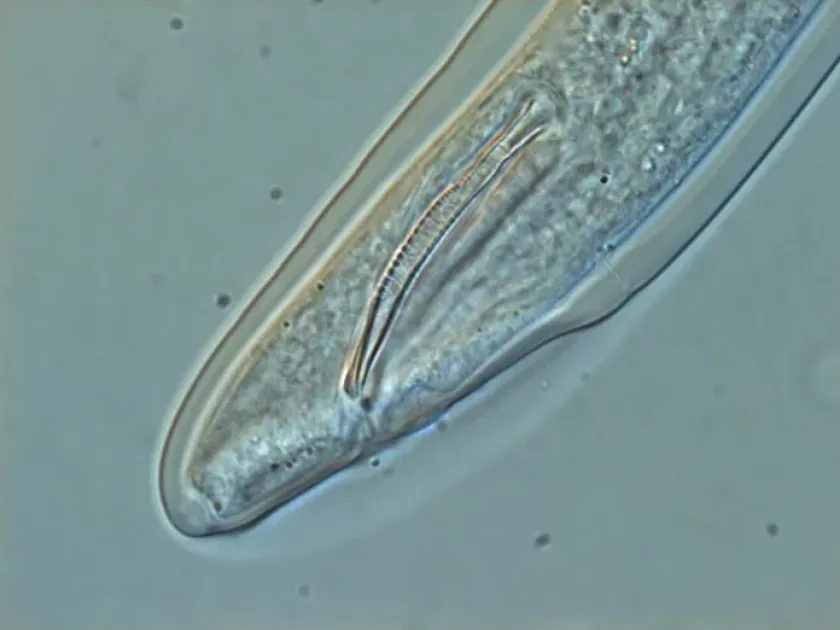
Description
How to identify
Paratrichodorus anemones is a microscopic ectoparasitic nematode belonging to the family Trichodoridae. These nematodes are known as "stubby root" nematodes due to the characteristic damage they inflict upon the root systems of their hosts.
Identification of this species in the field is impossible without professional assistance. Diagnosis relies on soil and root sampling followed by extraction techniques in a laboratory to identify the presence of these organisms within the rhizosphere.
These nematodes thrive in light, sandy, or coarse-textured soils. Their morphology allows them to navigate through large soil pores with ease, seeking out the root tips of developing plants to feed on the epidermal cells.
The life cycle involves several larval stages, all of which are capable of feeding. Reproduction is relatively rapid under warm and moist soil conditions, allowing populations to establish quickly in favorable environments.
A critical aspect of their biology is their ability to act as vectors for soil-borne plant viruses, specifically the Tobacco Rattle Virus (TRV), which causes significant economic losses in various horticultural and ornamental crops.
What it damages
The host range of Paratrichodorus anemones is broad, affecting a variety of agricultural and horticultural crops. Major targets include potatoes, sugar beets, lettuce, and numerous bulbous ornamental flowers like anemones and tulips.
Damage occurs when the nematode uses its onchiostyle to puncture root cells. The feeding activity kills or damages the meristematic tissue at the root tips, causing them to cease elongation and branch excessively, resulting in a stunted, "stubby" root system.
Due to the impaired root system, plants suffer from nutrient and water deficiencies. This manifests as yellowing (chlorosis), wilting during the hottest parts of the day, and overall stunted growth that limits the plant's yield potential.
The feeding sites created by the nematodes provide pathways for secondary infection by bacteria and fungi, which can lead to localized root rot, further complicating the plant's health and recovery.
In cases where viral transmission occurs, plants may show symptoms such as necrosis, leaf mottling, and ringspot patterns, which often render the produce unmarketable and the plant physiologically non-viable.
When it appears
The activity of these nematodes is largely governed by soil temperature and moisture levels. They are most active during the growing season when temperatures range between 15°C and 25°C.
During the spring, as temperatures rise, the nematodes become highly active, moving toward the emerging roots of seedlings. Early-season damage is particularly detrimental, as it affects the plant's establishment phase.
Summer conditions can be stressful for the nematode population if the soil dries out significantly. However, irrigation practices often maintain the soil moisture levels necessary for their survival and continued feeding throughout the season.
As autumn approaches, the nematodes move deeper into the soil profile or congregate near the roots of perennial plants to overwinter. They are relatively hardy and can survive in the soil even after the host crop has been harvested.
The seasonal population dynamics are cyclical, heavily influenced by the presence of susceptible host crops and the timing of agricultural interventions that affect soil conditions.
Control measures
Managing Paratrichodorus anemones requires an integrated strategy, as no single method is entirely effective. Prevention and cultural practices are the cornerstones of successful nematode management.
Crop rotation is essential for reducing population density. By planting non-host crops for consecutive seasons, the nematode population can be naturally suppressed, making the soil safer for future susceptible crops.
The use of certified, clean planting material is vital to prevent the introduction of these nematodes into previously uninfested areas. Strict quarantine measures should be applied to all imported bulbs or seedlings.
Green manure crops, such as those from the Brassicaceae family, can be utilized to suppress nematode populations through the release of natural bio-fumigants during the decomposition process in the soil.
- Implement long-term crop rotation cycles.
- Ensure the use of virus-indexed and nematode-free plant stock.
- Maintain optimal soil health and fertility to improve plant vigor.
Taxonomy
- Latin name
- Paratrichodorus anemones
- Order
- Nematodes
- Family
- Trichodoridae
- EPPO code
- PATRAN
Discussion
No discussions yet — be the first.