
Paratrichodorus christiei
Paratrichodorus christiei
Description
How to identify
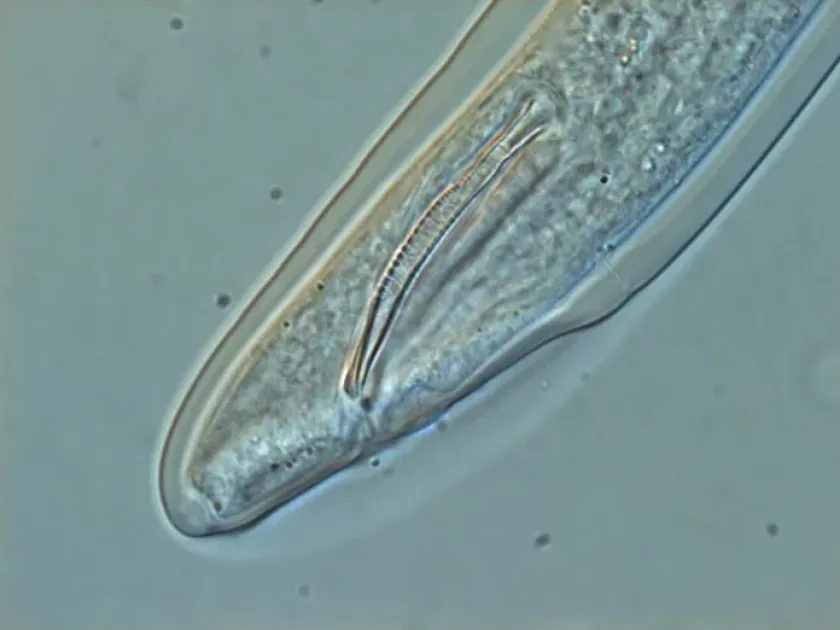
Paratrichodorus christiei belongs to the phylum Nematoda, class Enoplea, order Triplonchida, and the family Trichodoridae. These are ectoparasitic nematodes that do not penetrate root tissues but feed externally by piercing epidermal cells with a specialized hollow mouthpart known as an onchiostyle.
These microscopic worms possess a characteristic stubby appearance, typically measuring between 0.5 and 1 mm in length. Their bodies are cylindrical and stout, which gives them the common name "stubby-root nematodes" due to the specific injury symptoms they cause in host plants.
Identification of this pest is extremely difficult without laboratory intervention. Because they are soil-borne and microscopic, detection requires professional soil and root sampling followed by microscopic examination and molecular diagnostic testing by trained nematologists.
They exhibit high mobility in moist soil environments, moving freely through soil pores to seek out healthy root systems. They show a strong preference for coarse-textured, sandy, or sandy loam soils, which provide sufficient space for their movement.
A critical biological aspect is their role as a vector for various plant viruses, most notably the Tobacco Rattle Virus (TRV). Often, the viral infection caused by the nematode creates more significant economic loss than the physical damage to the roots.
What it damages
Paratrichodorus christiei is a highly polyphagous pest, attacking a wide range of agricultural crops including potatoes, onions, tomatoes, sugar beets, ornamental plants, and various turfgrass species in golf courses and landscapes.
Direct damage occurs as the nematode feeds on root tips, causing necrosis. This feeding behavior halts root elongation and triggers excessive lateral branching, resulting in a stunted, "stubby," or "brush-like" root architecture that limits nutrient and water uptake.
The indirect damage linked to virus transmission is severe. In potatoes, this manifests as "spraing" or corky ringspot, where internal brown arcs or spots render the tubers unmarketable. Foliar symptoms include mosaic patterns, chlorosis, and general systemic stunting.
Severe infestations during the early stages of plant development lead to poor establishment, reduced biomass, and in extreme cases, total crop failure if the nematode population density is high enough to overwhelm the root system.
The economic threshold for this nematode is quite low, as even a small number of virus-carrying individuals can initiate an outbreak throughout a field, especially under environmental conditions that favor nematode mobility and host plant stress.
When it appears
The activity of Paratrichodorus christiei is heavily influenced by soil temperature and moisture. Their population growth typically peaks during the spring and autumn months when soil temperatures range between 15°C and 20°C (60°F–68°F).
These nematodes undergo several generations within a single growing season. The speed of their life cycle is temperature-dependent; within their physiological optimum, higher soil temperatures generally accelerate the development of each generation.
Most significant damage occurs while the host plants are in their rapid growth phases. During this time, the constant availability of fresh root tips provides a continuous food supply, leading to increased feeding pressure and potential viral transmission.
In cases of extreme drought or freezing soil temperatures, the nematodes may enter a state of dormancy (anabiosis), surviving in deeper soil layers or within the rhizosphere of perennial weeds that act as long-term reservoirs.
The spread of the nematode across a field is relatively slow on its own, but human activity—specifically the movement of infested soil via tractors, equipment, or irrigation water—can drastically accelerate the infestation of clean fields.
Signs of infestation
Visual symptoms in the field often appear as patches of stunted, uneven, or chlorotic plants. These areas may look like they are suffering from nutrient deficiency or drought stress, even when irrigation and fertilization levels are optimal.
Upon closer inspection of the root system, a diagnostician will notice the absence of long, healthy primary roots. Instead, the roots will appear thickened, discolored, and necrotic, with a bushy appearance due to the cessation of primary growth and subsequent lateral root proliferation.
Signs of viral infection, such as the Tobacco Rattle Virus, include ringspots on leaves, yellow mosaic patterns, and severe leaf deformation. These symptoms are tell-tale indicators that the nematodes present are actively transmitting viral pathogens.
When harvesting potatoes, the presence of corky ringspot (brown internal necrotic rings) in the flesh of the tuber is a definitive diagnostic sign of recent nematode-vectored viral infection, significantly lowering the market value of the crop.
Final confirmation always requires a laboratory-based soil assay. By extracting nematodes from soil samples collected from the root zone of symptomatic plants, specialists can quantify the population and confirm the presence of Paratrichodorus christiei.
Control measures
Integrated Pest Management (IPM) is essential for controlling this nematode. Strategies include strict crop rotation with non-host species and rigorous weed management to eliminate perennial plants that serve as reservoirs for both the nematode and the viruses it carries.
Agronomic practices, such as deep tillage and optimized planting dates, can help the plants establish a robust root system before the peak activity period of the nematodes occurs, potentially minimizing the impact of the feeding.
Chemical control involving soil fumigants or nematicides is possible but often restricted due to environmental regulations, high costs, and the technical complexity of application. These are usually reserved for high-value cropping systems.
Preventative measures are the most effective strategy. Always use certified, disease-free planting material and ensure that all machinery is thoroughly cleaned before moving from an infested field to a clean one to prevent the passive spread of the pest.
- Utilizing bio-fumigant cover crops, such as specific mustards or oilseed radishes, to naturally suppress nematode populations.
- Sanitizing irrigation equipment and tools to prevent the movement of contaminated soil particles.
- Employing biological control agents like beneficial fungi (e.g., Pochonia chlamydosporia) or specific soil bacteria to manage population density.
Taxonomy
- Latin name
- Paratrichodorus christiei
- Order
- Nematodes
- Family
- Trichodoridae
- EPPO code
- TRIHCH
Discussion
No discussions yet — be the first.