
Paratrichodorus
Paratrichodorus
Description
How to identify
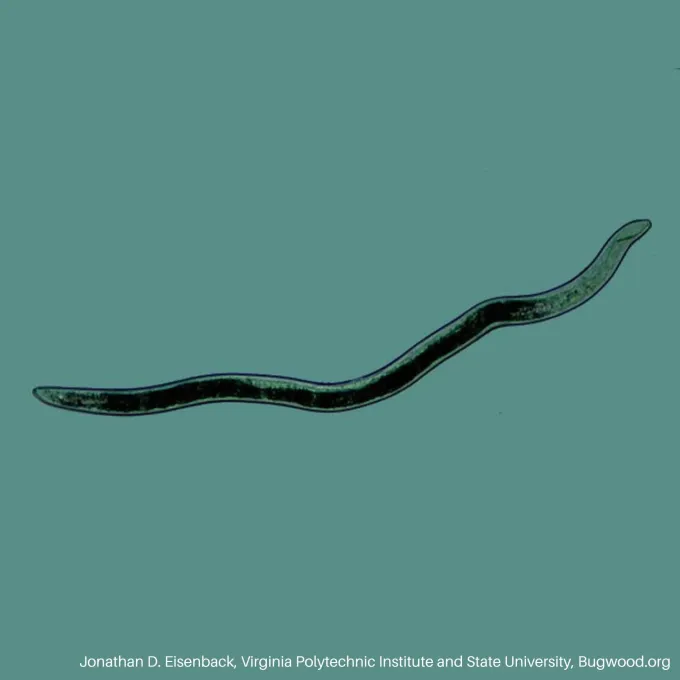
Paratrichodorus is a genus of free-living ectoparasitic nematodes belonging to the family Trichodoridae. These pests are known for their distinctively curved stylet, called an onchiostyle, which is used to penetrate plant root cells.
These microscopic organisms, typically measuring 0.5 to 1.5 mm, thrive in the water films of soil particles. They are most active in well-aerated, sandy, or light-textured soils where moisture content remains stable.
Their life cycle includes an egg stage, four larval stages, and an adult stage. The duration of their lifecycle is relatively short, often completing a generation in just 3–4 weeks under favorable temperature and humidity conditions.
A significant aspect of their biology is their ability to act as natural vectors for plant viruses, most notably the Tobacco Rattle Virus (TRV). This relationship causes the well-known «spraing» or «corky ringspot» disease in various crops.
Due to their mobility and reliance on soil moisture, population densities can fluctuate significantly based on environmental stressors. They do not penetrate inside the roots but feed from the outside, moving from cell to cell.
What it damages
Paratrichodorus has a very wide host range, attacking numerous economically vital crops. Potatoes, sugar beets, tomatoes, onions, and various ornamental bulbs are among the most susceptible to infestation.
The damage is caused primarily at the root tips. By feeding on the meristematic tissues, the nematodes inhibit root elongation and promote the development of lateral roots, leading to a stunted, «stubby» root system.
In potatoes, the indirect damage caused by virus transmission is often more severe than the direct root feeding. The resulting necrotic lesions on the tubers render the harvest commercially worthless.
Infected crops often exhibit signs of nutrient deficiency, such as chlorosis and wilting, because the damaged root system cannot efficiently uptake water and minerals from the soil.
Significant economic losses occur when high populations coincide with susceptible crop growth stages. Even in the absence of virus transmission, physical root damage can lead to yield losses of 20–50%.
Signs of infestation
Field symptoms often manifest as patchy growth, where localized areas of stunted or pale plants appear within an otherwise healthy crop. These patches may expand over successive growing seasons.
Upon examination, the root systems appear abnormal, often characterized by shortened, blunt-ended roots that lack fine root hairs. This specific symptom is the reason they are commonly called «stubby root» nematodes.
Potato tubers show dark, corky rings or arcs internally when sliced, which is the hallmark of the Tobacco Rattle Virus transmitted by the nematode. This condition significantly downgrades the quality of the harvest.
General signs of stunted development and yellowing (chlorosis) in the foliage are common, especially in the early stages of plant growth when the root system is under the most stress.
For accurate diagnosis, soil samples must be collected from the rhizosphere of affected plants. Laboratory processing using nematode extraction techniques is required to confirm the presence and density of Paratrichodorus.
Control measures
Integrated pest management (IPM) is essential for controlling this nematode. A rotation with non-host crops is the most effective way to reduce population levels in the soil over time.
Good weed control is mandatory, as many common weeds serve as reservoirs for both the nematode and the viruses they transmit. Removing these hosts limits the nematode's ability to survive between crop seasons.
Chemical control via soil fumigation or nematicides can be effective but is costly and often restricted due to environmental concerns. Applications should be targeted based on threshold density data.
Choosing resistant or tolerant crop varieties is a highly sustainable strategy. Breeding programs focusing on resistance to Tobacco Rattle Virus and nematode feeding are critical for long-term management.
Strict phytosanitary practices, such as washing farm machinery to remove soil before moving between fields, are necessary to prevent the accidental introduction of the nematode into clean areas.
Taxonomy
- Latin name
- Paratrichodorus
- Order
- Nematodes
- Family
- Trichodoridae
- EPPO code
- PATRSP
Discussion
No discussions yet — be the first.