
Paratrichodorus minor
Paratrichodorus minor
Description
How to identify
Paratrichodorus minor belongs to the phylum Nematoda, class Enoplea, order Triplonchida, and the family Trichodoridae. It is an ectoparasitic nematode that leads a strictly soil-dwelling life.
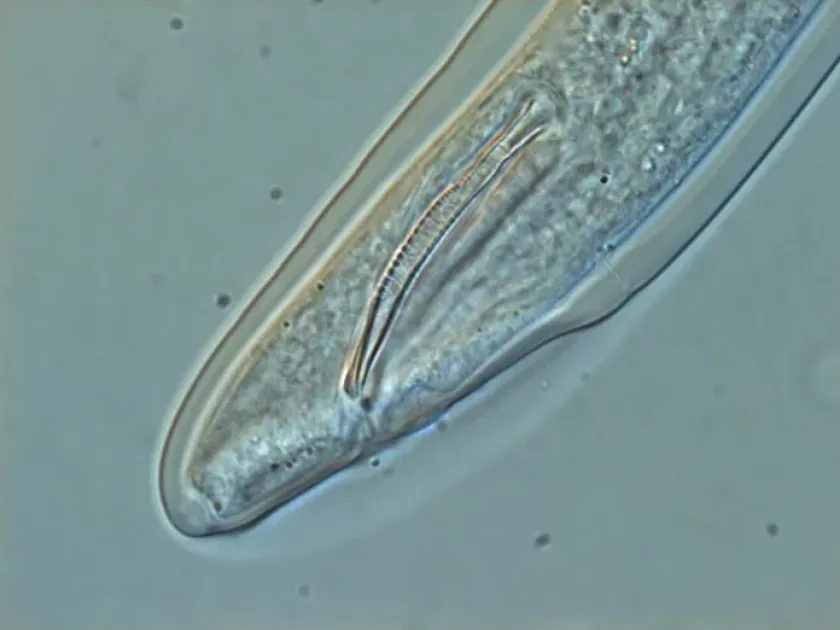
Adult individuals have a cylindrical body measuring approximately 0.5–1.0 mm in length. A unique characteristic of this genus is its feeding apparatus, an onchiostyle (stylet) shaped like a curved hollow tooth, which allows the nematode to puncture epidermal cells of plant roots.
This species is highly mobile within the soil environment. It does not penetrate the root tissue but feeds exclusively on the surface, moving from cell to cell, which makes it extremely difficult to detect during standard root inspections.
Detecting the presence of this pest is only possible through laboratory soil analysis using techniques like the Baermann funnel or flotation methods. Visual identification in the field is impossible due to the nematode's microscopic size.
The reproductive efficiency of Paratrichodorus minor is directly dependent on soil texture. These nematodes thrive in light, sandy, and sandy-loam soils, where their movement between soil particles is facilitated.
What it damages
Paratrichodorus minor has a wide host range. It affects vegetable crops such as potatoes, tomatoes, carrots, and onions, as well as field crops like sugar beets and corn. Many ornamental plants are also susceptible to its feeding.
The primary damage is caused to the root meristem (the growth zone). By feeding on the contents of root tip cells, the nematode injects salivary enzymes that cause cell death and arrest root elongation.
A secondary aspect of its damage is its role as a virus vector. Paratrichodorus minor transmits the Tobacco Rattle Virus (TRV) and pea early browning virus, both of which cause severe plant deformations and significant yield losses.
Plants infested by these nematodes lose their ability to efficiently absorb water and nutrients due to the compromised root system, making them highly vulnerable to drought stress and secondary fungal infections.
The economic impact manifests not only in direct yield loss but also in reduced product quality. For example, in carrots, root damage often leads to severe malformation and branching, rendering the vegetables unmarketable.
Signs of infestation
Early signs of infestation in a field often appear as patches of stunted, low-growing plants. Areas with high nematode populations are noticeable by the uneven growth patterns and patchy development across the field.
Root system damage is characterized by distinct deformations. Root tips often become thickened, turn brown, and die, while the root system may appear "stubby" or show excessive lateral branching.
The foliage responds to root damage with chlorosis, wilting during hot hours, and an overall loss of turgor. In early growth stages, seedlings may die or show severe growth retardation.
When the nematode transmits viruses, leaves may exhibit specific mottling, mosaic patterns, or ring spots. In potatoes, for instance, a condition known as "corking" often occurs, where tubers become deformed and develop internal necrotic spots.
Diagnosis is aided by analyzing crop history: if previous seasons have shown problems with root crop quality or uneven growth in light-textured soils, the presence of ectoparasitic nematodes should be highly suspected.
Control measures
The primary control method is the implementation of a rigorous crop rotation scheme. Using trap crops or antagonists, such as certain varieties of marigolds or mustard, can help reduce nematode populations in the soil.
Agronomic practices include strict weed control, as many weeds act as alternative hosts for both the nematodes and the viruses they transmit. Maintaining optimal soil moisture is also critical, as excessive water saturation can facilitate nematode movement.
Chemical control involves the use of specialized nematicides applied before sowing or planting. However, the use of such chemicals requires strict adherence to regulations due to their high toxicity and potential impact on beneficial soil biota.
Soil steaming or deep plowing can temporarily limit pest density. Thermal disinfection (steaming) is highly effective in greenhouses but is often economically prohibitive for large-scale open-field production.
Soil monitoring before planting remains a key factor for success. Laboratory analysis helps determine the nematode population density, allowing for informed decisions regarding the necessity and timing of plant protection interventions.
Taxonomy
- Latin name
- Paratrichodorus minor
- Order
- Nematodes
- Family
- Trichodoridae
- EPPO code
- TRIHMI
Discussion
No discussions yet — be the first.