
Paratrichodorus pachydermus
Paratrichodorus pachydermus
Description
How to identify
Paratrichodorus pachydermus is a species of free-living soil nematode belonging to the family Trichodoridae, order Triplonchida.
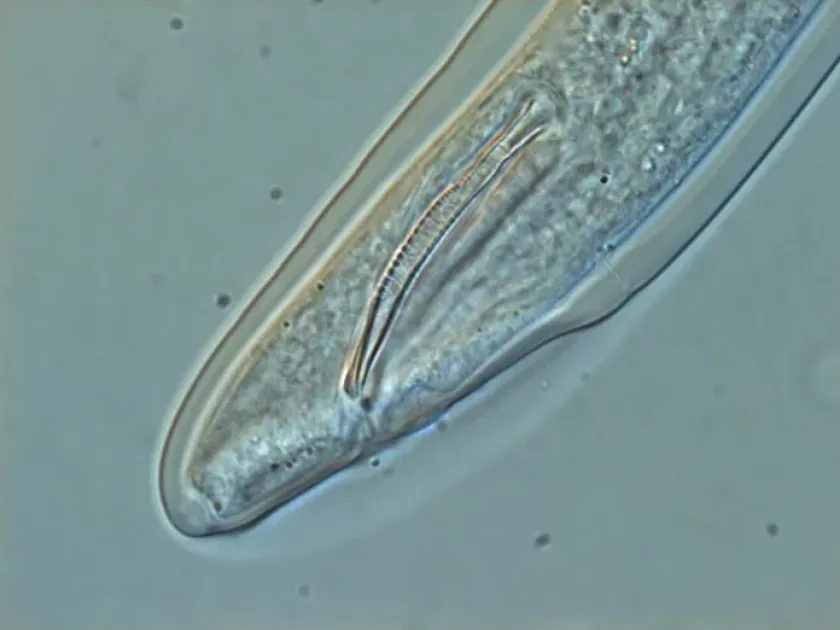
Adult nematodes are microscopic, measuring between 0.5 and 1.2 mm in length, and possess a distinct curved stylet known as an onchiostyle.
These organisms thrive primarily in sandy and sandy-loam soils where the pore spaces allow for migration within the soil moisture film.
Unlike many other plant-parasitic nematodes, they do not form survival cysts, relying instead on active movement toward root systems.
They are particularly known in agronomy as efficient vectors of Tobacco Rattle Virus (TRV), which is a significant threat to global agriculture.
What it damages
This nematode has a wide host range, including potatoes, sugar beets, cereals, various vegetable crops, and ornamental plants.
Direct damage involves feeding on root tips, which leads to stunted growth, reduced water uptake, and overall poor physiological condition of the plant.
However, the most severe economic impact comes from the transmission of viruses that cause internal necrosis, such as "spraing" or corky ringspot in potatoes.
In sugar beet, infection leads to significantly reduced root mass and structural malformations of the taproot.
The cumulative damage often results in uneven crop stands, leading to significant yield losses and lower product market value.
Signs of infestation
Infestation is typically identified by patchy growth patterns in the field, where plants appear stunted, chlorotic, or wilted compared to healthy zones.
The characteristic sign in tubers is the presence of brown, necrotic arcs or rings inside the potato flesh, often invisible from the exterior.
Root systems may appear truncated or stubby, with a lack of fine root hairs, which explains the plant's inability to thrive during dry periods.
Early-season symptoms include delayed emergence and weak seedlings that fail to establish a vigorous root architecture.
Field diagnosis must be supported by laboratory soil testing to confirm the nematode population density before implementing costly management plans.
Control measures
Integrated Pest Management (IPM) is essential, starting with crop rotation using plants that are not suitable hosts for the nematode population.
Weed management is a critical step, as many common weeds act as overwintering reservoirs for both the nematode and the associated TRV virus.
Selecting nematode-resistant or tolerant crop varieties remains the most sustainable approach to minimizing harvest losses from internal defects.
Chemical control via soil fumigation or granular nematicides can be utilized in high-infestation areas but requires strict compliance with safety regulations.
Preventative practices such as cleaning machinery between fields help contain the nematode's spread, as it is primarily transported through contaminated soil.
Taxonomy
- Latin name
- Paratrichodorus pachydermus
- Order
- Nematodes
- Family
- Trichodoridae
- EPPO code
- TRIHPA
Discussion
No discussions yet — be the first.