
Paratrichodorus ornatus
Paratrichodorus ornatus
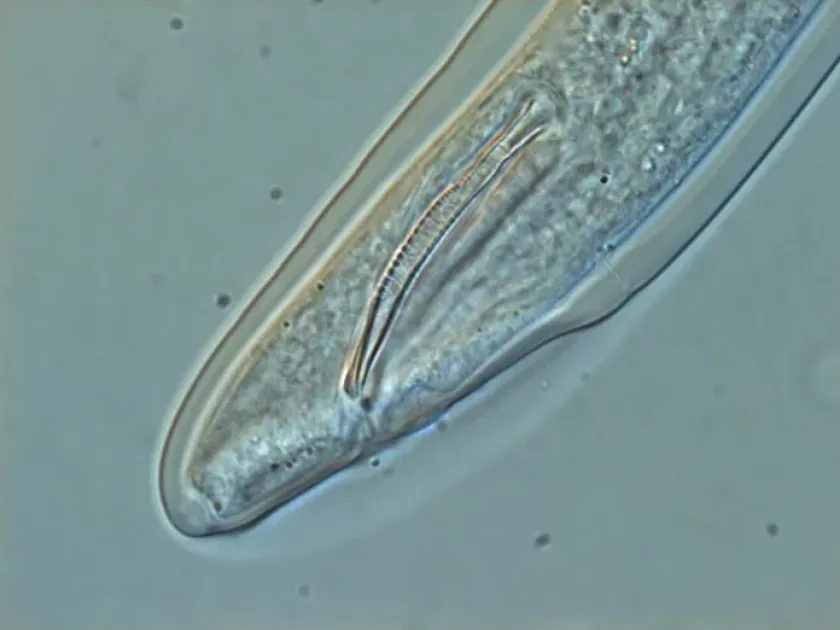
Description
How to identify
Paratrichodorus ornatus belongs to the nematode phylum, class Enoplea, order Triplonchida, and family Trichodoridae. It is an ectoparasitic nematode that feeds externally on roots using a specialized feeding organ called an onchiostyle, which is shaped like a curved tooth.
Adult nematodes are microscopic, measuring between 0.5 and 1.0 millimeters in length with a spindle-shaped body. Due to their small size, they are difficult to detect without specialized laboratory techniques, such as the Baermann funnel extraction method applied to soil samples.
These nematodes possess well-developed sensory organs, allowing them to move actively through soil pores in search of favorable feeding zones. They thrive best in light, sandy, or sandy-loam soils, where movement between soil particles is easier.
The life cycle consists of four larval stages and an adult stage. Reproduction occurs without the need for host switching, and the population can survive in the soil for long periods by entering a state of dormancy if host plants are absent.
A critical biological aspect of this species is its role as a vector for the Tobacco Rattle Virus (TRV), which causes devastating diseases in various agricultural and horticultural crops.
What it damages
The host range of this pest is extremely broad, including potatoes, sugar beets, onions, various vegetables, as well as many ornamental plants and tree nursery stock.
The nematode feeds on root hairs and root tips, leading to necrosis and the cessation of root elongation. This damage prevents the plant from effectively absorbing water and essential nutrients from the soil.
Potatoes are particularly susceptible to damage. During feeding, the nematode transmits viruses that cause "spraing" or "ring necrosis" in the tubers, which severely degrades the quality and marketability of the harvest.
In various vegetables, the damage manifests as stunted growth and reduced yields. Secondary fungal or bacterial infections often infiltrate the roots through the micro-wounds caused by the nematode's feeding style, leading to root rot.
In the field, damage typically appears in patches rather than uniformly, reflecting the heterogeneous nature of soil moisture and texture. Areas with high nematode density are marked by stunted, chlorotic plants that lag behind in development.
When it appears
Activity begins in the spring when soil temperatures reach 8–10 degrees Celsius. The optimal range for active feeding and reproduction is between 15 and 22 degrees Celsius.
During the peak of summer, if temperatures are high and soil moisture is low, population activity may decrease. The nematodes often migrate deeper into the soil profile to find more stable environmental conditions.
In the autumn, with the arrival of cooler, wetter conditions, a second wave of activity often occurs. The nematodes continue to feed on the roots of perennial crops or remaining annual weeds in preparation for the winter.
Overwintering occurs in the larval or adult stages within the soil or in the root zone of wintering weeds. They are hardy and can withstand freezing temperatures, remaining viable until spring warmth returns.
Soil moisture is a critical factor for development; activity levels increase in wet, well-hydrated soils, whereas reproduction rates drop significantly in excessively dry environments.
Signs of infestation
The primary field sign is uneven crop growth, often described as "patchiness." This involves irregular areas where plants appear stunted, chlorotic, and weak compared to surrounding healthy plants.
Examination of the root system often reveals significant deformation: roots appear short, thickened, and stunted, with visible necrosis at the tips. A "stubby root" appearance or excessive lateral branching is a classic reaction to the loss of primary root apical meristems.
On potato tubers, external symptoms may include depressed spots or lesions, while internal symptoms include characteristic ring-like necrosis visible upon slicing the tuber.
Above-ground, plants show clear signs of nutrient deficiency, including yellowing leaves, leaf curling, and delayed flowering or pod formation, as the root system fails to support the plant's metabolic needs.
A definitive diagnosis can only be confirmed through laboratory analysis, where soil and root samples are processed to estimate the population density of the nematodes present.
Control measures
Management must be integrated, as chemical control options are restricted due to the high toxicity of nematicides and strict environmental regulations governing their use.
Crop rotation is a fundamental agronomic tool. By excluding host crops for 3–4 years, farmers can significantly reduce the nematode population density due to the lack of available food sources.
Rigorous weed control is essential, as various weeds serve as reservoirs for both the nematodes themselves and the viruses they transmit, which can bridge the gap between crop cycles.
The use of resistant or tolerant potato and vegetable varieties is a high-priority strategy. Breeders focus on developing cultivars that can withstand nematode feeding without manifesting severe yield loss or viral infection.
- Application of authorized nematicides during soil preparation, strictly following label rates.
- Green manuring (cover cropping) with antagonistic plants such as mustard or oilseed radish to improve soil health.
- Strict phytosanitary control of seed potatoes and nursery stock to prevent the introduction of the pest into new areas.
Taxonomy
- Latin name
- Paratrichodorus ornatus
- Order
- Nematodes
- Family
- Trichodoridae
- EPPO code
- PATROR
Discussion
No discussions yet — be the first.