
Citrus swallowtail
Papilio xuthus
Description
How to identify
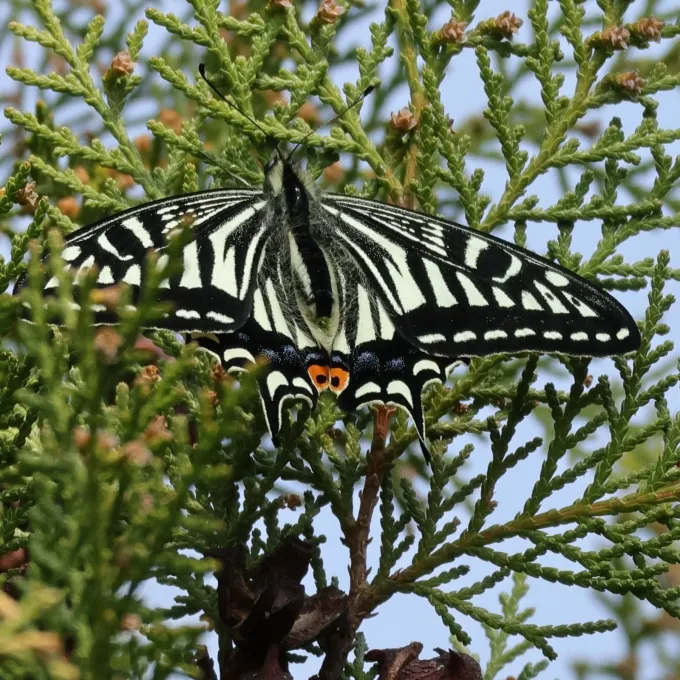
The Citrus swallowtail (Papilio xuthus) is a prominent butterfly belonging to the Papilionidae family, known for its distinctive appearance.
Adult butterflies have a wingspan ranging from 80 to 100 mm, featuring yellow wings with intricate black stripes and spots.
A key identifying feature is the presence of long tails on the hindwings, accompanied by bright blue markings near the edges.
In the larval stage, young caterpillars resemble bird droppings, providing excellent camouflage against potential predators in the trees.
As they mature, the caterpillars turn bright green with black bands and possess an osmeterium—a fleshy organ that emits a foul odor when threatened.
What it damages
The larvae of the Citrus swallowtail primarily feed on the leaves of plants within the Rutaceae family, especially citrus species.
Common hosts include lemon, mandarin, orange, and grapefruit trees, where the larvae concentrate their feeding on young, tender foliage.
Aside from commercial plantations, they also thrive on wild rutaceous shrubs, which serve as natural breeding grounds for the pest.
Damage is characterized by the consumption of leaf tissue, which can lead to rapid defoliation of young shoots and branches.
Heavy infestations significantly reduce the tree's photosynthetic capacity, causing stunted growth and a considerable decrease in fruit yield.
When it appears
The development of the Citrus swallowtail is highly dependent on environmental conditions, with multiple generations appearing during the season.
In favorable climates, the lifecycle is continuous throughout the warmer months, leading to overlapping generations on citrus trees.
Adult activity begins in early spring and persists through autumn, as butterflies actively seek hosts for egg-laying.
Eggs are typically deposited singly on the leaves, where the emerging caterpillars begin feeding immediately upon hatching.
The species survives the winter stage as a pupa, which is firmly attached to the branches of the host plant or nearby structures.
Signs of infestation
The most visible signs of infestation are ragged leaf margins and the complete removal of leaf tissues, leaving only the primary veins.
Frass (caterpillar droppings) found on the foliage or on the ground beneath the tree canopy is a clear indicator of feeding activity.
Caterpillars can often be located by inspecting the leaves, especially near the tips of branches or along the midrib of a leaf.
Extensive defoliation resulting from the pest's activity is often apparent from a distance as bare patches in the otherwise dense citrus canopy.
The presence of adult butterflies hovering near citrus trees is a strong sign that the next generation of larvae is imminent.
Control measures
Hand-picking caterpillars is a highly effective method for controlling the population in small gardens or young orchards.
Biological controls, such as spraying Bacillus thuringiensis (Bt) based products, target the larvae without harming beneficial insects.
Chemical insecticides should be utilized as a last resort, ensuring that applications are timed correctly to target young larval stages.
Regular orchard scouting is essential to identify egg masses and early-instar larvae before they cause significant structural damage.
Implementing good horticultural practices, including proper fertilization and irrigation, helps trees recover more quickly from foliage loss.
Taxonomy
- Latin name
- Papilio xuthus
- Order
- Lepidoptera (butterflies)
- Family
- Papilionidae
- EPPO code
- PAPIXU
Discussion
No discussions yet — be the first.