
Spicebush swallowtail
Papilio troilus
Description
How to identify
The Spicebush swallowtail (Papilio troilus) is a member of the order Lepidoptera and the family Papilionidae. This large butterfly species can be a localized pest when its larvae feed on specific host plants.
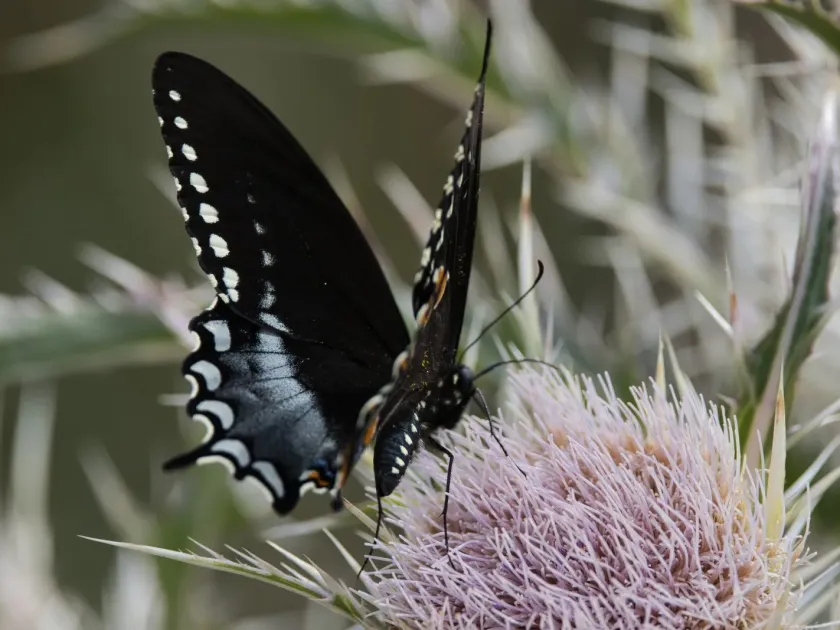
Adult butterflies have a wingspan of approximately 8-10 cm. Their wings are primarily black with iridescent blue-green markings on the hindwings, providing a striking appearance.
The larvae go through several instars. In later stages, they are easily recognizable by their bright green color and large, prominent false "eyes" on the thoracic segments to deter predators.
A key biological feature of the larvae is the osmeterium, a Y-shaped, fleshy organ behind the head that is everted when the caterpillar is threatened, emitting a strong, unpleasant odor.
The lifecycle follows complete metamorphosis: egg, larva, pupa, and adult. They typically overwinter in the pupal stage, attached to host stems or garden debris.
##damage##This species primarily feeds on plants in the Lauraceae family, with sassafras and spicebush being the most frequent hosts for their caterpillars.
In nurseries or home gardens featuring these ornamental or aromatic plants, the larvae can cause localized damage to the foliage.
Caterpillars practice a specific protective behavior by folding and rolling leaves, fastening them with silk, and creating a nest where they reside and feed safely.
Economic damage manifests as leaf consumption, which can lead to significant defoliation and stress on the host plant if the caterpillar population is high.
Severe infestation on young seedlings or small ornamental shrubs can stunt growth and ruin the aesthetic value of the plantings.
When it appears
Adult butterfly activity occurs during the warm months, typically stretching from late spring through early autumn, depending on the geographical region.
The first generation of adults emerges after the winter diapause as soon as temperatures stabilize, usually in the latter half of spring.
Caterpillar feeding is most intensive during the summer months when host plants are in their peak vegetative growth phase and foliage is abundant.
The development from egg to adult takes approximately 6-8 weeks, allowing for multiple generations per growing season in warmer climates.
By late summer, populations may peak, making late-season monitoring essential for protecting sensitive ornamental specimens in the landscape.
Signs of infestation
The primary visual sign of infestation is the presence of rolled or folded leaves on sassafras or spicebush branches, tied together with silk threads.
Opening these leaf nests will reveal the distinctively marked, green caterpillars, which may display their orange-red osmeterium if disturbed.
The presence of frass (caterpillar droppings) on the ground below the infested branches or on the remaining leaf surfaces is a clear indicator of feeding activity.
The feeding pattern involves jagged edges along the leaf margins, often consuming significant portions of the leaf blade starting from the exterior.
In cases of heavy infestation, the defoliation becomes visible, leading to thinning of the plant canopy and a noticeably ragged appearance.
Control measures
In small garden settings, manual removal and destruction of the leaf nests and caterpillars is the most effective and eco-friendly control method.
Biological insecticides containing Bacillus thuringiensis (Bt) are highly effective and selective against lepidopteran larvae, minimizing harm to beneficial insects.
Cultural practices include regular scouting of host plants throughout the spring and summer to catch and remove infestations before they spread.
Pheromone traps can be used for monitoring adult butterfly flight patterns, which helps in timing potential interventions if damage thresholds are exceeded.
Chemical insecticides should be reserved for severe outbreaks, as broad-spectrum treatments can disrupt the ecosystem and harm pollinators and natural predators.
Taxonomy
- Latin name
- Papilio troilus
- Order
- Lepidoptera (butterflies)
- Family
- Papilionidae
- EPPO code
- PAPITR
Discussion
No discussions yet — be the first.