
Spangle swallowtail
Papilio protenor
Description
How to identify
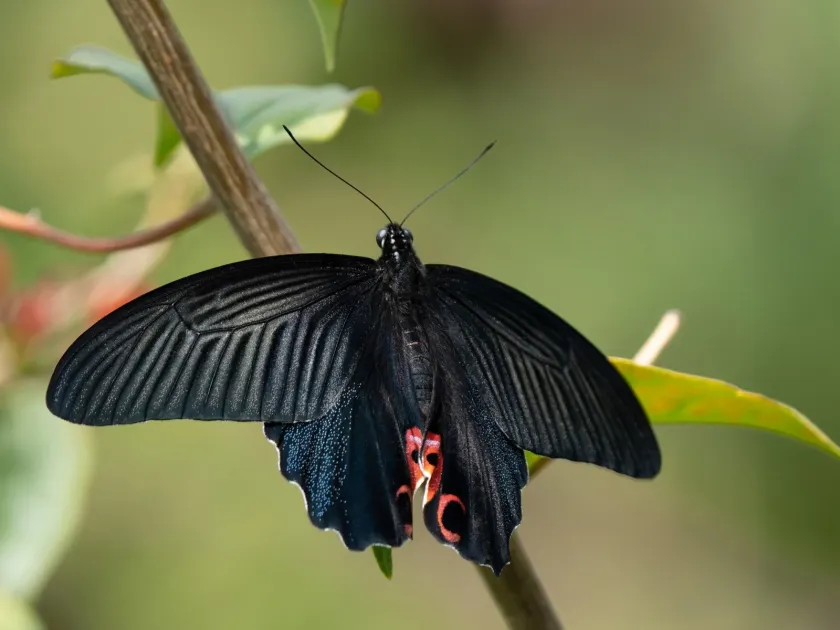
The Spangle swallowtail (Papilio protenor) is a large butterfly species within the Papilionidae family. Adults typically feature black wings with striking red markings on the hindwings, making them distinct from other common swallowtail species in their native habitat.
The larvae, or caterpillars, undergo significant transformations throughout their growth. Early stages often resemble bird droppings to deter predators, while mature caterpillars exhibit a vibrant green coloration with dark markings and fake "eye-spots" on the thorax.
Pupae of this species are usually attached to stems or branches using a silk girdle. Their appearance is exceptionally well-camouflaged, often mimicking the texture and shape of a dry twig, which protects them from birds and other natural enemies.
The species is primarily native to regions of East and Southeast Asia, including countries like Japan, China, and Korea. In favorable conditions, they can produce multiple generations annually, significantly increasing their potential to cause agricultural damage.
These butterflies prefer warm climates, meaning their population densities peak during the active growing season of citrus trees. Female butterflies lay individual eggs on the underside of leaves to provide the newly hatched larvae with immediate food.
What it damages
The primary damage is caused by the larvae, which are voracious consumers of foliage. They belong to the Rutaceae family feeders, with a strong preference for citrus trees, including oranges, lemons, mandarins, and pomelos.
Larvae consume both tender young leaves and older foliage. Severe defoliation reduces the photosynthetic capacity of the tree, which can lead to weakened growth, poor fruit development, and decreased overall crop yields for commercial farmers.
In nurseries, young saplings are particularly vulnerable. Caterpillar feeding on terminal buds can distort the tree's architecture and inhibit healthy vertical growth, causing significant economic losses for plant growers.
Large-scale infestations can strip a tree of its leaves in a relatively short period. If left uncontrolled, repeated feeding cycles significantly stress the trees, making them more susceptible to secondary fungal or bacterial infections.
While citrus is the preferred host, the pest may occasionally spill over onto native or ornamental Rutaceae plants in the landscape, maintaining a presence in the local ecosystem even when commercial orchard populations are managed.
Signs of infestation
The most evident sign of a Spangle swallowtail infestation is the presence of irregular leaf margins. Larvae start eating from the edges of the leaf, often consuming the blade while leaving the thicker veins behind in their early stages.
Accumulated frass (caterpillar excrement) on leaves or lower branches is a reliable indicator of larval presence. As the caterpillars grow, the amount of frass increases, making it easier to spot the location of the infestation within the canopy.
The presence of shed skins (exuviae) on the leaves or stems confirms that the caterpillars are actively molting and growing. Finding these skins suggests a thriving population that may require immediate intervention.
When disturbed, the caterpillar may protrude a specialized organ known as an osmeterium from its thorax. This organ emits a pungent, characteristic odor, which serves as a defense mechanism and a visible alert for the presence of the pest.
The discovery of pupae attached to branches indicates that the pest is entering its transformation stage. Removing these pupae manually can help disrupt the life cycle and prevent the emergence of the next generation of adults.
Control measures
For home gardens and small orchards, hand-picking caterpillars is an effective control strategy. Inspecting the underside of leaves during the morning hours when larvae are most active can help maintain low population levels.
Biological control using formulations based on Bacillus thuringiensis is highly effective and environmentally friendly. It specifically targets lepidopteran pests without harming beneficial insects such as bees and predatory wasps.
Chemical control should be employed only when necessary, using approved insecticides according to local agricultural regulations. Proper application timing is critical to protect pollinators and ensure residue levels remain within safety limits.
Cultural practices, such as maintaining orchard hygiene and removing weeds that could act as secondary hosts, help reduce the overall infestation pressure. Pruning to ensure good airflow can also make trees less attractive to ovipositing females.
- Deploying pheromone traps to monitor adult flight and emergence patterns.
- Encouraging natural predators and parasitoids in the orchard environment.
- Regular canopy inspections during the peak growing season to catch early larval stages.
Taxonomy
- Latin name
- Papilio protenor
- Order
- Lepidoptera (butterflies)
- Family
- Papilionidae
- EPPO code
- PAPIPD
Discussion
No discussions yet — be the first.